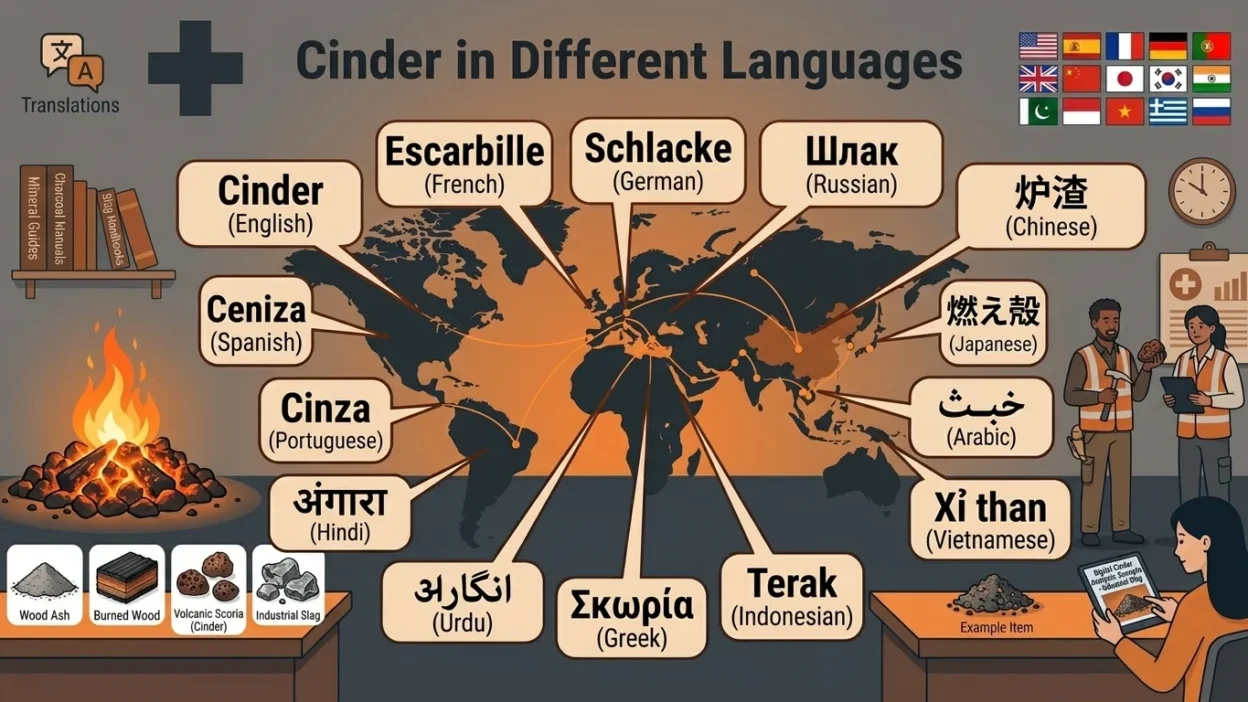
A cinder is a small piece of partly burned material left after a fire. Depending on the context, it may refer to an ember, ash, clinker, slag, or volcanic cinder. Because these meanings differ, the most accurate translation can vary by context.
Cinder in Different Languages (1–25)
| Language | Native Word | Easy English Pronunciation |
|---|---|---|
| English | Cinder | SIN-der |
| Spanish | Ascua | AHS-kwah |
| French | Escarbille | Es-kar-BEE-yuh |
| German | Aschenrest | AH-shen-rest |
| Italian | Brace | BRAH-cheh |
| Portuguese | Brasa | BRAH-zah |
| Dutch | Sintel | SIN-tel |
| Swedish | Glöd | Glurd |
| Norwegian | Glør | Gluhr |
| Danish | Gløde | GLUH-duh |
| Finnish | Hiillos | HEE-yos |
| Icelandic | Glóð | Glohth |
| Irish | Luaith | LOO-ah |
| Welsh | Marwor | MAR-wor |
| Scottish Gaelic | Gual-fhiodha | GOO-al EE-a |
| Polish | Żużel | ZHOO-zhel |
| Czech | Struska | STROOS-ka |
| Slovak | Troska | TROHS-ka |
| Slovenian | Žlindra | ZHLEEN-dra |
| Croatian | Žar | ZHAR |
| Serbian | Жар | ZHAR |
| Bosnian | Žar | ZHAR |
| Romanian | Cenușă | Cheh-NOO-shuh |
| Hungarian | Salak | SHAH-lak |
| Greek | Στάχτη | STAH-khtee |
| Language | Native Word | Easy English Pronunciation |
|---|---|---|
| Russian | Шлак | Shlak |
| Ukrainian | Шлак | Shlak |
| Belarusian | Шлак | Shlak |
| Bulgarian | Шлака | SHLA-ka |
| Macedonian | Згура | ZGOO-ra |
| Albanian | Zgjyrë | ZHYEER-uh |
| Turkish | Köz | Kurz |
| Arabic | جمرة | Jam-ra |
| Hebrew | גחל | Ga-khal |
| Persian | اخگر | Akh-gar |
| Kurdish | Kember | Kem-ber |
| Hindi | अंगारा | Ang-AA-ra |
| Urdu | انگارہ | Ang-AA-ra |
| Punjabi | ਅੰਗਾਰਾ | Ang-AA-ra |
| Bengali | অঙ্গার | On-gaar |
| Gujarati | અંગાર | Ang-aar |
| Marathi | निखारा | Ni-KHAA-ra |
| Nepali | अंगार | Ang-Aar |
| Sinhala | අඟුරු | An-gu-roo |
| Tamil | நெருப்புக்கரி | Ne-rup-pu-ka-ree |
| Telugu | నిప్పుకణం | Nip-pu-ka-nam |
| Kannada | ಕೆಂಡ | Ken-da |
| Malayalam | കനൽ | Ka-nal |
| Thai | ถ่านที่คุอยู่ | Than Tee Khu Yoo |
| Vietnamese | Than hồng | Than Hong |
Cinder in Different Languages (51–70)
| Language | Native Word | Easy English Pronunciation |
|---|---|---|
| Indonesian | Bara | BAH-rah |
| Malay | Bara | BAH-rah |
| Filipino (Tagalog) | Baga | BAH-gah |
| Chinese (Mandarin) | 炭渣 | Tàn zhā |
| Japanese | 燃えさし | Moe-sashi |
| Korean | 불씨 | Bul-ssi |
| Mongolian | Цог | Tsog |
| Burmese | မီးကြွင်း | Mee-jwin |
| Khmer | ធ្យូងកំពុងឆេះ | Chheung Kom-pong Chheh |
| Lao | ຖ່ານແດງ | Than Daeng |
| Swahili | Kaa | Kah-ah |
| Zulu | Ilahle elivuthayo | Ee-LAH-leh eh-lee-voo-THA-yo |
| Afrikaans | Gloeiende kool | GLOO-yen-deh kool |
| Amharic | ፍም | Fim |
| Yoruba | Èédú | Eh-eh-doo |
| Hausa | Garwashin wuta | Gar-wa-shin WOO-ta |
| Maori | Warou | Wah-roh |
| Hawaiian | Lanahu ʻā | Lah-na-hoo ah |
| Samoan | Malala | Mah-LAH-lah |
| Esperanto | Cindro | TSIN-dro |
Why Learn “Cinder” in Different Languages?
Learning cinder in different languages can help you build vocabulary related to fire, embers, ash, coal, and volcanoes. It is also useful for writers, students, translators, and anyone interested in understanding nature-related words.
How to Say “Cinder” in Different Languages
When translating cinder, context matters. In English, a cinder may mean a partly burned piece of wood or coal, but it can also refer to industrial slag or volcanic material. Therefore, some languages may use a word closer to ember rather than an exact one-word equivalent.
Cinder, Ember, and Ash: What’s the Difference?
- Cinder – a partly burned piece of material left after a fire.
- Ember – a small, glowing piece of burning wood or coal.
- Ash – the fine powder left after something has completely burned.
These words are related, but they should not always be translated using the same word.
Related Vocabulary
After learning cinder in different languages, you may also want to learn:
- Ember in Different Languages
- Ash in Different Languages
- Fire in Different Languages
- Smoke in Different Languages
- Coal in Different Languages
- Flame in Different Languages
Tips for Learning Fire Vocabulary
- Learn cinder, ember, ash, and flame together.
- Pay attention to the exact meaning in each language.
- Practice the words in simple sentences.
- Listen to native pronunciation where possible.
- Learn related vocabulary by topic for easier memorization.
Conclusion
Learning cinder in different languages is a useful way to expand your vocabulary about fire and natural materials. These 70 translations provide a helpful starting point, although the best translation may change depending on whether you mean an ember, ash, burned residue, or slag.
Frequently Asked Questions
1. What does “cinder” mean?
A cinder is a small piece of partly burned material, often left after wood or coal has burned.
2. What is cinder in Spanish?
For a glowing cinder or ember, Spanish commonly uses ascua.
3. What is cinder in Hindi?
अंगारा (Angaara) commonly refers to a glowing coal, ember, or cinder.
4. What is cinder in Urdu?
انگارہ (Angaara) can refer to an ember or glowing cinder.
5. What is cinder in Japanese?
燃えさし (Moesashi) refers to a partially burned remainder or cinder.
6. Is cinder the same as ash?
No. Ash is usually fine powder, while a cinder is generally a larger piece of partly burned material.
7. What should I learn next?
You can learn ember, ash, fire, smoke, coal, and flame to expand your fire-related vocabulary.
I