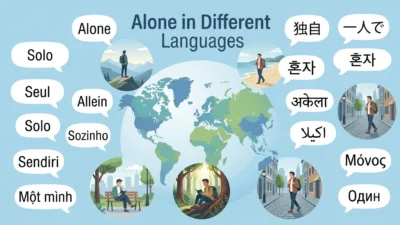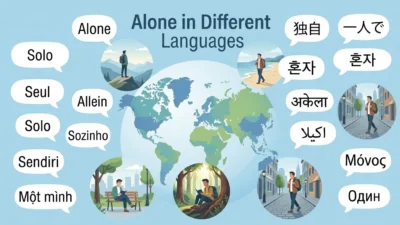
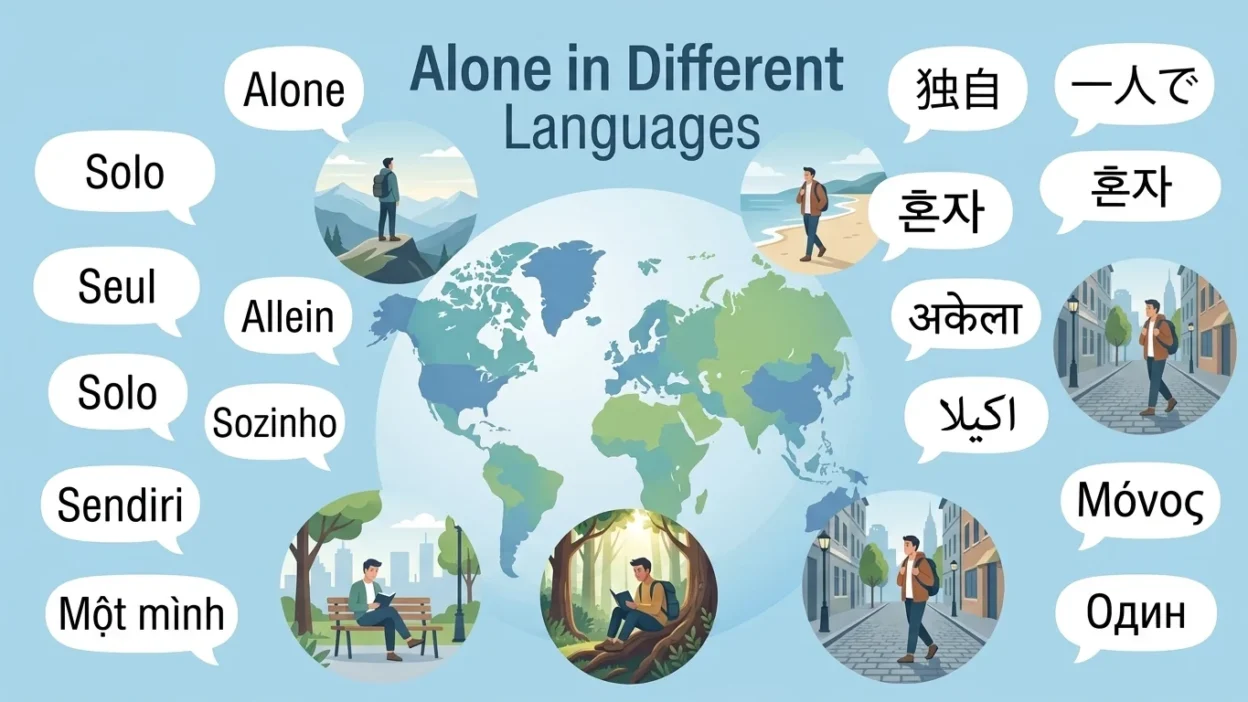
Being able to say alone in different languages is useful when learning vocabulary, traveling, or expressing feelings. Depending on the context, alone can mean by yourself, without company, solitary, or on your own. This guide provides common translations with easy English pronunciations.
Alone in Different Languages (1–25)
| Language | Native Word/Phrase | Easy English Pronunciation |
|---|---|---|
| English | Alone | Uh-Lone |
| Spanish | Solo / Sola | SO-lo / SO-la |
| French | Seul / Seule | Sul / Sul |
| German | Allein | Ah-LINE |
| Italian | Solo / Sola | SO-lo / SO-la |
| Portuguese | Sozinho / Sozinha | So-ZEEN-yo / So-ZEEN-ya |
| Dutch | Alleen | Ah-LANE |
| Swedish | Ensam | EN-sam |
| Norwegian | Alene | Ah-LAY-ne |
| Danish | Alene | Ah-LAY-ne |
| Finnish | Yksin | UUK-sin |
| Icelandic | Einn | Ayn |
| Irish | I m’aonar | Im AY-nur |
| Welsh | Ar fy mhen fy hun | Ar Vuh Hen Vuh Hin |
| Scottish Gaelic | Nam aonar | Nam AY-nar |
| Polish | Sam / Sama | Sam / SA-ma |
| Czech | Sám / Sama | Saam / SA-ma |
| Slovak | Sám / Sama | Saam / SA-ma |
| Slovenian | Sam | Sahm |
| Croatian | Sam | Sahm |
| Serbian | Сам | Sahm |
| Bosnian | Sam | Sahm |
| Romanian | Singur / Singură | Seen-GOOR / Seen-GOO-ra |
| Hungarian | Egyedül | Edj-eh-DOOL |
| Greek | Μόνος / Μόνη | MO-nos / MO-nee |
| Language | Native Word/Phrase | Easy English Pronunciation |
|---|
| Russian | Один / Одна | A-deen / Ad-NA |
| Ukrainian | Сам / Сама | Sahm / SA-ma |
| Belarusian | Сам / Сама | Sahm / SA-ma |
| Bulgarian | Сам / Сама | Sahm / SA-ma |
| Macedonian | Сам / Сама | Sahm / SA-ma |
| Albanian | Vetëm | Veh-TUM |
| Turkish | Yalnız | Yahl-nuz |
| Arabic | وحيد | Wa-heed |
| Hebrew | לבד | Le-vad |
| Persian | تنها | Tan-ha |
| Kurdish | Tenê | Te-ne |
| Hindi | अकेला / अकेली | A-ke-la / A-ke-lee |
| Urdu | اکیلا / اکیلی | A-ke-la / A-ke-lee |
| Punjabi | ਇਕੱਲਾ / ਇਕੱਲੀ | Ik-ka-la / Ik-ka-lee |
| Bengali | একা | Ek-a |
| Gujarati | એકલો / એકલી | Ek-lo / Ek-lee |
| Marathi | एकटा / एकटी | Ek-ta / Ek-tee |
| Nepali | एक्लै | Ek-lai |
| Sinhala | තනි | Ta-ni |
| Tamil | தனியாக | Tha-ni-ya-ga |
| Telugu | ఒంటరిగా | On-ta-ri-ga |
| Kannada | ಒಬ್ಬಂಟಿ | Ob-ban-tee |
| Malayalam | ഒറ്റയ്ക്ക് | Ot-ta-ykk |
| Thai | คนเดียว | Khon Diao |
| Vietnamese | Một mình | Mot Minh |
| Language | Native Word/Phrase | Easy English Pronunciation |
|---|---|---|
| Indonesian | Sendiri | Sen-dee-ree |
| Malay | Bersendirian | Ber-sen-dee-ree-an |
| Filipino (Tagalog) | Mag-isa | Mag Ee-sa |
| Chinese (Mandarin) | 独自 | Doo Zrr |
| Japanese | 一人で | Hee-to-ree De |
| Korean | 혼자 | Hon-ja |
| Mongolian | Ганцаараа | Gan-tsaa-raa |
| Burmese | တစ်ယောက်တည်း | Ta-yout Ta-ley |
| Khmer | ម្នាក់ឯង | Mneak Aeng |
| Lao | ຢູ່ຄົນດຽວ | Yoo Khon Diao |
| Swahili | Peke yangu | Pe-ke Yan-goo |
| Zulu | Ngedwa | Nged-wa |
| Afrikaans | Alleen | Ah-LANE |
| Amharic | ብቻ | Bi-cha |
| Yoruba | Nikan | Nee-kan |
| Hausa | Shi kaɗai | Shee Ka-dye |
| Maori | Mokemoke | Mo-ke-mo-ke |
| Hawaiian | Hoʻokahi | Ho-o-ka-hee |
| Samoan | Na o aʻu | Na O Ah-oo |
| Esperanto | Sola | So-la |
Why Learn “Alone” in Different Languages?
Learning alone in different languages helps you express feelings, describe situations, and expand your vocabulary. The word can describe being physically by yourself or emotionally solitary, depending on the context.
How to Say “Alone” in Different Languages
If you’re searching for how to say alone in different languages, it’s useful to learn both the pronunciation and the correct usage. Some languages have different forms based on gender or grammar.
Alone Translations Around the World
These alone translations are commonly used across Europe, Asia, Africa, the Americas, and Oceania. While some languages distinguish between masculine and feminine forms, the meanings remain similar.
Related Vocabulary
After learning alone in different languages, you may also want to learn:
- Lonely in Different Languages
- Together in Different Languages
- Friend in Different Languages
- Family in Different Languages
- Love in Different Languages
- Peace in Different Languages
Tips for Using the Word “Alone”
- Learn whether the language has masculine and feminine forms.
- Practice pronunciation with native speakers when possible.
- Understand the context, as “alone” and “lonely” may have different meanings.
- Use the word in simple sentences to remember it.
- Review regularly to improve vocabulary.
Conclusion
Learning alone in different languages helps you communicate more naturally and understand vocabulary across many cultures. These 70 translations are useful for travelers, students, and anyone interested in languages.
Frequently Asked Questions
1. How do you say “alone” in different languages?
Examples include Solo (Spanish), Seul (French), Allein (German), 独自 (Dúzì) (Chinese), and 一人で (Hitori de) (Japanese).
2. Is “alone” the same as “lonely”?
Not always. Alone usually means being by yourself, while lonely describes an emotional feeling of sadness due to lack of companionship.
3. Do some languages have gender-specific forms?
Yes. Languages such as Spanish, Italian, French, Romanian, Hindi, and Urdu often have masculine and feminine forms.
4. Are these translations commonly used?
Yes. These are standard words or expressions widely understood by native speakers.
5. Why should I learn this vocabulary?
It improves your language skills, helps you describe situations accurately, and makes communication easier while traveling or studying.