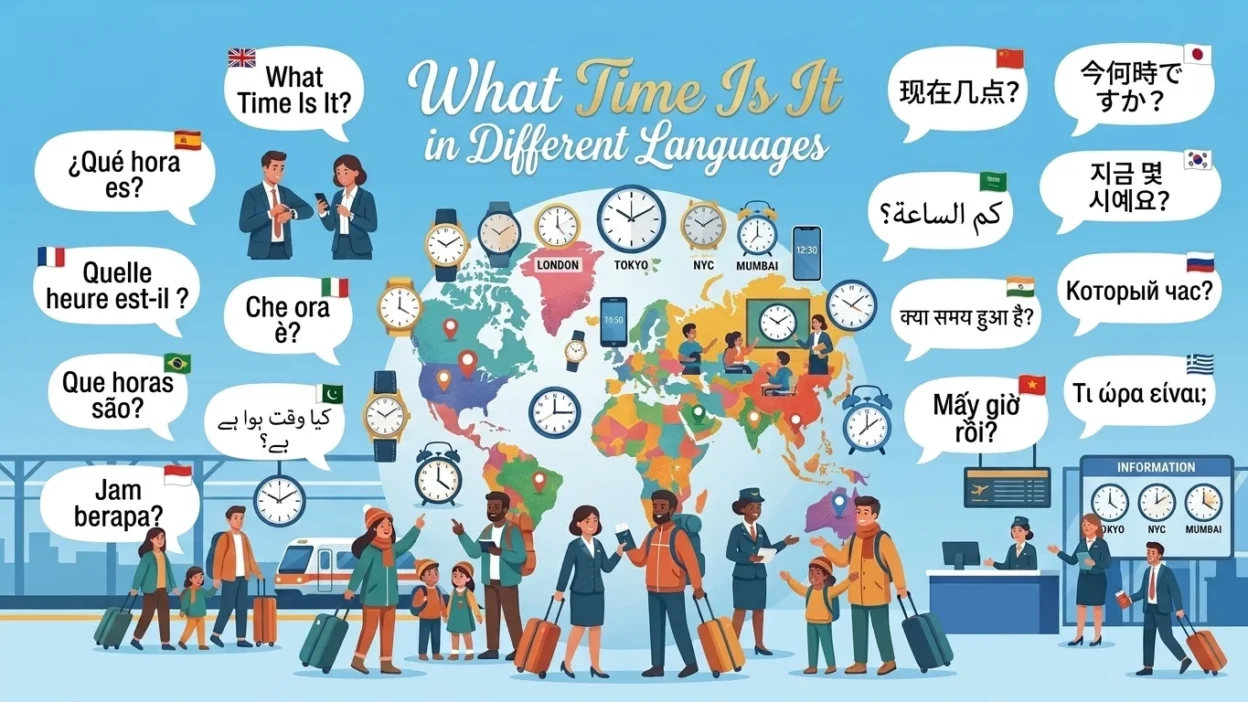
Knowing how to ask “What time is it?” in different languages is one of the most useful phrases for travelers and language learners. Whether you’re catching a train, attending a meeting, or simply curious about the time, this expression helps you communicate politely wherever you go.
This guide includes What time is it translations with easy English pronunciations. If you’re searching for What time is it in all languages or how to say What time is it in different languages, this collection is the perfect place to begin.
What Time Is It in Different Languages (1–25)
| Language | Native Phrase | Easy English Pronunciation |
|---|---|---|
| English | What time is it? | What Time Is It |
| Spanish | ¿Qué hora es? | Kay OR-a Es |
| French | Quelle heure est-il ? | Kel Ur Eh-Teel |
| German | Wie spät ist es? | Vee Shpayt Ist Es |
| Italian | Che ora è? | Kay O-ra Eh |
| Portuguese | Que horas são? | Kay OR-as Sow |
| Dutch | Hoe laat is het? | Hoo Late Is Het |
| Swedish | Vad är klockan? | Vad Air KLOK-an |
| Norwegian | Hva er klokka? | Hva Air KLOK-ka |
| Danish | Hvad er klokken? | Veth Air KLOK-en |
| Finnish | Paljonko kello on? | Pal-yon-ko Kel-lo On |
| Icelandic | Hvað er klukkan? | Kvath Air KLOOK-an |
| Irish | Cén t-am é? | Kane Tam Ay |
| Welsh | Faint o’r gloch yw hi? | Vint Or Gloch Uh Hee |
| Scottish Gaelic | Dè an uair a tha e? | Jay An Oo-er A Ha Eh |
| Polish | Która jest godzina? | KTO-ra Yest God-ZEE-na |
| Czech | Kolik je hodin? | KO-lik Yeh Ho-din |
| Slovak | Koľko je hodín? | KOL-ko Yeh Ho-deen |
| Slovenian | Koliko je ura? | KO-li-ko Yeh Oo-ra |
| Croatian | Koliko je sati? | KO-li-ko Yeh Sa-tee |
| Serbian | Колико је сати? | KO-li-ko Yeh Sa-tee |
| Bosnian | Koliko je sati? | KO-li-ko Yeh Sa-tee |
| Romanian | Cât este ceasul? | Kut ES-te Chea-sul |
| Hungarian | Mennyi az idő? | MENN-yee Az EE-do |
| Greek | Τι ώρα είναι; | Tee O-ra EE-ne |
| Language | Native Phrase | Easy English Pronunciation |
|---|
| Russian | Который час? | Ka-TO-riy Chas |
| Ukrainian | Котра година? | Ko-TRA Ho-DY-na |
| Belarusian | Колькі часу? | KOL-kee Cha-su |
| Bulgarian | Колко е часът? | KOL-ko Eh Cha-SUT |
| Macedonian | Колку е часот? | KOL-koo Eh Cha-SOT |
| Albanian | Sa është ora? | Sa Ush-tuh O-ra |
| Turkish | Saat kaç? | Saat Kach |
| Arabic | كم الساعة؟ | Kam As-Sa-ah |
| Hebrew | מה השעה? | Ma Ha-Sha-ah |
| Persian | ساعت چند است؟ | Sa-at Chand Ast |
| Kurdish | Saet çend e? | Sa-et Chend Eh |
| Hindi | क्या समय हुआ है? | Kya Sa-may Hu-a Hai |
| Urdu | کیا وقت ہوا ہے؟ | Kya Waqt Hu-a Hai |
| Punjabi | ਕੀ ਵਕਤ ਹੋਇਆ ਹੈ? | Kee Vakt Ho-ya Hai |
| Bengali | কয়টা বাজে? | Koy-ta Ba-je |
| Gujarati | કેટલા વાગ્યા છે? | Ket-la Vaag-ya Chhe |
| Marathi | किती वाजले आहेत? | Ki-tee Vaaj-le Aa-het |
| Nepali | कति बज्यो? | Ka-ti Baj-yo |
| Sinhala | දැන් වෙලාව කීයද? | Dan Ve-la-va Kee-ya-da |
| Tamil | இப்போது மணி என்ன? | Ip-po-thu Ma-ni En-na |
| Telugu | ఇప్పుడు సమయం ఎంత? | Ip-pu-du Sa-ma-yam En-tha |
| Kannada | ಈಗ ಸಮಯ ಎಷ್ಟು? | Ee-ga Sa-ma-ya Esh-tu |
| Malayalam | ഇപ്പോൾ സമയം എത്രയാണ്? | Ip-pol Sa-ma-yam Eth-ra-yaanu |
| Thai | ตอนนี้กี่โมง | Ton Nee Kee Mong |
| Vietnamese | Mấy giờ rồi? | May Zoh Roy |
| Language | Native Phrase | Easy English Pronunciation |
|---|---|---|
| Indonesian | Jam berapa? | Jam Buh-RA-pa |
| Malay | Pukul berapa? | Poo-kool Buh-RA-pa |
| Filipino (Tagalog) | Anong oras na? | A-nong O-ras Na |
| Chinese (Mandarin) | 现在几点? | Shyen Zai Jee Dian |
| Japanese | 今何時ですか? | Ee-ma Nan-ji Des Ka |
| Korean | 지금 몇 시예요? | Jee-geum Myut Shee-ye-yo |
| Mongolian | Хэдэн цаг вэ? | He-den Tsag Ve |
| Burmese | အခု ဘယ်နှနာရီလဲ? | A-khu Beh Na-yee Le |
| Khmer | ឥឡូវម៉ោងប៉ុន្មាន? | Ey-lov Mao Pong-man |
| Lao | ຕອນນີ້ຈັກໂມງ? | Ton Nee Jak Mong |
| Swahili | Saa ngapi? | Saa Nga-pee |
| Zulu | Yisikhathi sini? | Yee-si-KHA-ti See-nee |
| Afrikaans | Hoe laat is dit? | Hoo Laat Is Dit |
| Amharic | ስንት ሰዓት ነው? | Sint Se-at New |
| Yoruba | Ago melo ni? | A-go Meh-lo Nee |
| Hausa | Karfe nawa? | Kar-fe Na-wa |
| Maori | Kua hia te wā? | Koo-a He-a Te Waa |
| Hawaiian | ʻEhia ka hola? | Eh-hee-a Ka Ho-la |
| Samoan | O le ā le taimi? | O Le Aa Le Tai-mee |
| Esperanto | Kioma horo estas? | Kee-o-ma Ho-ro Es-tas |
Why Learn “What Time Is It?” in Different Languages?
Learning What time is it in different languages is useful for travel, business, school, and everyday conversations. Whether you’re asking for the time at a train station, airport, or meeting, this phrase helps you communicate clearly with native speakers.
How to Say “What Time Is It?” in Different Languages
If you’re searching for how to say What time is it in different languages, practice both the pronunciation and the native script. This improves your confidence and makes it easier to understand responses.
What Time Is It Translations Around the World
These What time is it translations are commonly used across Europe, Asia, Africa, the Americas, and Oceania. Some languages have both formal and informal versions, but the phrases above are widely recognized.
Related Time and Travel Phrases
After learning What time is it in different languages, you may also want to learn:
- What Day Is It? in Different Languages
- Where Is the Bathroom? in Different Languages
- Where Are You From? in Different Languages
- What Is Your Name? in Different Languages
- Thank You in Different Languages
- Goodbye in Different Languages
These common expressions help you communicate confidently while traveling or learning a new language.
Tips for Learning Time Expressions
- Practice the pronunciation daily.
- Learn how to understand the answers, not just ask the question.
- Memorize the numbers in your target language.
- Listen to native speakers whenever possible.
- Use the phrase during real conversations.
Conclusion
Learning What time is it in different languages is an essential skill for travelers and language learners. These 70 translations help you ask for the time politely and improve your communication in many different countries.
Frequently Asked Questions
1. How do you say “What time is it?” in different languages?
Examples include ¿Qué hora es? (Spanish), Quelle heure est-il ? (French), Wie spät ist es? (German), and 现在几点?(Xiànzài jǐ diǎn?) in Chinese.
2. Is this phrase useful for travelers?
Yes. It is one of the most practical phrases to know when using public transportation, attending events, or asking for directions.
3. Are there formal and informal versions?
Some languages have both, but the phrases listed here are commonly understood in everyday situations.
4. Are these translations accurate?
Yes. These are standard expressions widely used by native speakers, though minor regional variations may exist.
5. What should I learn after this phrase?
It’s helpful to learn numbers, days of the week, months, and other common travel phrases to understand time-related conversations.