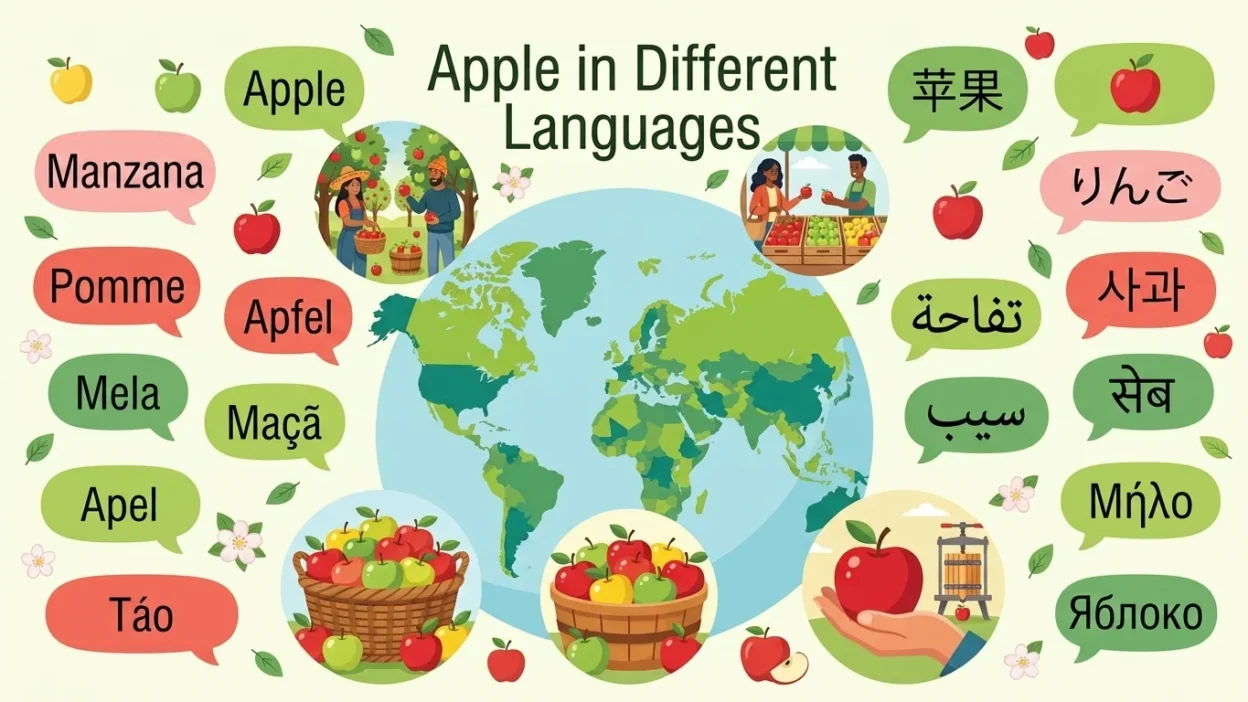
The word apple is one of the first vocabulary words many people learn in a new language. It is useful for travelers, students, teachers, and language enthusiasts. Learning apple in different languages helps you build everyday vocabulary and communicate more confidently across cultures.
This guide includes apple translations with easy English pronunciations. If you’re searching for apple in all languages or how to say apple in different languages, this collection is the perfect place to begin.
Apple in Different Languages (1–25)
| Language | Native Word | Easy English Pronunciation |
|---|---|---|
| English | Apple | AP-puhl |
| Spanish | Manzana | Man-ZAH-na |
| French | Pomme | Pom |
| German | Apfel | AP-fel |
| Italian | Mela | MAY-la |
| Portuguese | Maçã | Mah-SAHN |
| Dutch | Appel | AP-pel |
| Swedish | Äpple | EP-leh |
| Norwegian | Eple | EP-leh |
| Danish | Æble | EH-bleh |
| Finnish | Omena | O-me-na |
| Icelandic | Epli | EP-li |
| Irish | Úll | Ool |
| Welsh | Afal | AV-al |
| Scottish Gaelic | Ubhal | OO-al |
| Polish | Jabłko | YAB-ko |
| Czech | Jablko | YABL-ko |
| Slovak | Jablko | YABL-ko |
| Slovenian | Jabolko | Ya-BOL-ko |
| Croatian | Jabuka | Ya-BOO-ka |
| Serbian | Јабука | Ya-BOO-ka |
| Bosnian | Jabuka | Ya-BOO-ka |
| Romanian | Măr | Mur |
| Hungarian | Alma | AL-ma |
| Greek | Μήλο | MEE-lo |
| Language | Native Word | Easy English Pronunciation |
|---|
| Russian | Яблоко | YAB-la-ka |
| Ukrainian | Яблуко | YAB-loo-ko |
| Belarusian | Яблык | YAB-lik |
| Bulgarian | Ябълка | YA-bul-ka |
| Macedonian | Јаболко | Ya-BOL-ko |
| Albanian | Mollë | MOL-luh |
| Turkish | Elma | EL-ma |
| Arabic | تفاحة | Tuf-FA-ha |
| Hebrew | תפוח | Ta-poo-akh |
| Persian | سیب | Seeb |
| Kurdish | Sêv | Sev |
| Hindi | सेब | Seb |
| Urdu | سیب | Seeb |
| Punjabi | ਸੇਬ | Seb |
| Bengali | আপেল | A-pel |
| Gujarati | સફરજન | Sa-fa-ra-jan |
| Marathi | सफरचंद | Sa-fa-ra-chand |
| Nepali | स्याउ | Syau |
| Sinhala | ඇපල් | Ae-pal |
| Tamil | ஆப்பிள் | Aa-pil |
| Telugu | ఆపిల్ | Aa-pil |
| Kannada | ಸೇಬು | Say-boo |
| Malayalam | ആപ്പിൾ | Aa-pil |
| Thai | แอปเปิล | Ap-pern |
| Vietnamese | Táo | Tao |
| Language | Native Word | Easy English Pronunciation |
|---|---|---|
| Indonesian | Apel | Ah-pel |
| Malay | Epal | Eh-pal |
| Filipino (Tagalog) | Mansanas | Man-sa-NA-s |
| Chinese (Mandarin) | 苹果 | Píng Guǒ |
| Japanese | りんご | Rin-go |
| Korean | 사과 | Sa-gwa |
| Mongolian | Алим | A-lim |
| Burmese | ပန်းသီး | Pan Thee |
| Khmer | ផ្លែប៉ោម | Plae Paom |
| Lao | ຫມາກໂປມ | Mak Pom |
| Swahili | Tufaha | Too-FA-ha |
| Zulu | Ihhabhula | Ee-ha-boo-la |
| Afrikaans | Appel | Ah-pel |
| Amharic | ፖም | Pom |
| Yoruba | Àpù | Ah-poo |
| Hausa | Tuffa | TOOF-fa |
| Maori | Āporo | Aa-po-ro |
| Hawaiian | ʻĀpala | Aa-pa-la |
| Samoan | Apu | Ah-poo |
| Esperanto | Pomo | PO-mo |
Why Learn “Apple” in Different Languages?
Learning apple in different languages is a simple way to expand your everyday vocabulary. Since apples are one of the most common fruits worldwide, knowing this word can help when shopping, traveling, studying, or practicing a new language.
How to Say “Apple” in Different Languages
If you’re searching for how to say apple in different languages, it’s helpful to learn both the native spelling and the pronunciation. This makes it easier to recognize the word in conversations, menus, grocery stores, and language lessons.
Apple Translations Around the World
These apple translations are commonly used across Europe, Asia, Africa, the Americas, and Oceania. While many languages have unique words for the fruit, some share similar spellings due to historical linguistic influences.
Related Fruit Vocabulary
After learning apple in different languages, you may also want to learn:
- Banana in Different Languages
- Orange in Different Languages
- Mango in Different Languages
- Grapes in Different Languages
- Strawberry in Different Languages
- Watermelon in Different Languages
Tips for Learning Fruit Names
- Learn fruit names with pictures for faster memorization.
- Practice both pronunciation and spelling.
- Use the words in simple daily sentences.
- Read food labels and grocery lists in your target language.
- Review vocabulary regularly to improve retention.
Conclusion
Learning apple in different languages is a practical way to improve your vocabulary and communicate in everyday situations. These 70 translations will help travelers, students, teachers, and language enthusiasts recognize and use the word with confidence.
Frequently Asked Questions
1. How do you say “apple” in different languages?
Examples include Manzana (Spanish), Pomme (French), Apfel (German), 苹果 (Píngguǒ) (Chinese), and りんご (Ringo) (Japanese).
2. Are these translations commonly used?
Yes. These are the standard words for apple used by native speakers in everyday conversations.
3. Why should I learn fruit names in other languages?
Fruit names are among the most common vocabulary words and are useful for shopping, dining, traveling, and language learning.
4. Do all languages have unique words for apple?
Most languages have their own native word, while some have borrowed or adapted similar terms from neighboring languages.
5. What should I learn after fruit names?
You can continue with vegetables, colors, numbers, drinks, common foods, and everyday conversation phrases to build a strong vocabulary.