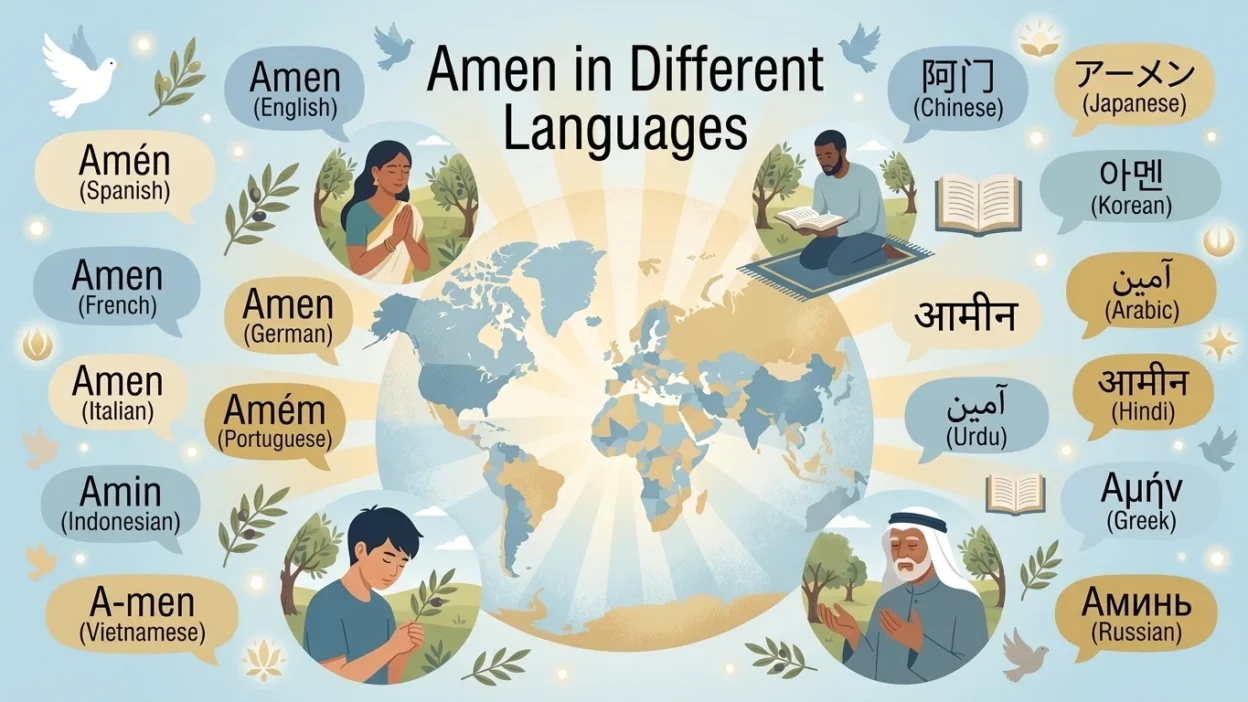
The word Amen is one of the most recognized religious expressions across the world. It is commonly spoken at the end of prayers and means “so be it,” “truly,” or “let it be so.” While many languages use a nearly identical form, the spelling and pronunciation may vary slightly.
This guide includes Amen translations with easy English pronunciations. If you’re searching for Amen in all languages or how to say Amen in different languages, this collection is the perfect place to begin.
Amen in Different Languages (1–25)
| Language | Native Word | Easy English Pronunciation |
|---|---|---|
| English | Amen | Ah-Men |
| Spanish | Amén | Ah-MEN |
| French | Amen | Ah-MEN |
| German | Amen | Ah-MEN |
| Italian | Amen | Ah-MEN |
| Portuguese | Amém | Ah-MENG |
| Dutch | Amen | Ah-MEN |
| Swedish | Amen | Ah-MEN |
| Norwegian | Amen | Ah-MEN |
| Danish | Amen | Ah-MEN |
| Finnish | Aamen | AA-men |
| Icelandic | Amen | Ah-MEN |
| Irish | Áiméan | AW-mee-an |
| Welsh | Amen | Ah-MEN |
| Scottish Gaelic | Amen | Ah-MEN |
| Polish | Amen | Ah-MEN |
| Czech | Amen | Ah-MEN |
| Slovak | Amen | Ah-MEN |
| Slovenian | Amen | Ah-MEN |
| Croatian | Amen | Ah-MEN |
| Serbian | Амин | Ah-MEEN |
| Bosnian | Amin | Ah-MEEN |
| Romanian | Amin | Ah-MEEN |
| Hungarian | Ámen | AA-men |
| Greek | Αμήν | Ah-MEEN |
| Language | Native Word | Easy English Pronunciation |
|---|---|---|
| Russian | Аминь | Ah-MEEN |
| Ukrainian | Амінь | Ah-MEEN |
| Belarusian | Амін | Ah-MEEN |
| Bulgarian | Амин | Ah-MEEN |
| Macedonian | Амин | Ah-MEEN |
| Albanian | Amen | Ah-MEN |
| Turkish | Âmin | Aa-MEEN |
| Arabic | آمين | Aa-MEEN |
| Hebrew | אמן | Ah-MEN |
| Persian | آمین | Aa-MEEN |
| Kurdish | Amîn | Aa-MEEN |
| Hindi | आमीन | Aa-MEEN |
| Urdu | آمین | Aa-MEEN |
| Punjabi | ਆਮੀਨ | Aa-MEEN |
| Bengali | আমীন | Aa-MEEN |
| Gujarati | આમીન | Aa-MEEN |
| Marathi | आमेन | Aa-MEN |
| Nepali | आमेन | Aa-MEN |
| Sinhala | ආමෙන් | Aa-MEN |
| Tamil | ஆமென் | Aa-MEN |
| Telugu | ఆమేన్ | Aa-MEN |
| Kannada | ಆಮೆನ್ | Aa-MEN |
| Malayalam | ആമേൻ | Aa-MEN |
| Thai | อาเมน | Aa-Men |
| Vietnamese | A-men | Ah-Men |
| Language | Native Word | Easy English Pronunciation |
|---|---|---|
| Indonesian | Amin | Aa-MEEN |
| Malay | Amin | Aa-MEEN |
| Filipino (Tagalog) | Amen | Ah-MEN |
| Chinese (Mandarin) | 阿们 | Ā Men |
| Japanese | アーメン | Ā-men |
| Korean | 아멘 | A-men |
| Mongolian | Амен | A-men |
| Burmese | အာမင် | Aa-Min |
| Khmer | អាម៉ែន | Aa-Men |
| Lao | ອາແມນ | Aa-Men |
| Swahili | Amina | Aa-MEE-na |
| Zulu | Amen | Ah-MEN |
| Afrikaans | Amen | Ah-MEN |
| Amharic | አሜን | Ah-MEN |
| Yoruba | Amin | Aa-MEEN |
| Hausa | Amin | Aa-MEEN |
| Maori | Āmene | Aa-MEH-neh |
| Hawaiian | ʻĀmene | Aa-MEH-neh |
| Samoan | Amene | Ah-MEH-neh |
| Esperanto | Amen | Ah-MEN |
Why Learn “Amen” in Different Languages?
Learning Amen in different languages helps you understand religious traditions, prayers, and cultural expressions around the world. Although the word has ancient origins, it has been preserved in many languages with only small differences in pronunciation and spelling.
How to Say “Amen” in Different Languages
If you’re searching for how to say Amen in different languages, learning the native spelling and pronunciation will help you recognize the word in prayers, worship services, religious literature, and everyday expressions of faith.
Amen Translations Around the World
These Amen translations are widely recognized across Europe, Asia, Africa, the Americas, and Oceania. Many languages retain the form Amen, while others use Amin, reflecting linguistic and religious traditions.
Related Religious Vocabulary
After learning Amen in different languages, you may also want to learn:
- God in Different Languages
- Prayer in Different Languages
- Faith in Different Languages
- Peace in Different Languages
- Blessing in Different Languages
- Church in Different Languages
Tips for Learning Religious Words
- Practice both the native spelling and pronunciation.
- Learn the cultural context of each word.
- Listen to native speakers during prayers or readings.
- Respect regional pronunciation differences.
- Expand your vocabulary by learning related spiritual expressions.
Conclusion
Learning Amen in different languages is a meaningful way to explore languages, cultures, and religious traditions. These 70 translations help language learners, travelers, and students recognize one of the world’s most widely spoken expressions of affirmation and prayer.
Frequently Asked Questions
1. What does “Amen” mean?
Amen generally means “so be it,” “truly,” or “let it be so.” It is traditionally spoken at the end of prayers or statements of faith.
2. Is “Amen” the same in every language?
Many languages use Amen or a closely related form such as Amin, although pronunciation and spelling can vary.
3. Why do some languages use “Amin” instead of “Amen”?
Languages influenced by Arabic or certain religious traditions often use Amin, while many European languages preserve Amen.
4. Is “Amen” used only in Christianity?
No. Variants such as Amen and Amin are used in Christianity, Judaism, and Islam, though pronunciation and usage may differ by tradition.
5. Are these translations commonly used?
Yes. These are standard forms widely recognized by native speakers in religious contexts