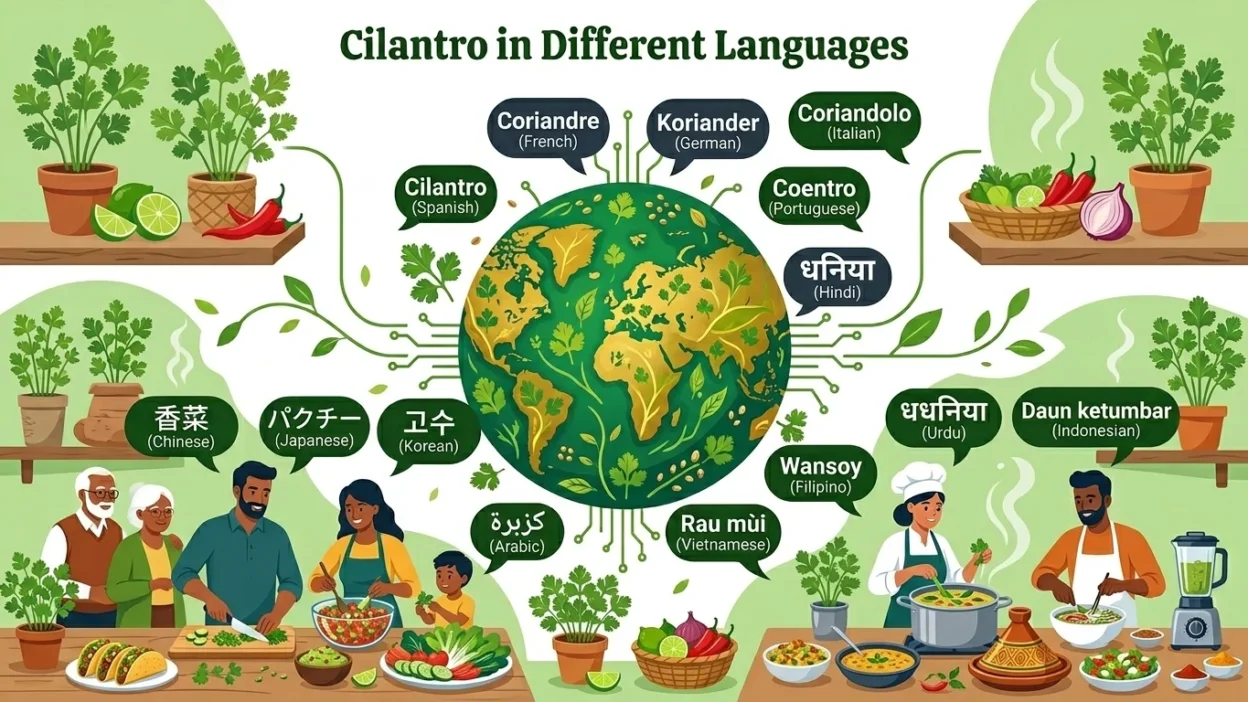
Cilantro is the fresh leafy herb of the coriander plant, widely used in Mexican, Indian, Thai, Middle Eastern, and many other cuisines. In some countries, the leaves are simply called coriander, while cilantro specifically refers to the fresh leaves and stems.
Cilantro in Different Languages (1–25)
| Language | Native Word | Easy English Pronunciation |
|---|---|---|
| English | Cilantro | Si-LAHN-troh |
| Spanish | Cilantro | See-LAHN-troh |
| French | Coriandre | Koh-ree-AHN-druh |
| German | Koriander | Koh-ree-AHN-der |
| Italian | Coriandolo | Koh-ree-ahn-DOH-lo |
| Portuguese | Coentro | Kway-EN-troh |
| Dutch | Koriander | Koh-ree-AHN-der |
| Swedish | Koriander | Koh-ree-AHN-der |
| Norwegian | Koriander | Koh-ree-AHN-der |
| Danish | Koriander | Koh-ree-AHN-der |
| Finnish | Korianteri | Koh-ree-ahn-TEH-ree |
| Icelandic | Kóríander | KOH-ree-ahn-der |
| Irish | Lus an choire | Lus un KHIR-eh |
| Welsh | Coriander | Koh-ree-AN-der |
| Scottish Gaelic | Coriander | Koh-ree-AN-der |
| Polish | Kolendra | Koh-LEN-drah |
| Czech | Koriandr | Koh-ree-AN-dər |
| Slovak | Koriander | Koh-ree-AN-der |
| Slovenian | Koriander | Koh-ree-AN-der |
| Croatian | Korijander | Koh-ree-YAN-der |
| Serbian | Коријандер | Koh-ree-YAN-der |
| Bosnian | Korijander | Koh-ree-YAN-der |
| Romanian | Coriandru | Koh-ree-AHN-droo |
| Hungarian | Koriander | Koh-ree-AHN-der |
| Greek | Κόλιανδρος | KOH-lee-an-dros |
| Language | Native Word | Easy English Pronunciation |
|---|---|---|
| Russian | Кинза | KEEN-za |
| Ukrainian | Кінза | KEEN-za |
| Belarusian | Кінза | KEEN-za |
| Bulgarian | Кориандър | Koh-ree-AN-dur |
| Macedonian | Коријандер | Koh-ree-YAN-der |
| Albanian | Koriandër | Koh-ree-AN-der |
| Turkish | Kişniş | Kish-NEESH |
| Arabic | كزبرة | Kuz-BA-ra |
| Hebrew | כוסברה | Koo-SBA-ra |
| Persian | گشنیز | Gesh-NEEZ |
| Kurdish | Gihêz | Gee-HEZ |
| Hindi | धनिया | Dha-NEE-ya |
| Urdu | دھنیا | Dha-NEE-ya |
| Punjabi | ਧਨੀਆ | Dha-NEE-aa |
| Bengali | ধনেপাতা | Dho-ne-PA-ta |
| Gujarati | ધાણા | DHA-na |
| Marathi | कोथिंबीर | Koth-im-BEER |
| Nepali | धनियाँ | Dha-NEE-ya |
| Sinhala | කොත්තමල්ලි කොළ | Kot-tha-MAL-lee Kol |
| Tamil | கொத்தமல்லி | Kot-tha-MAL-lee |
| Telugu | కొత్తిమీర | Kot-thi-MEE-ra |
| Kannada | ಕೊತ್ತಂಬರಿ ಸೊಪ್ಪು | Kot-tam-ba-ri Sop-poo |
| Malayalam | മല്ലിയില | Mal-li-ya-la |
| Thai | ผักชี | Phak-Chee |
| Vietnamese | Rau mùi | Rao Moo-ee |
| Language | Native Word | Easy English Pronunciation |
|---|---|---|
| Indonesian | Daun ketumbar | Da-oon Keh-toom-BAR |
| Malay | Daun ketumbar | Da-oon Keh-toom-BAR |
| Filipino (Tagalog) | Wansoy | Wan-SOY |
| Chinese (Mandarin) | 香菜 | Xiāng Cài |
| Japanese | パクチー | Pa-ku-chee |
| Korean | 고수 | Go-soo |
| Mongolian | Кинза | Keen-za |
| Burmese | နံနံပင် | Nan-nan-pin |
| Khmer | ជីវ៉ាន់ស៊ុយ | Jee-van-sooy |
| Lao | ຜັກຫອມປ້ອມ | Phak Hom Pom |
| Swahili | Giligilani | Gee-lee-gee-LA-nee |
| Zulu | I-coriander | Ee-koh-ree-AN-der |
| Afrikaans | Koljander | Kol-YAN-der |
| Amharic | ድንብላል | Din-blaal |
| Yoruba | Ewé koriander | Eh-way Koh-ree-AN-der |
| Hausa | Citta | Chit-ta |
| Maori | Korianara | Koh-ree-ah-NAH-ra |
| Hawaiian | Korianada | Koh-ree-ah-NA-da |
| Samoan | Korianita | Koh-ree-ah-NEE-ta |
| Esperanto | Koriandro | Koh-ree-AN-dro |
Why Learn “Cilantro” in Different Languages?
Learning cilantro in different languages is especially useful when traveling, shopping for ingredients, reading international recipes, or ordering food. Cilantro is a popular herb in cuisines around the world.
How to Say “Cilantro” in Different Languages
If you’re searching for how to say cilantro in different languages, you’ll notice that many languages use a form of coriander, while others have a separate everyday word for the fresh herb.
Cilantro vs. Coriander
The terminology can be confusing. In American English, cilantro usually means the fresh leaves and stems, while coriander usually refers to the dried seeds. In British English, coriander commonly refers to the fresh herb as well as the seeds, depending on context.
Cilantro Translations Around the World
The herb has different names across Asia, Europe, Africa, and the Americas. Some languages distinguish between the fresh leaves and coriander seeds, so the exact translation can depend on how the ingredient is being used.
Related Food Vocabulary
After learning cilantro in different languages, you may also want to learn:
- Coriander in Different Languages
- Parsley in Different Languages
- Basil in Different Languages
- Mint in Different Languages
- Garlic in Different Languages
- Onion in Different Languages
Tips for Learning Food Vocabulary
- Learn ingredient names while cooking.
- Practice pronunciation with food-related sentences.
- Compare local names with English names.
- Read recipes in your target language.
- Learn herbs and spices together for easier recall.
Conclusion
Learning cilantro in different languages is a useful way to expand your food and cooking vocabulary. These 70 translations can help language learners understand recipes, shop for ingredients, and communicate more confidently when discussing food.
Frequently Asked Questions
1. What is cilantro called in Spanish?
Cilantro is cilantro in Spanish, pronounced approximately see-LAHN-troh.
2. What is cilantro called in Hindi?
Cilantro is commonly called धनिया (Dhaniya) in Hindi.
3. What is cilantro called in Urdu?
In Urdu, cilantro is commonly called دھنیا (Dhaniya).
4. What is cilantro called in Chinese?
In Mandarin Chinese, cilantro is commonly called 香菜 (Xiāngcài).
5. Is cilantro the same as coriander?
The terminology varies. American English generally uses cilantro for the fresh leaves and coriander for the seeds. British English commonly uses coriander for the fresh herb too.
6. What is cilantro called in Japanese?
A common Japanese word is パクチー (Pakuchī).
7. What should I learn after “cilantro”?
You can continue with parsley, basil, mint, rosemary, thyme, garlic, and ginger to build your food vocabulary.