
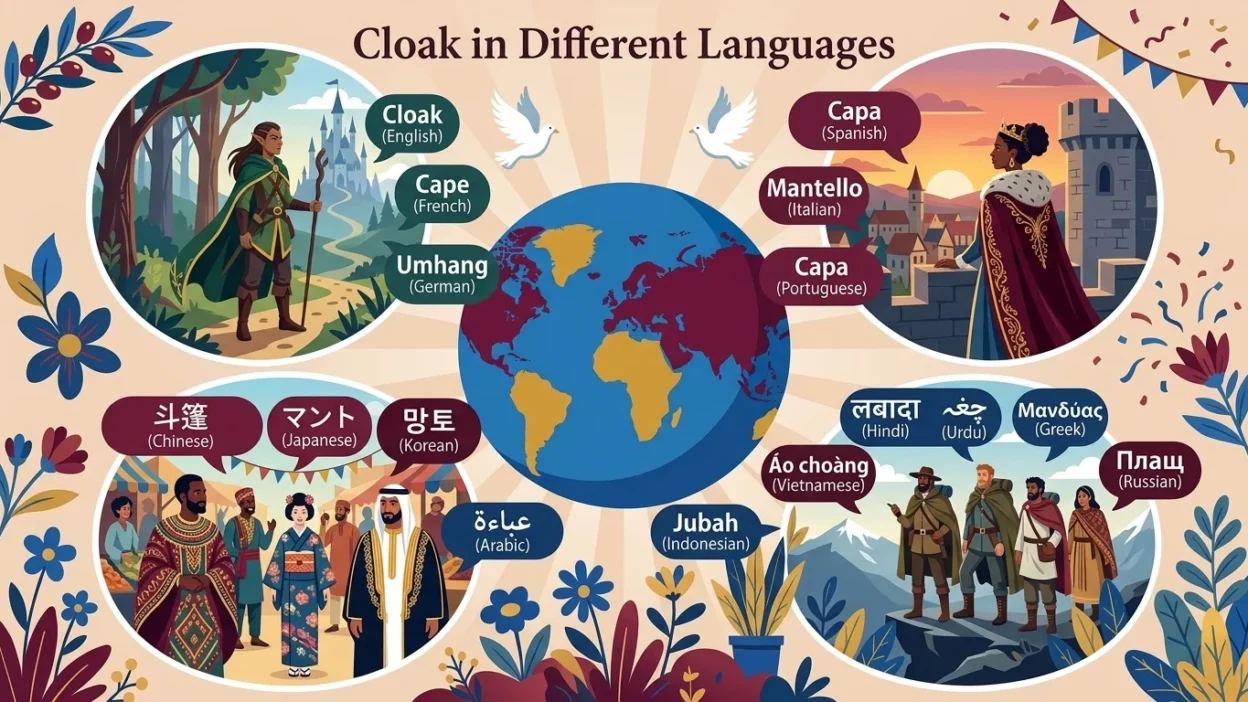
A cloak is a loose outer garment worn over clothing for warmth, protection, or ceremonial purposes. Throughout history, cloaks have been worn by travelers, royalty, soldiers, and in traditional clothing across many cultures. Learning cloak in different languages is useful for language learners, travelers, writers, and history enthusiasts.
This guide includes cloak translations with easy English pronunciations. If you’re searching for cloak in all languages or how to say cloak in different languages, this collection is the perfect place to begin.
Cloak in Different Languages (1–25)
| Language | Native Word | Easy English Pronunciation |
|---|---|---|
| English | Cloak | Klohk |
| Spanish | Capa | KAH-pah |
| French | Cape | Kap |
| German | Umhang | OOM-hang |
| Italian | Mantello | Man-TEL-lo |
| Portuguese | Capa | KAH-pah |
| Dutch | Mantel | MAN-tel |
| Swedish | Kappa | KAP-pa |
| Norwegian | Kappe | KAP-peh |
| Danish | Kappe | KAP-peh |
| Finnish | Viitta | VEE-ta |
| Icelandic | Skikkja | SKIK-ya |
| Irish | Clóca | KLOH-ka |
| Welsh | Mantell | MAN-thel |
| Scottish Gaelic | Cleòc | Klyohk |
| Polish | Peleryna | Peh-leh-RIH-na |
| Czech | Plášť | Plaasht |
| Slovak | Plášť | Plaasht |
| Slovenian | Plašč | Plashch |
| Croatian | Plašt | Plasht |
| Serbian | Плашт | Plasht |
| Bosnian | Plašt | Plasht |
| Romanian | Pelerină | Peh-leh-REE-nuh |
| Hungarian | Köpeny | Ker-pehny |
| Greek | Μανδύας | Man-THEE-as |
| Language | Native Word | Easy English Pronunciation |
|---|---|---|
| Russian | Плащ | Plashch |
| Ukrainian | Плащ | Plashch |
| Belarusian | Плашч | Plashch |
| Bulgarian | Пелерина | Pe-le-REE-na |
| Macedonian | Наметка | Na-MET-ka |
| Albanian | Pelerinë | Pe-le-REE-nuh |
| Turkish | Pelerin | Pe-le-RIN |
| Arabic | عباءة | A-ba-ya |
| Hebrew | גלימה | Glee-MAH |
| Persian | شنل | Sha-nel |
| Kurdish | Pelerin | Pe-le-RIN |
| Hindi | लबादा | La-baa-da |
| Urdu | چغہ | Chu-gha |
| Punjabi | ਚੋਗਾ | Cho-ga |
| Bengali | চাদর | Cha-dor |
| Gujarati | ડગલો | Dug-lo |
| Marathi | अंगरखा | An-ga-ra-kha |
| Nepali | लबादा | La-baa-da |
| Sinhala | සළුව | Sa-lu-wa |
| Tamil | அங்கி | An-gi |
| Telugu | అంగీ | An-gee |
| Kannada | ಅಂಗಿ | An-gi |
| Malayalam | മേലങ്കി | Mel-an-ki |
| Thai | เสื้อคลุม | Suea Kloom |
| Vietnamese | Áo choàng | Ow Chwang |
| Language | Native Word | Easy English Pronunciation |
|---|---|---|
| Indonesian | Jubah | Joo-bah |
| Malay | Jubah | Joo-bah |
| Filipino (Tagalog) | Balabal | Ba-la-bal |
| Chinese (Mandarin) | 斗篷 | Dòu Péng |
| Japanese | マント | Man-to |
| Korean | 망토 | Mang-to |
| Mongolian | Нөмрөг | Num-rug |
| Burmese | ဝတ်ရုံ | Wut-Yone |
| Khmer | អាវធំ | Av Thom |
| Lao | ເສື້ອຄຸມ | Suea Khum |
| Swahili | Joho | JOH-ho |
| Zulu | Ingubo | In-GOO-bo |
| Afrikaans | Mantel | MAN-tel |
| Amharic | ካባ | Ka-ba |
| Yoruba | Aṣọ àwọ̀ | A-shaw Ah-woh |
| Hausa | Alkyabba | Al-kya-ba |
| Maori | Korowai | Ko-ro-WHY |
| Hawaiian | ʻAhuʻula | Ah-hoo-OO-la |
| Samoan | Oofu talaloa | O-o-foo Ta-la-lo-a |
| Esperanto | Mantelo | Man-TE-lo |
Why Learn “Cloak” in Different Languages?
Learning cloak in different languages helps you expand your vocabulary related to clothing, history, literature, fantasy, and traditional fashion. Cloaks have been worn for centuries in many cultures for warmth, protection, and ceremonial purposes.
How to Say “Cloak” in Different Languages
If you’re searching for how to say cloak in different languages, learning both the native spelling and pronunciation will help you recognize the word in books, museums, films, historical texts, and everyday conversations.
Cloak Translations Around the World
These cloak translations are commonly used across Europe, Asia, Africa, the Americas, and Oceania. Some languages use the same word for a cloak and a cape, while others distinguish between different types of outer garments.
Related Clothing Vocabulary
After learning cloak in different languages, you may also want to learn:
- Coat in Different Languages
- Jacket in Different Languages
- Hat in Different Languages
- Dress in Different Languages
- Shoes in Different Languages
- Scarf in Different Languages
Tips for Learning Clothing Vocabulary
- Learn clothing words alongside pictures.
- Practice pronunciation with native speakers.
- Use the vocabulary in simple sentences.
- Group similar clothing terms together.
- Review regularly to improve long-term memory.
Conclusion
Learning cloak in different languages is a great way to build your clothing vocabulary while exploring different cultures and historical traditions. These 70 translations provide a practical reference for students, travelers, writers, and language enthusiasts.
Frequently Asked Questions
1. How do you say “cloak” in different languages?
Examples include Capa (Spanish), Cape (French), Umhang (German), 斗篷 (Dòupéng) (Chinese), and マント (Manto) (Japanese).
2. Is a cloak the same as a cape?
Not always. A cloak is typically a full outer garment that may have sleeves or a hood, while a cape is usually shorter and hangs from the shoulders.
3. Are these translations commonly used?
Yes. These are standard words used by native speakers, though some languages may use different terms depending on the style of the garment.
4. Why should I learn clothing vocabulary?
Clothing words are useful for shopping, traveling, reading literature, and everyday conversations.
5. What should I learn after “cloak”?
You can continue with coat, shirt, pants, boots, hat, and gloves to build a stronger clothing vocabulary