
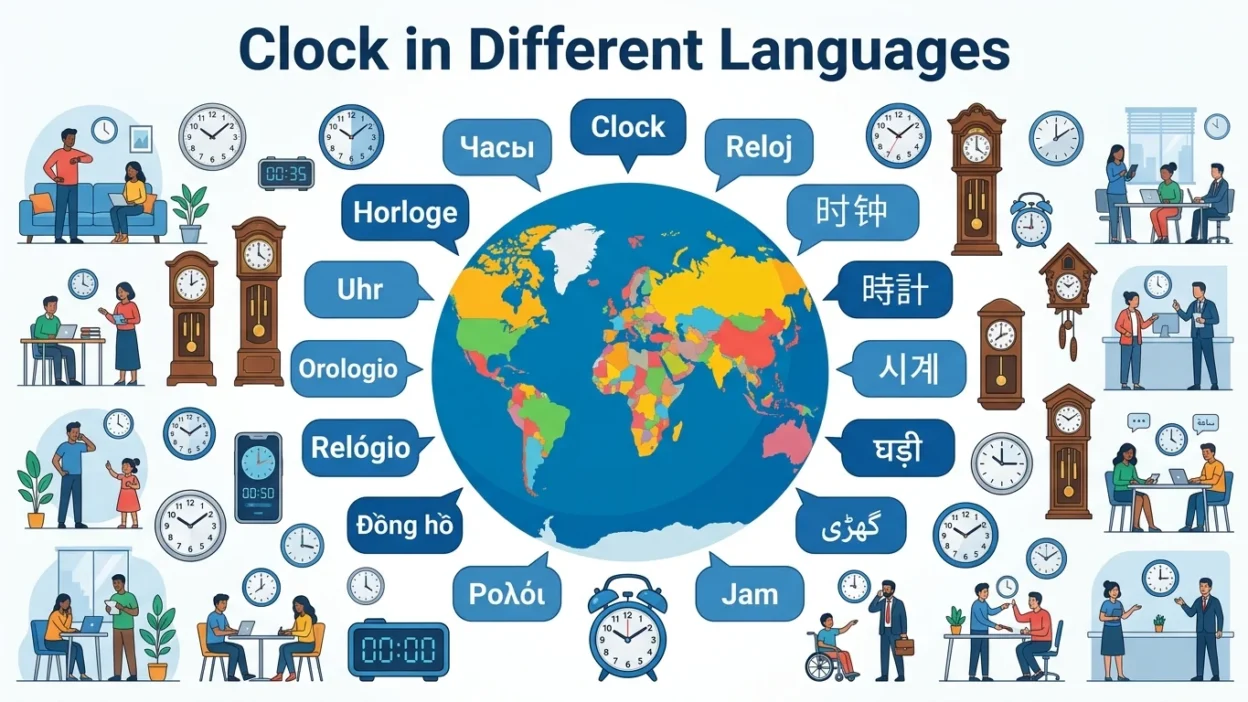
A clock is a device used to measure and display time. Whether it’s a wall clock, alarm clock, grandfather clock, or digital clock, this everyday object is recognized in every culture. Learning clock in different languages is useful for travelers, students, and language learners.
This guide includes clock translations with easy English pronunciations. If you’re searching for clock in all languages or how to say clock in different languages, this collection is the perfect place to begin.
Clock in Different Languages (1–25)
| Language | Native Word | Easy English Pronunciation |
|---|---|---|
| English | Clock | Klok |
| Spanish | Reloj | Reh-LOH |
| French | Horloge | Or-LOZH |
| German | Uhr | Oor |
| Italian | Orologio | O-ro-LOH-jo |
| Portuguese | Relógio | He-LOH-zhyoo |
| Dutch | Klok | Klok |
| Swedish | Klocka | KLOK-ka |
| Norwegian | Klokke | KLOK-keh |
| Danish | Ur | Oor |
| Finnish | Kello | KEL-lo |
| Icelandic | Klukka | KLOOK-ka |
| Irish | Clog | Klug |
| Welsh | Cloc | Klok |
| Scottish Gaelic | Cloc | Klok |
| Polish | Zegar | ZEH-gar |
| Czech | Hodiny | HO-di-nee |
| Slovak | Hodiny | HO-di-nee |
| Slovenian | Ura | OO-ra |
| Croatian | Sat | Saht |
| Serbian | Сат | Saht |
| Bosnian | Sat | Saht |
| Romanian | Ceas | Chas |
| Hungarian | Óra | OH-ra |
| Greek | Ρολόι | Ro-LOI |
| Language | Native Word | Easy English Pronunciation |
|---|
| Russian | Часы | Cha-SY |
| Ukrainian | Годинник | Ho-DYN-nyk |
| Belarusian | Гадзіннік | Ha-DZIN-nik |
| Bulgarian | Часовник | Cha-SOV-nik |
| Macedonian | Часовник | Cha-SOV-nik |
| Albanian | Orë | O-ruh |
| Turkish | Saat | Sa-at |
| Arabic | ساعة | Saa-ah |
| Hebrew | שעון | Sha-ON |
| Persian | ساعت | Saa-at |
| Kurdish | Demjimêr | Dem-je-MER |
| Hindi | घड़ी | Gha-ree |
| Urdu | گھڑی | Gha-ree |
| Punjabi | ਘੜੀ | Gha-ree |
| Bengali | ঘড়ি | Gho-ri |
| Gujarati | ઘડિયાળ | Gha-di-yaal |
| Marathi | घड्याळ | Gha-dyaal |
| Nepali | घडी | Gha-dee |
| Sinhala | ඔරලෝසුව | O-ra-lo-su-wa |
| Tamil | கடிகாரம் | Ka-di-gaa-ram |
| Telugu | గడియారం | Ga-di-yaa-ram |
| Kannada | ಗಡಿಯಾರ | Ga-di-ya-ra |
| Malayalam | ഘടികാരം | Gha-di-kaa-ram |
| Thai | นาฬิกา | Na-li-ka |
| Vietnamese | Đồng hồ | Dong Ho |
| Language | Native Word | Easy English Pronunciation |
|---|---|---|
| Indonesian | Jam | Jahm |
| Malay | Jam | Jahm |
| Filipino (Tagalog) | Orasan | O-ra-san |
| Chinese (Mandarin) | 时钟 | Shí Zhōng |
| Japanese | 時計 | To-kei |
| Korean | 시계 | Shi-gye |
| Mongolian | Цаг | Tsag |
| Burmese | နာရီ | Na-ree |
| Khmer | នាឡិកា | Nea-li-ka |
| Lao | ໂມງ | Mohng |
| Swahili | Saa | Saa |
| Zulu | Iwashi | Ee-WAH-shee |
| Afrikaans | Horlosie | Hor-LO-see |
| Amharic | ሰዓት | Se-at |
| Yoruba | Aago | Aa-go |
| Hausa | Agogo | A-go-go |
| Maori | Karaka | Ka-ra-ka |
| Hawaiian | Uaki | Oo-ah-kee |
| Samoan | Uati | Oo-ah-tee |
| Esperanto | Horloĝo | Hor-LO-zho |
Why Learn “Clock” in Different Languages?
Learning clock in different languages helps you communicate about time, schedules, travel, school, and daily life. It is one of the most practical vocabulary words for beginners learning a new language.
How to Say “Clock” in Different Languages
If you’re searching for how to say clock in different languages, learning both the native spelling and pronunciation will help you recognize the word on signs, in dictionaries, classrooms, and conversations.
Clock Translations Around the World
These clock translations are commonly used across Europe, Asia, Africa, the Americas, and Oceania. Some languages use the same word for both clock and watch, while others have separate words depending on the context.
Related Time Vocabulary
After learning clock in different languages, you may also want to learn:
- Time in Different Languages
- Watch in Different Languages
- Hour in Different Languages
- Minute in Different Languages
- Second in Different Languages
- Calendar in Different Languages
Tips for Learning Time Vocabulary
- Practice saying the words while reading a clock.
- Learn numbers alongside time-related words.
- Listen to native speakers tell the time.
- Use flashcards with pictures of clocks.
- Review vocabulary regularly for better retention.
Conclusion
Learning clock in different languages helps you build practical vocabulary for everyday conversations, travel, education, and work. These 70 translations provide a useful reference for students, travelers, and language learners worldwide.
Frequently Asked Questions
1. How do you say “clock” in different languages?
Examples include Reloj (Spanish), Horloge (French), Uhr (German), 时钟 (Shízhōng) (Chinese), and 時計 (Tokei) (Japanese).
2. Is “clock” the same as “watch”?
Not always. A clock is generally a stationary device that displays time, while a watch is designed to be worn on the wrist or carried.
3. Are these translations commonly used?
Yes. These are standard words widely used by native speakers, though some languages use the same word for both clocks and watches.
4. Why should I learn time-related vocabulary?
Time vocabulary is essential for travel, work, school, appointments, and everyday communication.
5. What should I learn after “clock”?
You can continue with time, calendar, hour, minute, second, and alarm to strengthen your everyday vocabulary.