The word “cut” has several meanings in English. It can mean to slice something, make an incision, reduce something, or separate something with a sharp object. Because of these different meanings, translations can vary depending on context.
| Language | Native Word | Easy English Pronunciation |
|---|---|---|
| English | Cut | KUT |
| Spanish | Cortar | Kor-TAR |
| French | Couper | Koo-PAY |
| German | Schneiden | SHNY-dən |
| Italian | Tagliare | Tahl-YAH-reh |
| Portuguese | Cortar | Kor-TAR |
| Dutch | Snijden | SNY-dən |
| Swedish | Skära | SHAY-ra |
| Norwegian | Kutte | KOO-teh |
| Danish | Skære | SKAIR-eh |
| Finnish | Leikata | LAY-ka-ta |
| Icelandic | Skera | SKEH-ra |
| Irish | Gearr | GYAR |
| Welsh | Torri | TOR-ree |
| Scottish Gaelic | Gearradh | GYAR-uh |
| Polish | Ciąć | CHONCH |
| Czech | Řezat | RZHEH-zat |
| Slovak | Rezať | REH-zat |
| Slovenian | Rezati | REH-za-tee |
| Croatian | Rezati | REH-za-tee |
| Serbian | Сећи | SEH-chee |
| Bosnian | Rezati | REH-za-tee |
| Romanian | Tăia | TAH-ya |
| Hungarian | Vágni | VAAG-nee |
| Greek | Κόβω | KO-vo |
| Language | Native Word | Easy English Pronunciation |
|---|---|---|
| Russian | Резать | REH-zat |
| Ukrainian | Різати | REE-za-tee |
| Belarusian | Рэзаць | REH-zats |
| Bulgarian | Режа | REH-zha |
| Macedonian | Сече | SEH-cheh |
| Albanian | Pres | PRES |
| Turkish | Kesmek | KES-mek |
| Arabic | قطع | QAT-eh |
| Hebrew | לחתוך | Lah-KH-toch |
| Persian | بریدن | Bo-REE-dan |
| Kurdish | Birîn | Bee-REEN |
| Hindi | काटना | KAAT-na |
| Urdu | کاٹنا | KAAT-na |
| Punjabi | ਕੱਟਣਾ | KAT-na |
| Bengali | কাটা | KA-ta |
| Gujarati | કાપવું | KAAP-voo |
| Marathi | कापणे | KAA-pa-nay |
| Nepali | काट्नु | KAAT-noo |
| Sinhala | කපනවා | Ka-pa-na-vaa |
| Tamil | வெட்ட | VET-ta |
| Telugu | కోయడం | KO-ya-dam |
| Kannada | ಕತ್ತರಿಸು | Kat-ta-ri-soo |
| Malayalam | മുറിക്കുക | Moo-ri-koo-ga |
| Thai | ตัด | TAT |
| Vietnamese | Cắt | KUHT |
| Language | Native Word | Easy English Pronunciation |
|---|---|---|
| Indonesian | Memotong | Meh-MOH-tong |
| Malay | Memotong | Meh-MOH-tong |
| Filipino (Tagalog) | Gupit | Goo-PIT |
| Chinese (Mandarin) | 切 | CHYEH |
| Japanese | 切る | KEE-roo |
| Korean | 자르다 | JA-reu-da |
| Mongolian | Огтлох | OGT-lohkh |
| Burmese | ဖြတ် | Phyat |
| Khmer | កាត់ | Kat |
| Lao | ຕັດ | Tat |
| Swahili | Kata | KAH-ta |
| Zulu | Sika | SEE-ka |
| Afrikaans | Sny | SNY |
| Amharic | መቁረጥ | Meh-KOO-ret |
| Yoruba | Gé | GEH |
| Hausa | Yanka | YAN-ka |
| Māori | Tapahi | Ta-pa-hee |
| Hawaiian | ʻOki | OH-kee |
| Samoan | Oti | OH-tee |
| Esperanto | Tranĉi | Tran-chee |
Why Learn “Cut” in Different Languages? 🌍
Learning “cut” in different languages is useful for travelers, students, writers, translators, and language enthusiasts. It is also a practical everyday word because cutting can involve food, paper, hair, fabric, wood, or other materials.
How to Say “Cut” in Different Languages
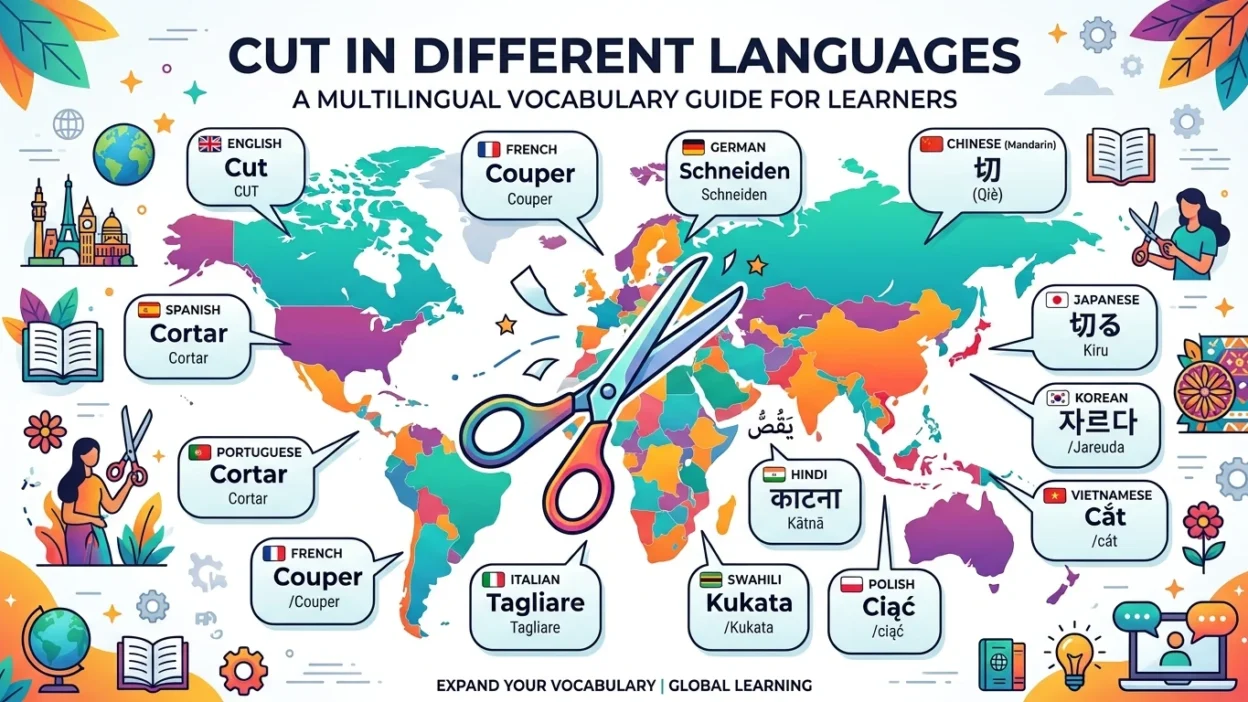
There are many fascinating ways to express “cut” around the world. For example, Spanish uses cortar, French uses couper, German uses schneiden, and Japanese uses 切る (kiru).
The exact translation can change depending on whether you mean to cut something, a cut or wound, a haircut, or a reduction.
“Cut” as a Verb and Noun ✂️
In English, cut can function as both a verb and a noun:
- Verb: “Please cut the paper.”
- Noun: “There is a cut on his finger.”
- Haircut: “I need a cut.”
- Reduction: “The company announced a budget cut.”
- Editing: “The director made a cut to the scene.”
Because of these different meanings, there isn’t always one universal translation for every situation.
Related Words for “Cut”
If you’re expanding your vocabulary, these related words are helpful:
- Slice — cut into thin pieces
- Chop — cut into smaller pieces
- Trim — remove unwanted or excess parts
- Snip — make a small cut, often with scissors
- Slash — make a long or forceful cut
- Carve — cut into a material to create a shape
- Divide — separate something into parts
- Reduce — make something smaller or lower
Tips for Learning “Cut” in Other Languages 🧠
Don’t memorize the translation alone. Learn it in a useful phrase such as “cut the paper,” “cut the vegetables,” “cut your hair,” or “cut the price.”
This helps you understand which grammatical form and meaning are appropriate in real conversations.
Conclusion ✨
From cortar in Spanish to sika in Zulu and tapahi in Māori, the simple English word “cut” has many interesting equivalents around the world.
Whether you’re learning a new language or creating multilingual vocabulary content, these 70 translations of “cut” are a handy place to start.
Frequently Asked Questions
What is “cut” in Spanish?
Cut is commonly translated as cortar in Spanish, pronounced approximately kor-TAR.
What is “cut” in French?
The common French verb for to cut is couper, pronounced approximately koo-PAY.
What is “cut” in German?
The German verb schneiden means to cut, especially when referring to cutting something with a blade or similar tool.
What is “cut” in Hindi?
Cut is commonly expressed as काटना (kaatna) in Hindi.
What is “cut” in Urdu?
In Urdu, to cut is commonly کاٹنا (kaatna).
What is “cut” in Japanese?
The Japanese verb 切る (kiru) means to cut.
What is “cut” in Chinese?
Mandarin commonly uses 切 (qiē) for to cut/slice, particularly when cutting food or other objects.
How many languages are included in this list?
This series contains 70 languages, covering languages from Europe, Asia, Africa, Oceania, and other regions.