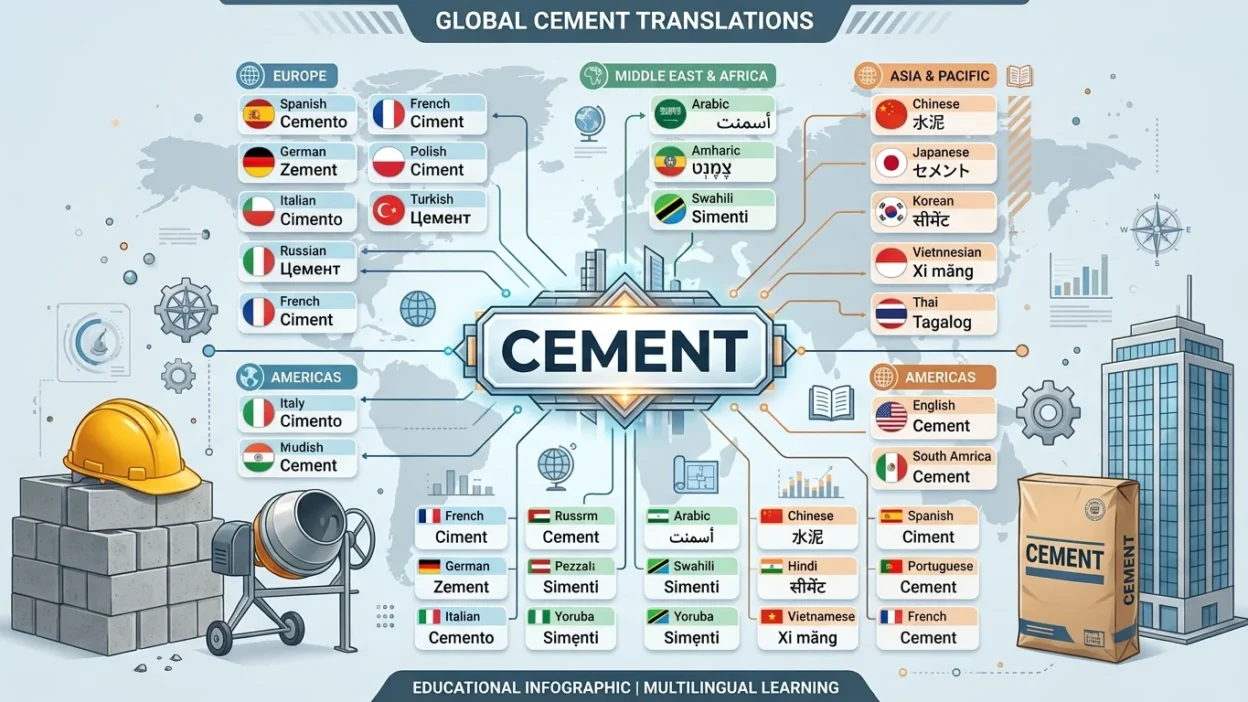
Cement is one of the most important materials used in construction around the world. From houses and roads to bridges, tunnels, and skyscrapers, cement plays a major role in building strong and durable structures.
Learning how to say “cement” in different languages is useful for travelers, construction professionals, students, translators, language learners, and anyone interested in international vocabulary. Below, you’ll find the word for cement in 70 languages, along with an easy English pronunciation guide.
Cement in Different Languages
| Language | Native Word | Easy English Pronunciation |
|---|---|---|
| English | Cement | See-MENT |
| Spanish | Cemento | Seh-MEN-toh |
| French | Ciment | See-MAHN |
| German | Zement | Tse-MENT |
| Italian | Cemento | Cheh-MEN-toh |
| Portuguese | Cimento | See-MEN-toh |
| Dutch | Cement | Seh-MENT |
| Swedish | Cement | Seh-MENT |
| Norwegian | Sement | Seh-MENT |
| Danish | Cement | Seh-MENT |
| Finnish | Sementti | Seh-MEN-tee |
| Icelandic | Sement | Seh-MENT |
| Irish | Stroighin | STROH-in |
| Welsh | Sment | SMENT |
| Scottish Gaelic | Saimeant | SAY-ment |
| Polish | Cement | TSEH-ment |
| Czech | Cement | TSEH-ment |
| Slovak | Cement | TSEH-ment |
| Slovenian | Cement | TSEH-ment |
| Croatian | Cement | TSEH-ment |
| Serbian | Цемент | TSEH-ment |
| Bosnian | Cement | TSEH-ment |
| Romanian | Ciment | Chee-MENT |
| Hungarian | Cement | TSEH-ment |
| Greek | Τσιμέντο | Tsee-MEN-toh |
Cement in Russian, Ukrainian, and Other European Languages
| Language | Native Word | Easy English Pronunciation |
|---|---|---|
| Russian | Цемент | TSEH-ment |
| Ukrainian | Цемент | TSEH-ment |
| Belarusian | Цэмент | TSEH-ment |
| Bulgarian | Цимент | TSEE-ment |
| Macedonian | Цемент | TSEH-ment |
| Albanian | Çimento | Chee-MEN-toh |
| Turkish | Çimento | Chee-MEN-toh |
| Arabic | إسمنت | Is-MENT |
| Hebrew | מלט | MEH-let |
| Persian | سیمان | See-MAAN |
| Kurdish | Sîmento | See-MEN-toh |
| Hindi | सीमेंट | SEE-ment |
| Urdu | سیمنٹ | SEE-ment |
| Punjabi | ਸੀਮੈਂਟ | SEE-ment |
| Bengali | সিমেন্ট | SEE-ment |
| Gujarati | સિમેન્ટ | SEE-ment |
| Marathi | सिमेंट | SEE-ment |
| Nepali | सिमेन्ट | SEE-ment |
| Sinhala | සිමෙන්ති | See-MEN-thee |
| Tamil | சிமெண்ட் | See-MENT |
| Telugu | సిమెంట్ | See-MENT |
| Kannada | ಸಿಮೆಂಟ್ | See-MENT |
| Malayalam | സിമന്റ് | See-MENT |
| Thai | ปูนซีเมนต์ | Poon See-MEN |
| Vietnamese | Xi măng | See-MANG |
Cement in Asian Languages
| Language | Native Word | Easy English Pronunciation |
|---|---|---|
| Indonesian | Semen | SEH-men |
| Malay | Simen | SEE-men |
| Filipino (Tagalog) | Semento | Seh-MEN-toh |
| Chinese (Mandarin) | 水泥 | SHWAY-nee |
| Japanese | セメント | Seh-MEN-toh |
| Korean | 시멘트 | Shee-MEN-teu |
| Mongolian | Цемент | TSEH-ment |
| Burmese | ဘိလပ်မြေ | Bee-lat-myay |
| Khmer | ស៊ីម៉ង់ត៍ | See-MANG |
| Lao | ຊີມັງ | See-Mang |
Cement in African Languages
| Language | Native Word | Easy English Pronunciation |
|---|---|---|
| Swahili | Saruji | Sa-ROO-jee |
| Zulu | Usimende | Oo-see-MEN-deh |
| Afrikaans | Sement | Seh-MENT |
| Amharic | ሲሚንቶ | See-MEEN-toh |
| Yoruba | Símẹ́ǹtì | See-MEN-tee |
| Hausa | Siminti | See-MIN-tee |
Cement in Pacific and Other Languages
| Language | Native Word | Easy English Pronunciation |
|---|---|---|
| Māori | Sima | SEE-ma |
| Hawaiian | Sima | SEE-ma |
| Samoan | Sima | SEE-ma |
| Esperanto | Cemento | Tseh-MEN-toh |
What Does Cement Mean? 🧱
Cement is a binding material used in construction. When mixed with water, it forms a paste that can bind materials such as sand and gravel together.
Cement is an essential ingredient in materials such as concrete and mortar. It is commonly used for foundations, walls, floors, roads, bridges, and many other structures.
An important distinction is that cement is not the same thing as concrete. Cement is a component of concrete, while concrete is a mixture that generally contains cement, water, and aggregates such as sand and gravel.
How Do You Say Cement in Spanish?
In Spanish, cement is “cemento.”
Pronunciation: Seh-MEN-toh
Example:
El cemento se utiliza para construir edificios.
This means: “Cement is used to build buildings.”
How Do You Say Cement in French?
In French, cement is “ciment.”
Pronunciation: See-MAHN
The word is commonly used in construction-related contexts.
How Do You Say Cement in German?
In German, cement is “Zement.”
Pronunciation: Tse-MENT
German construction vocabulary often includes words derived from the same Latin-rooted terminology found in several European languages.
How Do You Say Cement in Italian?
In Italian, cement is “cemento.”
Pronunciation: Cheh-MEN-toh
It is a familiar construction term used when discussing building materials.
How Do You Say Cement in Portuguese?
In Portuguese, cement is “cimento.”
Pronunciation: See-MEN-toh
The word is very similar to the Spanish cemento, although the pronunciation differs.
How Do You Say Cement in Arabic?
In Arabic, cement is commonly written as إسمنت.
Pronunciation: Is-MENT
Arabic terminology can vary by region, so you may encounter other expressions for cement or cement-related construction materials.
How Do You Say Cement in Hindi?
In Hindi, cement is सीमेंट.
Pronunciation: SEE-ment
It is a commonly used word in everyday construction vocabulary.
How Do You Say Cement in Urdu?
In Urdu, cement is سیمنٹ.
Pronunciation: SEE-ment
Because the English-derived word is widely used in South Asian construction contexts, its pronunciation is quite familiar to Urdu speakers.
How Do You Say Cement in Chinese?
In Mandarin Chinese, cement is 水泥.
Pinyin: shuǐní
Easy pronunciation: SHWAY-nee
The literal components refer to water and mud-like material, reflecting the traditional terminology used for the material.
How Do You Say Cement in Japanese?
In Japanese, cement is セメント.
Pronunciation: Seh-MEN-to
It is written in katakana, which is commonly used for foreign-derived words.
How Do You Say Cement in Korean?
In Korean, cement is 시멘트.
Pronunciation: Shee-MEN-teu
The term is commonly used in construction and engineering contexts.
Cement vs. Concrete
Although people sometimes use cement and concrete as if they mean the same thing, they are technically different.
| Cement | Concrete |
|---|---|
| A binding material | A finished construction material |
| One ingredient of concrete | Contains cement, water, and aggregates |
| Usually a fine powder | A mixture that can be poured and hardened |
| Helps bind other materials | Used to make structures and surfaces |
A simple way to remember it is:
Cement is an ingredient; concrete is the mixture. 🧱
Cement vs. Mortar
Mortar is another construction material that contains cement, but it is primarily used to bond masonry units such as bricks and blocks.
For example:
- Cement → binding ingredient
- Mortar → used to join bricks or blocks
- Concrete → used for structural elements such as foundations and slabs
Knowing this difference can make construction vocabulary much easier to understand.
Related Cement Vocabulary
Here are some useful words related to cement:
- Cement powder 🧱
- Concrete
- Mortar
- Sand
- Gravel
- Aggregate
- Foundation
- Brick
- Construction
- Building materials
- Reinforced concrete
- Cement mixer
- Cement bag
- Cement paste
- Concrete slab
Why Learn Cement in Different Languages?
Learning cement in different languages can be useful in many situations.
🌍 Travel: Construction vocabulary can help when communicating abroad.
🏗️ Construction: International construction teams often work across language barriers.
📚 Education: Students studying architecture, engineering, or construction can benefit from multilingual vocabulary.
🗣️ Language Learning: Learning practical nouns makes vocabulary more useful in everyday situations.
💼 Business: Importers, exporters, contractors, and suppliers may communicate with international customers.
Interesting Facts About Cement
- Cement is one of the most widely used construction materials in the world.
- Modern cement is strongly associated with Portland cement.
- Cement becomes useful as a binder when mixed with water.
- Concrete typically uses cement together with aggregates and water.
- Cement vocabulary is surprisingly similar across many European languages.
- The word is closely related to Latin caementum, associated with quarried or cut stone and building material.
How to Remember the Word Cement
A simple memory trick is to notice how similar the word is across languages.
For example:
English: Cement
Spanish: Cemento
Italian: Cemento
Portuguese: Cimento
German: Zement
Polish: Cement
Dutch: Cement
Many of these words have the same basic “cement” sound, making them relatively easy to recognize.
Cement in 70 Languages — Quick Reference
If you need a quick answer, here are the main forms grouped together:
English: Cement
Spanish: Cemento
French: Ciment
German: Zement
Italian: Cemento
Portuguese: Cimento
Dutch: Cement
Swedish: Cement
Norwegian: Sement
Danish: Cement
Finnish: Sementti
Icelandic: Sement
Irish: Stroighin
Welsh: Sment
Scottish Gaelic: Saimeant
Polish: Cement
Czech: Cement
Slovak: Cement
Slovenian: Cement
Croatian: Cement
Serbian: Цемент
Bosnian: Cement
Romanian: Ciment
Hungarian: Cement
Greek: Τσιμέντο
Russian: Цемент
Ukrainian: Цемент
Belarusian: Цэмент
Bulgarian: Цимент
Macedonian: Цемент
Albanian: Çimento
Turkish: Çimento
Arabic: إسمنت
Hebrew: מלט
Persian: سیمان
Kurdish: Sîmento
Hindi: सीमेंट
Urdu: سیمنٹ
Punjabi: ਸੀਮੈਂਟ
Bengali: সিমেন্ট
Gujarati: સિમેન્ટ
Marathi: सिमेंट
Nepali: सिमेन्ट
Sinhala: සිමෙන්ති
Tamil: சிமெண்ட்
Telugu: సిమెంట్
Kannada: ಸಿಮೆಂಟ್
Malayalam: സിമന്റ്
Thai: ปูนซีเมนต์
Vietnamese: Xi măng
Indonesian: Semen
Malay: Simen
Filipino: Semento
Chinese: 水泥
Japanese: セメント
Korean: 시멘트
Mongolian: Цемент
Burmese: ဘိလပ်မြေ
Khmer: ស៊ីម៉ង់ត៍
Lao: ຊີມັງ
Swahili: Saruji
Zulu: Usimende
Afrikaans: Sement
Amharic: ሲሚንቶ
Yoruba: Símẹ́ǹtì
Hausa: Siminti
Māori: Sima
Hawaiian: Sima
Samoan: Sima
Esperanto: Cemento
Frequently Asked Questions
What is cement called in different languages?
The word for cement varies by language. For example, it is cemento in Spanish, ciment in French, Zement in German, cemento in Italian, and cimento in Portuguese.
What is cement called in Spanish?
Cement is called cemento in Spanish. It is pronounced approximately Seh-MEN-toh.
What is cement called in French?
Cement is ciment in French, pronounced approximately See-MAHN.
What is cement called in Hindi?
Cement is written as सीमेंट in Hindi and is pronounced approximately SEE-ment.
What is cement called in Urdu?
Cement is written as سیمنٹ in Urdu and is pronounced approximately SEE-ment.
What is cement called in Chinese?
In Mandarin Chinese, cement is 水泥 (shuǐní), pronounced approximately SHWAY-nee.
Is cement the same as concrete?
No. Cement is an ingredient used to make concrete. Concrete generally combines cement, water, and aggregates such as sand and gravel.
Which languages have words similar to English “cement”?
Many European languages have very similar forms, including Spanish cemento, Italian cemento, Portuguese cimento, Dutch cement, Polish cement, and German Zement.
Conclusion 🧱🌍
From cemento in Spanish and Italian to ciment in French and 水泥 in Mandarin, the word for cement changes across languages while its importance in construction remains universal.
Whether you’re learning languages, working in construction, studying engineering, or simply expanding your vocabulary, knowing how to say cement in different languages is a useful little building block for your language journey!