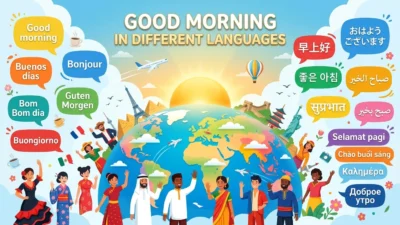
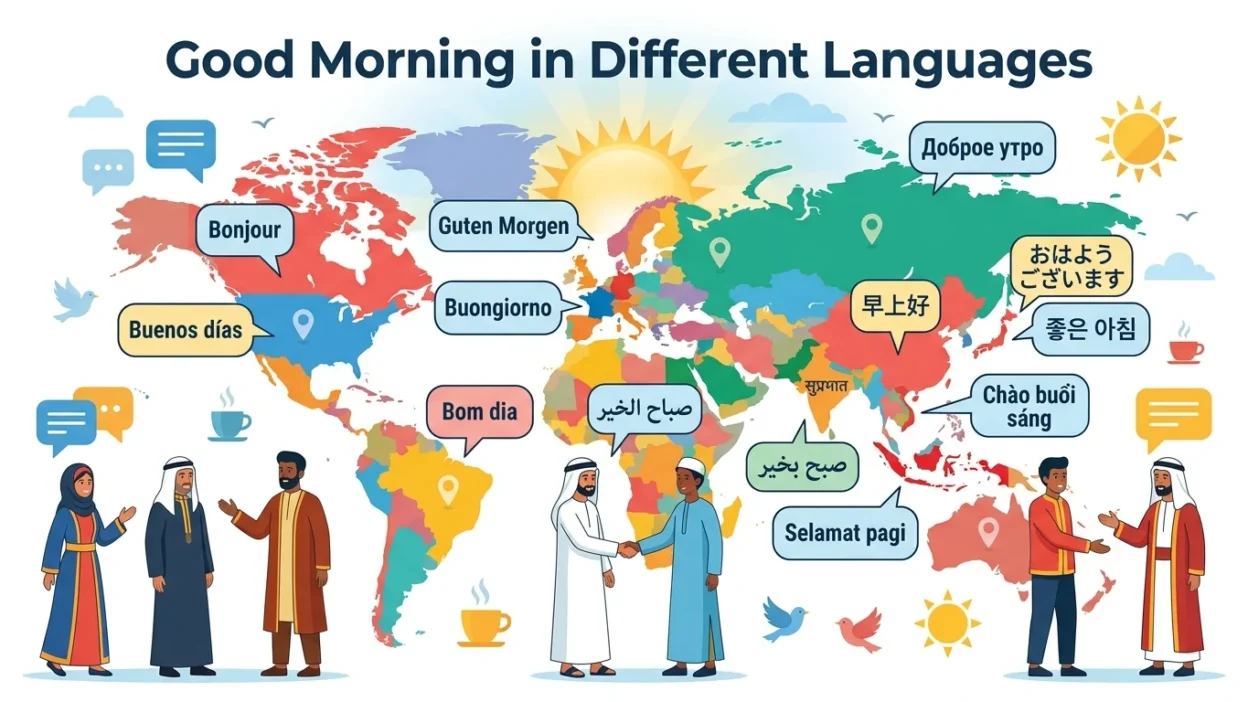
Learning good morning in different languages is a simple way to connect with people from different cultures, make a great first impression, and improve your language skills. Whether you’re traveling, studying a new language, making international friends, or simply curious about world cultures, knowing how to say “good morning” can help you communicate with confidence.
In this guide, you’ll discover 70 different languages, their correct native greeting, an easy English pronunciation, and a real-life example sentence with its English meaning. This easy-to-read guide is designed for quick learning and is optimized for anyone searching for good morning in all languages, how to say good morning in different languages, and good morning translations.
| Language | Native Phrase | Easy English Pronunciation |
|---|---|---|
| English | Good morning | Good MOR-ning |
| Spanish | Buenos días | BWEH-nos DEE-as |
| French | Bonjour | Bon-ZHOOR |
| German | Guten Morgen | GOO-ten MOR-gen |
| Italian | Buongiorno | Bwon-JOR-no |
| Portuguese | Bom dia | Bong DEE-ah |
| Dutch | Goedemorgen | HOO-duh-MOR-ghen |
| Swedish | God morgon | Goo MOR-gon |
| Norwegian | God morgen | Goo MOR-gen |
| Danish | Godmorgen | GO MOR-gen |
| Finnish | Hyvää huomenta | HOO-va HWO-men-ta |
| Icelandic | Góðan daginn | GO-than DAI-yin |
| Irish | Maidin mhaith | MA-jin wah |
| Welsh | Bore da | BO-reh DA |
| Scottish Gaelic | Madainn mhath | MATCH-in VAH |
| Polish | Dzień dobry | Jen DOB-ri |
| Czech | Dobré ráno | DO-breh RAA-no |
| Slovak | Dobré ráno | DO-breh RAA-no |
| Slovenian | Dobro jutro | DO-bro YOO-tro |
| Croatian | Dobro jutro | DO-bro YOO-tro |
| Serbian | Добро јутро | DO-bro YOO-tro |
| Bosnian | Dobro jutro | DO-bro YOO-tro |
| Romanian | Bună dimineața | BOO-na Dee-mee-NYA-tsa |
| Hungarian | Jó reggelt | Yo REG-gelt |
| Greek | Καλημέρα | Ka-lee-ME-ra |
| Russian | Доброе утро | DOB-ra-ye OO-tra |
| Ukrainian | Доброго ранку | DOB-ro-ho RAN-ku |
| Belarusian | Добрай раніцы | DOB-ray RA-ni-tsy |
| Bulgarian | Добро утро | DOB-ro OO-tro |
| Macedonian | Добро утро | DOB-ro OO-tro |
| Albanian | Mirëmëngjes | Mee-re MEN-jes |
| Turkish | Günaydın | Goo-NIGH-dun |
| Arabic | صباح الخير | Sa-BAH al-KHAIR |
| Hebrew | בוקר טוב | BO-ker TOV |
| Persian | صبح بخیر | Sobh be-kheyr |
| Kurdish | Beyanî baş | Beh-ya-NEE bash |
| Hindi | सुप्रभात | Soo-pra-BAAT |
| Urdu | صبح بخیر | Subah ba-khair |
| Punjabi | ਸਤ ਸ੍ਰੀ ਅਕਾਲ | Sat Sri Akaal |
| Bengali | সুপ্রভাত | Shoo-pro-BHAT |
| Gujarati | સુપ્રભાત | Su-pra-BHAT |
| Marathi | सुप्रभात | Soo-pra-BHAT |
| Nepali | शुभ प्रभात | Shub Pra-BHAT |
| Sinhala | සුභ උදෑසනක් | Suba U-da-sa-nak |
| Tamil | காலை வணக்கம் | KAA-lai Va-NAK-kam |
| Telugu | శుభోదయం | Shu-bho-da-yam |
| Kannada | ಶುಭೋದಯ | Shu-bho-da-ya |
| Malayalam | സുപ്രഭാതം | Su-pra-bhaa-tham |
| Thai | สวัสดีตอนเช้า | Sa-wat-dee Ton Chao |
| Vietnamese | Chào buổi sáng | Chow BOO-ee SANG |
| Indonesian | Selamat pagi | Se-LA-mat PA-gee |
| Malay | Selamat pagi | Se-LA-mat PA-gee |
| Filipino | Magandang umaga | Ma-ga-NDANG Oo-MA-ga |
| Chinese (Mandarin) | 早上好 | Zao Shang Hao |
| Japanese | おはようございます | O-ha-yo Go-zai-mas |
| Korean | 좋은 아침 | Jo-eun A-chim |
| Mongolian | Өглөөний мэнд | Ug-luu-nii Mend |
| Burmese | မင်္ဂလာနံနက်ခင်းပါ | Ming-ga-la Nan-net Khin-ba |
| Khmer | អរុណសួស្តី | A-roon Suo-sdei |
| Lao | ສະບາຍດີຕອນເຊົ້າ | Sa-bai-dee Ton Chao |
| Swahili | Habari za asubuhi | Ha-BA-ri za A-su-BU-hi |
| Zulu | Sawubona | Sa-woo-BO-na |
| Afrikaans | Goeiemôre | HOO-ee-MOR-uh |
| Amharic | እንደምን አደሩ | En-de-min A-de-roo |
| Yoruba | Ẹ káàárọ̀ | Eh Kaa-ro |
| Hausa | Ina kwana | EE-na KWA-na |
| Maori | Ata mārie | A-ta MAA-ree-eh |
| Hawaiian | Aloha kakahiaka | A-lo-ha Ka-ka-hee-A-ka |
| Samoan | Manuia le taeao | Ma-noo-EE-a leh Ta-E-ao |
| Esperanto | Bonan matenon | BO-nan Ma-te-NON |
Why Learn Good Morning in Different Languages?
Knowing good morning in different languages helps you communicate politely wherever you travel. A simple greeting often creates a positive first impression and shows respect for local customs. Even learning a few greetings can make conversations friendlier and more memorable.
How to Say Good Morning in Different Languages
Although every language has its own pronunciation and writing system, morning greetings usually express the same warm wish for a pleasant start to the day. Some languages use formal and informal versions, while others use one phrase for both situations.
Good Morning in All Languages for Travelers
If you’re traveling internationally, learning the local morning greeting can:
- Show cultural respect.
- Make locals feel appreciated.
- Help start conversations naturally.
- Improve your travel experience.
- Build confidence when speaking a new language.
Common Tips for Pronouncing Foreign Greetings
- Listen to native speakers whenever possible.
- Speak slowly at first.
- Focus on the rhythm instead of individual letters.
- Practice every morning.
- Don’t worry about having a perfect accent.
The End in Different Languages Around the World
Just as learning morning greetings is useful, many language learners also search for the end in different languages around the world. Here are a few examples:
| Language | Translation |
|---|---|
| English | The End |
| Spanish | Fin |
| French | Fin |
| German | Ende |
| Italian | Fine |
| Japanese | 終わり |
| Chinese | 结束 |
| Arabic | النهاية |
| Russian | Конец |
| Hindi | समाप्त |
Conclusion
Learning good morning in different languages is an enjoyable way to explore world cultures while improving your communication skills. Whether you’re preparing for travel, studying languages, or simply expanding your knowledge, these greetings can help you connect with people more naturally.
Keep practicing a few new greetings each day, and you’ll soon remember many of them with ease. Small phrases often create meaningful conversations across cultures.
Frequently Asked Questions
1. How do you say good morning in different languages?
Every language has its own greeting. Examples include Bonjour (French), Buenos días (Spanish), Guten Morgen (German), and Ohayō gozaimasu (Japanese).
2. Why should I learn good morning in different languages?
It helps you communicate respectfully, improve travel experiences, and understand different cultures.
3. Which language has the easiest way to say good morning?
Many learners find greetings like Bonjour, Bom dia, Aloha kakahiaka, and Selamat pagi easy to remember.
4. Are these good morning translations suitable for formal situations?
Most of the greetings listed are commonly used in polite everyday conversations. Some languages also have informal alternatives depending on the situation.
5. Can I use these greetings while traveling?
Yes. Learning local morning greetings is one of the easiest ways to make a positive first impression and show respect for local customs.

Ethan John is a content writer from the United Kingdom who focuses on language education and effective communication. He writes informative articles about grammar, pronunciation, translation, idioms, and language comparisons to help readers develop confidence in their reading and writing abilities. Ethan believes that learning a language should be practical, enjoyable, and relevant to everyday life. His content is designed for learners of all levels, offering clear guidance and useful insights into both English and other widely spoken languages around the world.