
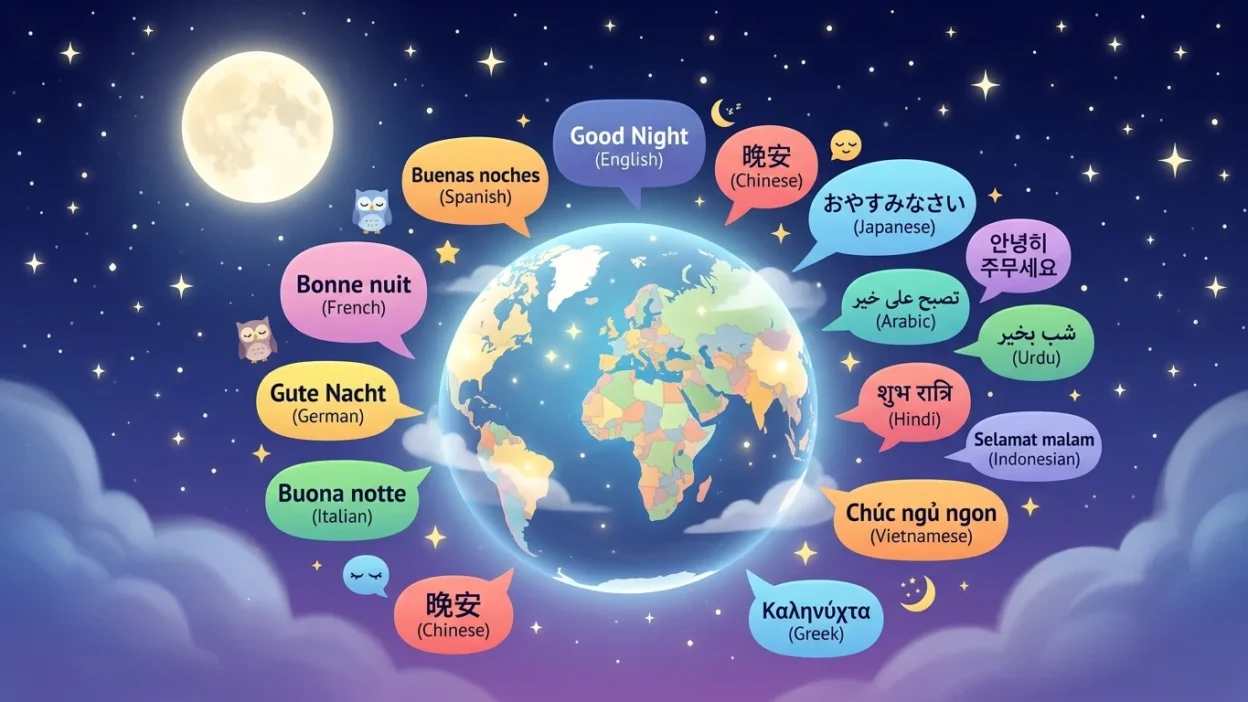
Saying good night in different languages is a beautiful way to connect with people, explore cultures, and learn how different communities express kindness before ending the day. A simple nighttime greeting can show respect, create warm conversations, and make your communication more meaningful.
Whether you are traveling, learning a new language, teaching students, or searching for how to say good night in different languages, this guide provides useful good night translations from around the world. You will discover native phrases, easy pronunciations, and common ways people wish each other a peaceful night.
Good Night in Different Languages
| Language | Native Phrase | Easy English Pronunciation |
|---|---|---|
| English | Good night | Good night |
| Spanish | Buenas noches | BWEH-nas NO-ches |
| French | Bonne nuit | Bon Nwee |
| German | Gute Nacht | GOO-teh Nahkht |
| Italian | Buona notte | BWO-na NOT-teh |
| Portuguese | Boa noite | BO-ah NOY-teh |
| Dutch | Goedenacht | HOO-duh-nakht |
| Swedish | God natt | Goo natt |
| Norwegian | God natt | Goo natt |
| Danish | Godnat | Goo-nat |
| Finnish | Hyvää yötä | HOO-vaa YOH-ta |
| Icelandic | Góða nótt | GO-tha noht |
| Irish | Oíche mhaith | EE-ha wah |
| Welsh | Nos da | Nos dah |
| Scottish Gaelic | Oidhche mhath | Oi-che vah |
| Polish | Dobranoc | DO-bra-nots |
| Czech | Dobrou noc | DO-broh nots |
| Slovak | Dobrú noc | DO-broo nots |
| Slovenian | Lahko noč | LAHK-oh notch |
| Croatian | Laku noć | LA-koo notch |
| Serbian | Лаку ноћ | LA-koo notch |
| Bosnian | Laku noć | LA-koo notch |
| Romanian | Noapte bună | NOAP-teh BOO-na |
| Hungarian | Jó éjszakát | Yo AY-sa-kaat |
| Greek | Καληνύχτα | Ka-lee-NEEKH-ta |
| Language | Native Phrase | Easy English Pronunciation |
|---|---|---|
| Russian | Спокойной ночи | Spa-KOY-noy NO-chee |
| Ukrainian | Надобраніч | Na-do-BRA-nich |
| Belarusian | Дабранач | Da-bra-NACH |
| Bulgarian | Лека нощ | LE-ka nosht |
| Macedonian | Добра ноќ | DO-bra nokj |
| Albanian | Natën e mirë | NA-ten eh MEER |
| Turkish | İyi geceler | Ee-YEE geh-jeh-LER |
| Arabic | تصبح على خير | Tus-bih ala khair |
| Hebrew | לילה טוב | LAY-la tov |
| Persian | شب بخیر | Shab be-kheyr |
| Kurdish | Şev baş | Shev bash |
| Hindi | शुभ रात्रि | Shubh RAA-tri |
| Urdu | شب بخیر | Shab ba-khair |
| Punjabi | ਸ਼ੁੱਭ ਰਾਤਰੀ | Shubh Raa-tri |
| Bengali | শুভ রাত্রি | Shubho RAA-tri |
| Gujarati | શુભ રાત્રિ | Shubh RAA-tri |
| Marathi | शुभ रात्री | Shubh RAA-tree |
| Nepali | शुभ रात्री | Shubh RAA-tree |
| Sinhala | සුභ රාත්රියක් | Suba RAA-thri-yak |
| Tamil | இனிய இரவு | Iniya Ira-vu |
| Telugu | శుభ రాత్రి | Shubha Raa-thri |
| Kannada | ಶುಭ ರಾತ್ರಿ | Shubha Raa-thri |
| Malayalam | ശുഭ രാത്രി | Shubha Raa-thri |
| Thai | ราตรีสวัสดิ์ | Raa-tree Sa-wat |
| Vietnamese | Chúc ngủ ngon | Chook ngu ngon |
| Language | Native Phrase | Easy English Pronunciation |
|---|---|---|
| Indonesian | Selamat malam | Se-LA-mat MA-lam |
| Malay | Selamat malam | Se-LA-mat MA-lam |
| Filipino (Tagalog) | Magandang gabi | Ma-GAN-dang GA-bi |
| Chinese (Mandarin) | 晚安 | Wǎn ān |
| Japanese | おやすみなさい | O-ya-su-mi-na-sai |
| Korean | 안녕히 주무세요 | An-nyeong-hi Ju-mu-se-yo |
| Mongolian | Сайхан амраарай | Sai-khan Am-raa-rai |
| Burmese | ကောင်းသောညပါ | Kaung-tho nya ba |
| Khmer | រាត្រីសួស្តី | Reatrey Suosdei |
| Lao | ຝັນດີ | Fan Dee |
| Swahili | Usiku mwema | Oo-see-koo MWE-ma |
| Zulu | Lala kahle | La-la KA-hle |
| Afrikaans | Goeienag | HOO-ee-nakh |
| Amharic | መልካም ሌሊት | Mel-kam Le-lit |
| Yoruba | Oru rere | O-roo REH-reh |
| Hausa | Sai da safe | Sai da SA-fe |
| Maori | Moe mai rā | Moy my rah |
| Hawaiian | Aloha pō | A-lo-ha poh |
| Samoan | Manuia le po | Ma-noo-ee-a leh poh |
| Esperanto | Bonan nokton | BO-nan NOK-ton |
Why Learn Good Night in Different Languages?
Learning good night in different languages is a simple way to understand global cultures and communicate more warmly. Night greetings are often used to express care, kindness, and good wishes before someone rests.
A small phrase like “good night” can make conversations more personal and memorable, especially when speaking with people from different countries.
How to Say Good Night in Different Languages
If you want to learn how to say good night in different languages, start by practicing the pronunciation and repeating the phrases regularly. Many greetings become easy to remember when connected with daily routines.
Using native phrases instead of direct translations can also help you sound more natural when communicating with speakers of other languages.
Good Night Translations Around the World
Good night translations may look different across languages, but the meaning is usually the same: wishing someone a peaceful and comfortable night.
From European languages like French and Spanish to Asian languages like Japanese and Korean, every culture has its own beautiful way of ending the day.
Good Morning and Good Night Greetings in Different Culture
Many language learners search for both good morning in different languages and good night in different languages around the world. Learning both greetings helps you communicate throughout the entire day while showing appreciation for different traditions.
Tips to Remember Good Night Phrases Easily
- Practice one or two greetings every day.
- Write phrases in a notebook.
- Say them aloud to improve pronunciation.
- Connect each phrase with its country or culture.
- Use greetings in real conversations whenever possible.
Conclusion
Learning good night in different languages is a fun and meaningful way to explore the world’s cultures. These simple greetings can help you build connections, improve language skills, and show respect to people from different backgrounds.
Whether you are traveling, studying languages, or simply curious about global expressions, these 70 good night translations are a great starting point for your language journey.
Frequently Asked Questions
1. How do you say good night in different languages?
You can say good night in many ways, such as Buenas noches in Spanish, Bonne nuit in French, Gute Nacht in German, and おやすみなさい (Oyasuminasai) in Japanese.
2. Why should I learn good night in different languages?
Learning nighttime greetings helps you communicate politely, understand cultures better, and create friendly connections with people worldwide.
3. What is the most common good night greeting worldwide?
Many languages have a phrase equivalent to good night, and greetings like Buenas noches, Bonne nuit, and Gute Nacht are widely recognized.
4. Are good night translations the same in every language?
The meaning is similar, but pronunciation, writing systems, and cultural usage can vary from one language to another.
5. Can I use these good night phrases while traveling?
Yes. Using a local good night greeting is a respectful way to interact with people and leave a positive impression.

Daniel Whitmore is a language writer and editor from the United Kingdom who is passionate about making language learning accessible to everyone. He specializes in English grammar, vocabulary, spelling differences, pronunciation, and multilingual communication. His articles break down complex language concepts into clear, practical lessons that readers can apply in everyday conversations and writing. Daniel enjoys exploring the history, culture, and evolution of languages while creating engaging content for students, educators, travelers, and language enthusiasts. His goal is to provide accurate, reader-friendly resources that help people build confidence in learning English and other world languages through simple explanations and real-life examples.