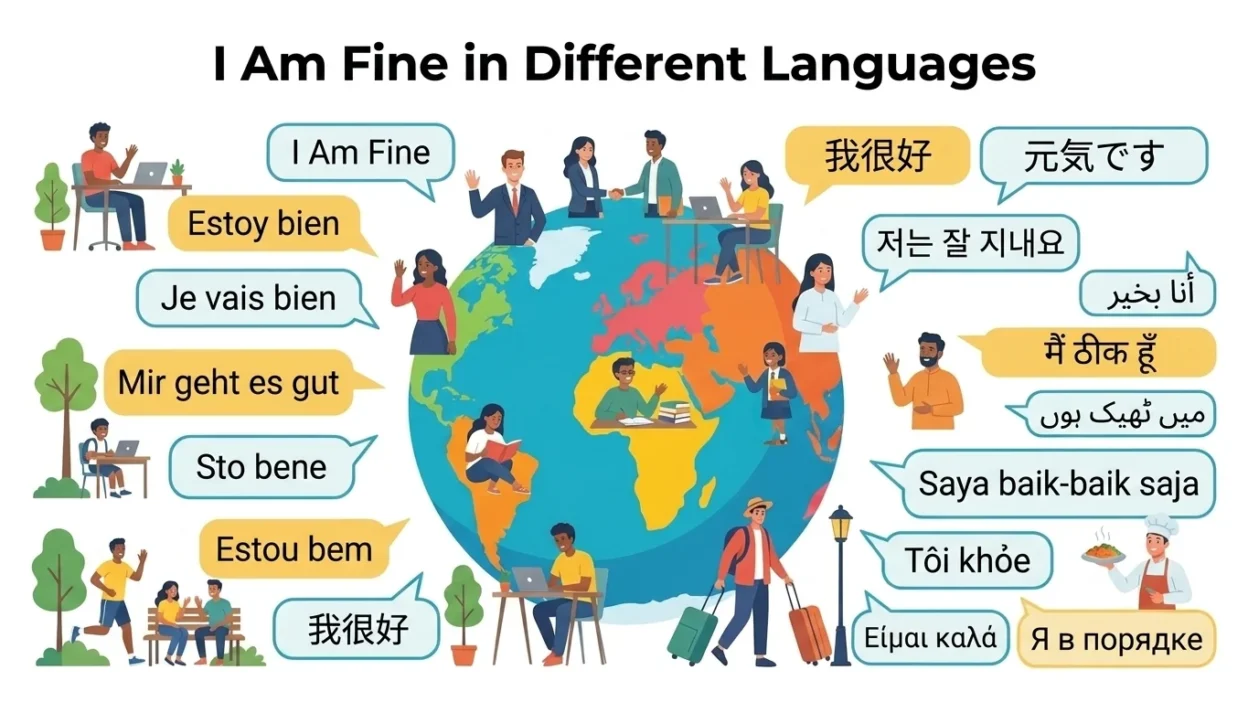
Saying I am fine in different languages is one of the most useful language skills for everyday conversations. Whether someone asks “How are you?”, you’re traveling abroad, or you’re learning a new language, knowing how to respond naturally can help you communicate with confidence.
This guide includes I am fine translations with easy English pronunciations. If you’re searching for I am fine in all languages or how to say I am fine in different languages, this collection is a great place to start.
I Am Fine in Different Languages (1–25)
| Language | Native Phrase | Easy English Pronunciation |
|---|---|---|
| English | I am fine | Eye Am Fine |
| Spanish | Estoy bien | Es-TOY Bee-EN |
| French | Je vais bien | Zhuh Vay Bee-EN |
| German | Mir geht es gut | Meer Gate Es Goot |
| Italian | Sto bene | Sto BEH-neh |
| Portuguese | Estou bem | Es-TOH Beng |
| Dutch | Het gaat goed | Het Gaat Hoot |
| Swedish | Jag mår bra | Yag Mor Bra |
| Norwegian | Jeg har det bra | Yay Har De Bra |
| Danish | Jeg har det godt | Yay Har De Got |
| Finnish | Minä voin hyvin | Mee-na Voyn HOO-vin |
| Icelandic | Mér líður vel | Myer LEE-thur Vel |
| Irish | Tá mé go maith | Taw May Go Mah |
| Welsh | Dw i’n iawn | Doo Een Yine |
| Scottish Gaelic | Tha mi gu math | Ha Mee Goo Mah |
| Polish | Mam się dobrze | Mam Shye DOB-zhe |
| Czech | Mám se dobře | Maam Se DOB-zhe |
| Slovak | Mám sa dobre | Maam Sa DOB-re |
| Slovenian | Dobro sem | DO-bro Sem |
| Croatian | Dobro sam | DO-bro Sam |
| Serbian | Добро сам | DO-bro Sam |
| Bosnian | Dobro sam | DO-bro Sam |
| Romanian | Sunt bine | Soont Bee-ne |
| Hungarian | Jól vagyok | Yol Va-dyok |
| Greek | Είμαι καλά | EE-me Ka-la |
| Language | Native Phrase | Easy English Pronunciation |
|---|---|---|
| Russian | Я в порядке | Ya V Pa-RYAD-ke |
| Ukrainian | У мене все добре | U Me-ne Vse DOB-re |
| Belarusian | У мяне ўсё добра | Oo Mya-nye Usyo Dob-ra |
| Bulgarian | Добре съм | DO-bre Sum |
| Macedonian | Добро сум | DO-bro Sum |
| Albanian | Jam mirë | Yam Meer |
| Turkish | İyiyim | Ee-yee-yim |
| Arabic | أنا بخير | Ana Bi-khair |
| Hebrew | אני בסדר | A-ni Be-SE-der |
| Persian | من خوبم | Man Khoo-bam |
| Kurdish | Ez baş im | Ez Bash Im |
| Hindi | मैं ठीक हूँ | Main Theek Hoon |
| Urdu | میں ٹھیک ہوں | Main Theek Hoon |
| Punjabi | ਮੈਂ ਠੀਕ ਹਾਂ | Main Theek Haan |
| Bengali | আমি ভালো আছি | A-mi Bha-lo A-chi |
| Gujarati | હું મજામાં છું | Hoon Ma-ja-ma Chhoo |
| Marathi | मी ठीक आहे | Mee Theek Aa-he |
| Nepali | म ठिक छु | Ma Theek Chhu |
| Sinhala | මම හොඳින් ඉන්නවා | Ma-ma Hon-din In-na-va |
| Tamil | நான் நலமாக இருக்கிறேன் | Naan Na-la-ma-ga Iruk-ki-ren |
| Telugu | నేను బాగున్నాను | Ne-nu Ba-gun-na-nu |
| Kannada | ನಾನು ಚೆನ್ನಾಗಿದ್ದೇನೆ | Naa-nu Chen-na-gi-dde-ne |
| Malayalam | ഞാൻ സുഖമാണ് | Njaan Su-kha-maan |
| Thai | ฉันสบายดี | Chan Sa-bai Dee |
| Vietnamese | Tôi khỏe | Toy Khoe |
| Language | Native Phrase | Easy English Pronunciation |
|---|---|---|
| Indonesian | Saya baik-baik saja | Sa-ya Ba-ik Ba-ik Sa-ja |
| Malay | Saya sihat | Sa-ya See-hat |
| Filipino (Tagalog) | Mabuti ako | Ma-boo-tee A-ko |
| Chinese (Mandarin) | 我很好 | Wo Hen Hao |
| Japanese | 元気です | Gen-ki Des |
| Korean | 저는 잘 지내요 | Jo-neun Jal Ji-nae-yo |
| Mongolian | Би сайн байна | Bee Sain Bain-a |
| Burmese | ကျွန်တော် နေကောင်းပါတယ် | Kyun-taw Nay-Kaung Par-tal |
| Khmer | ខ្ញុំសុខសប្បាយ | Khnyom Sok Sa-bai |
| Lao | ຂ້ອຍສະບາຍດີ | Khoy Sa-bai Dee |
| Swahili | Niko salama | Nee-ko Sa-la-ma |
| Zulu | Ngiyaphila | Ngee-ya-PHEE-la |
| Afrikaans | Dit gaan goed | Dit Ghan Hoot |
| Amharic | ደህና ነኝ | Deh-na Nen-y |
| Yoruba | Mo wa dada | Mo Wa Da-da |
| Hausa | Ina lafiya | Ee-na La-fi-ya |
| Maori | Kei te pai ahau | Kay Te Pie A-ha-u |
| Hawaiian | Maikaʻi au | My-kai Au |
| Samoan | O lea ua ou manuia | O Leh Ah Oo Ma-noo-ee-a |
| Esperanto | Mi fartas bone | Mee Far-tas BO-neh |
Why Learn “I Am Fine” in Different Languages?
Learning I am fine in different languages is useful for everyday conversations, travel, language learning, and meeting people from around the world. It’s one of the first responses you’ll use after someone asks, “How are you?”
Using the local language can make conversations feel friendlier and shows respect for another person’s culture.
How to Say “I Am Fine” in Different Languages
If you’re searching for how to say I am fine in different languages, practice both the pronunciation and the native writing. Repeating these expressions in daily conversations will help you remember them more easily.
I Am Fine Translations Around the World
These I am fine translations are commonly used in countries across Europe, Asia, Africa, the Americas, and Oceania. While some languages have formal and informal versions, the phrases above are widely understood.
Common Everyday Phrases to Learn
After learning I am fine in different languages, you may also want to learn:
- How are you in different languages
- Good Morning in different languages
- Good Afternoon in different languages
- Good Evening in different languages
- Good Night in different languages
- Thank You in different languages
- I Love You in different languages
Learning these everyday expressions will help you communicate naturally in many situations.
Tips for Remembering These Expressions
- Learn a few phrases every day.
- Listen to native pronunciation.
- Practice with language partners.
- Associate each phrase with its country.
- Review the phrases regularly.
Conclusion
Learning I am fine in different languages is an excellent way to improve your communication skills and build confidence when speaking with people from different cultures. These 70 translations will help you respond naturally wherever you travel or whom you meet.
Frequently Asked Questions
1. How do you say “I am fine” in different languages?
Examples include Estoy bien (Spanish), Je vais bien (French), Mir geht es gut (German), and 我很好 (Wǒ hěn hǎo) in Chinese.
2. Why should I learn “I am fine” in different languages?
It helps you answer one of the most common conversation questions and makes everyday communication easier.
3. Are there formal and informal versions?
Yes. Some languages have different expressions depending on the situation, but the phrases listed here are standard and commonly used.
4. Can I use these phrases while traveling?
Absolutely. They are among the most useful expressions for communicating with native speakers.
5. Are these translations accurate?
Yes. These are standard translations commonly used in everyday conversations, although slight regional differences may exist.
Meta Description:
Learn I am fine in different languages with 70 translations, easy pronunciations, and everyday responses from around the world in one complete guide.