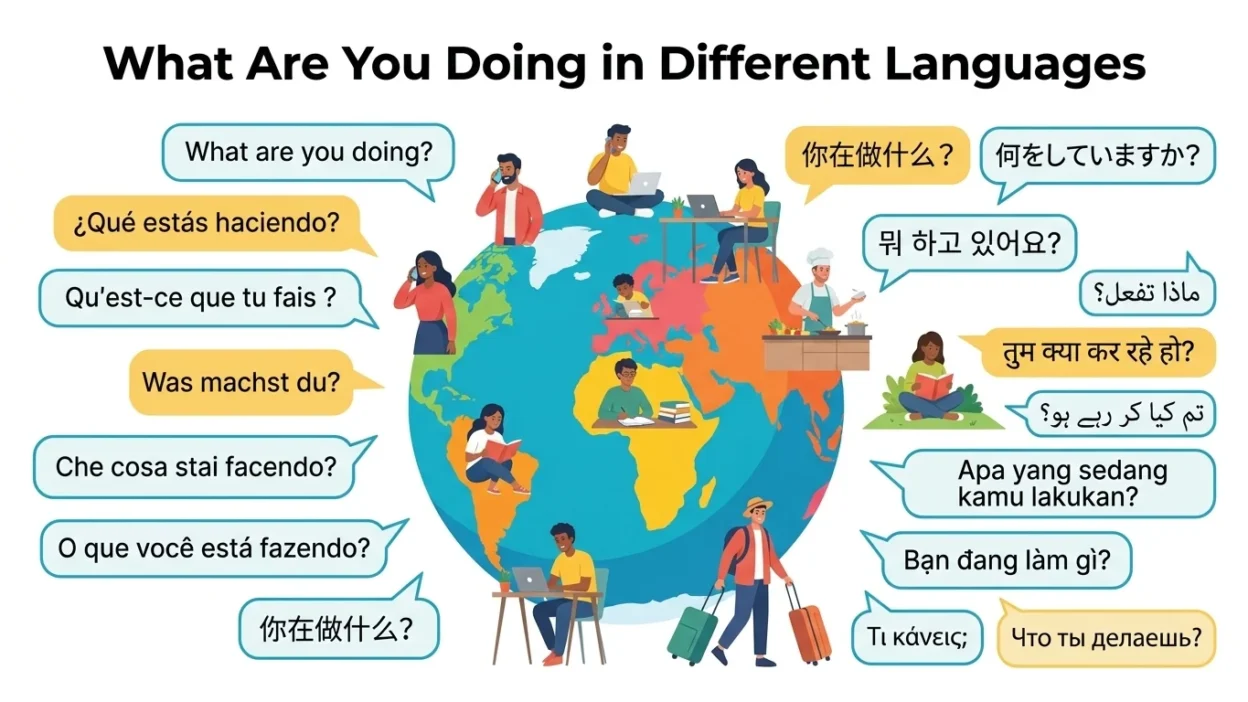
Learning what are you doing in different languages is a fun way to improve your communication skills and connect with people from different cultures. This common question is used every day in casual conversations with friends, family, coworkers, and new acquaintances.
Whether you’re traveling, learning a new language, or simply curious about global expressions, knowing what are you doing translations can help you start conversations naturally and confidently.
What Are You Doing in Different Languages (1–25)
| Language | Native Phrase | Easy English Pronunciation |
|---|---|---|
| English | What are you doing? | What are you DOO-ing |
| Spanish | ¿Qué estás haciendo? | Kay Es-TAS Ah-see-EN-do |
| French | Qu’est-ce que tu fais ? | Kes Kuh Too Fay |
| German | Was machst du? | Vas Mahkhst Doo |
| Italian | Che cosa stai facendo? | Kay KO-za Stai Fa-CHEN-do |
| Portuguese | O que você está fazendo? | O Kay Vo-SE Es-TA Fa-ZEN-do |
| Dutch | Wat ben je aan het doen? | Vat Ben Yeh Aan Het Doon |
| Swedish | Vad gör du? | Vad Yur Doo |
| Norwegian | Hva gjør du? | Hva Yur Doo |
| Danish | Hvad laver du? | Vel LAY-ver Doo |
| Finnish | Mitä sinä teet? | Mee-ta See-na Teet |
| Icelandic | Hvað ertu að gera? | Kvath Er-tu Ath Ge-ra |
| Irish | Cad atá tú ag déanamh? | Kad Ah-taw Too Ag Jay-nav |
| Welsh | Beth wyt ti’n ei wneud? | Beth Ooit Teen Ay Gwayd |
| Scottish Gaelic | Dè tha thu a’ dèanamh? | Jay Ha Hoo A Yen-iv |
| Polish | Co robisz? | Tso RO-bish |
| Czech | Co děláš? | Tso Dye-lash |
| Slovak | Čo robíš? | Cho RO-bish |
| Slovenian | Kaj delaš? | Kai DE-lash |
| Croatian | Što radiš? | Shto RA-dish |
| Serbian | Шта радиш? | Shta RA-dish |
| Bosnian | Šta radiš? | Shta RA-dish |
| Romanian | Ce faci? | Che FA-ch |
| Hungarian | Mit csinálsz? | Mit Chi-NAALS |
| Greek | Τι κάνεις; | Tee KA-nees |
What Are You Doing in Different Languages (26–50)
| Language | Native Phrase | Easy English Pronunciation |
|---|---|---|
| Russian | Что ты делаешь? | Shto Ty DYE-lay-esh |
| Ukrainian | Що ти робиш? | Shcho Ty RO-bysh |
| Belarusian | Што ты робіш? | Shto Ty RO-bish |
| Bulgarian | Какво правиш? | Kak-VO PRA-vish |
| Macedonian | Што правиш? | Shto PRA-vish |
| Albanian | Çfarë po bën? | Chfa-re Po Ben |
| Turkish | Ne yapıyorsun? | Ne Ya-puh-YOR-sun |
| Arabic | ماذا تفعل؟ | Ma-za Taf-al |
| Hebrew | מה אתה עושה? | Ma A-ta O-seh |
| Persian | داری چکار میکنی؟ | Da-ri Che-kar Mi-ko-ni |
| Kurdish | Tu çi dikî? | Too Chi Dee-kee |
| Hindi | तुम क्या कर रहे हो? | Tum Kya Kar Ra-he Ho |
| Urdu | تم کیا کر رہے ہو؟ | Tum Kya Kar Ra-he Ho |
| Punjabi | ਤੁਸੀਂ ਕੀ ਕਰ ਰਹੇ ਹੋ? | Tu-see Kee Kar Ra-he Ho |
| Bengali | তুমি কী করছ? | Tu-mi Kee Kor-cho |
| Gujarati | તમે શું કરી રહ્યા છો? | Ta-me Shu Ka-ri Ra-hya Cho |
| Marathi | तू काय करत आहेस? | Too Kaay Karat Aa-hes |
| Nepali | तिमी के गर्दैछौ? | Ti-mi Ke Gar-dai-chhau |
| Sinhala | ඔයා මොකද කරන්නේ? | O-ya Mo-ka-da Ka-ran-ne |
| Tamil | நீ என்ன செய்கிறாய்? | Nee En-na Sei-ki-raai |
| Telugu | నువ్వు ఏమి చేస్తున్నావు? | Nuv-vu E-mi Ches-tu-na-vu |
| Kannada | ನೀನು ಏನು ಮಾಡುತ್ತಿದ್ದೀಯ? | Nee-nu Ee-nu Maa-du-ti-dee-ya |
| Malayalam | നീ എന്താണ് ചെയ്യുന്നത്? | Nee En-tha-nu Chey-yun-na-thu |
| Thai | คุณกำลังทำอะไร | Khun Gam-lang Tham A-rai |
| Vietnamese | Bạn đang làm gì? | Ban Dang Lam Zee |
| Language | Native Phrase | Easy English Pronunciation |
|---|---|---|
| Indonesian | Apa yang sedang kamu lakukan? | A-pa Yang Se-dang Ka-moo La-ku-kan |
| Malay | Apa yang sedang awak lakukan? | A-pa Yang Se-dang A-wak La-ku-kan |
| Filipino (Tagalog) | Ano ang ginagawa mo? | A-no Ang Gi-na-ga-wa Mo |
| Chinese (Mandarin) | 你在做什么? | Nee Dzai Dzwor Shen-me |
| Japanese | 何をしていますか? | Nani O Shi-tei-mas Ka |
| Korean | 뭐 하고 있어요? | Mwo Ha-go Is-so-yo |
| Mongolian | Чи юу хийж байна? | Chi Yoo Heej Bain-a |
| Burmese | မင်းဘာလုပ်နေလဲ? | Min Bar Loat Nay Le |
| Khmer | អ្នកកំពុងធ្វើអ្វី? | Neak Kom-pong Tver A-vay |
| Lao | ເຈົ້າກຳລັງເຮັດຫຍັງ? | Jao Gam-lang Het Nyang |
| Swahili | Unafanya nini? | Oo-na-fan-ya Nee-nee |
| Zulu | Wenzani? | Wen-ZA-ni |
| Afrikaans | Wat doen jy? | Vat Doon Yay |
| Amharic | ምን እያደረግክ ነው? | Min E-ya-de-regk New |
| Yoruba | Kí ni o ń ṣe? | Kee Nee O Sheh |
| Hausa | Me kake yi? | Meh Ka-kay Yee |
| Maori | Kei te aha koe? | Kay Te A-ha Koy |
| Hawaiian | He aha kāu e hana nei? | Heh A-ha Ka-oo Eh Ha-na Nay |
| Samoan | O le ā lau mea o fai? | O Leh Ah Lau Meh-a O Fai |
| Esperanto | Kion vi faras? | Kee-on Vee Fa-ras |
Why Learn “What Are You Doing?” in Different Languages?
Learning what are you doing in different languages helps you start natural conversations with people around the world. It’s one of the most common everyday questions and is useful when chatting with friends, coworkers, classmates, or family members.
Using this phrase in someone’s native language can make conversations feel more friendly and personal.
How to Say “What Are You Doing?” in Different Languages
If you want to learn how to say what are you doing in different languages, begin by practicing the pronunciation and repeating the phrases regularly. Listening to native speakers and using the question in daily conversations will help improve your fluency.
What Are You Doing Translations Around the World
These what are you doing translations are widely used in Europe, Asia, Africa, the Americas, and Oceania. Some languages have both formal and informal versions, so it’s helpful to learn the one that best fits the situation.
Common Conversation Starters in Different Languages
Many language learners also search for everyday expressions such as:
- Good Morning in Different Languages
- Good Afternoon in Different Languages
- Good Evening in Different Languages
- Good Night in Different Languages
- How Are You in Different Languages
- Thank You in Different Languages
- I Love You in Different Languages
Learning these common phrases makes conversations easier and more natural.
Tips for Remembering These Phrases
- Practice a few languages every day.
- Listen to native pronunciation.
- Use flashcards for review.
- Associate each phrase with its country.
- Practice with native speakers whenever possible.
Conclusion
Learning what are you doing in different languages is an excellent way to improve your language skills and communicate with people from different cultures. These 70 translations will help you start conversations confidently whether you’re traveling, studying, or making new international friends.
Frequently Asked Questions
1. How do you say “What are you doing?” in different languages?
Examples include ¿Qué estás haciendo? (Spanish), Qu’est-ce que tu fais ? (French), Was machst du? (German), and 你在做什么? (Chinese).
2. Why should I learn this phrase?
It is one of the most commonly used conversation starters and helps you communicate naturally in everyday situations.
3. Is this phrase formal or informal?
It depends on the language. Some languages have separate formal and informal versions, while others use one phrase in most situations.
4. Can I use these phrases while traveling?
Yes. Asking someone what they are doing in their native language can be a friendly way to begin a conversation.
5. Are these translations accurate?
Yes. These are standard, commonly used expressions, though some regions may have slight variations.
.