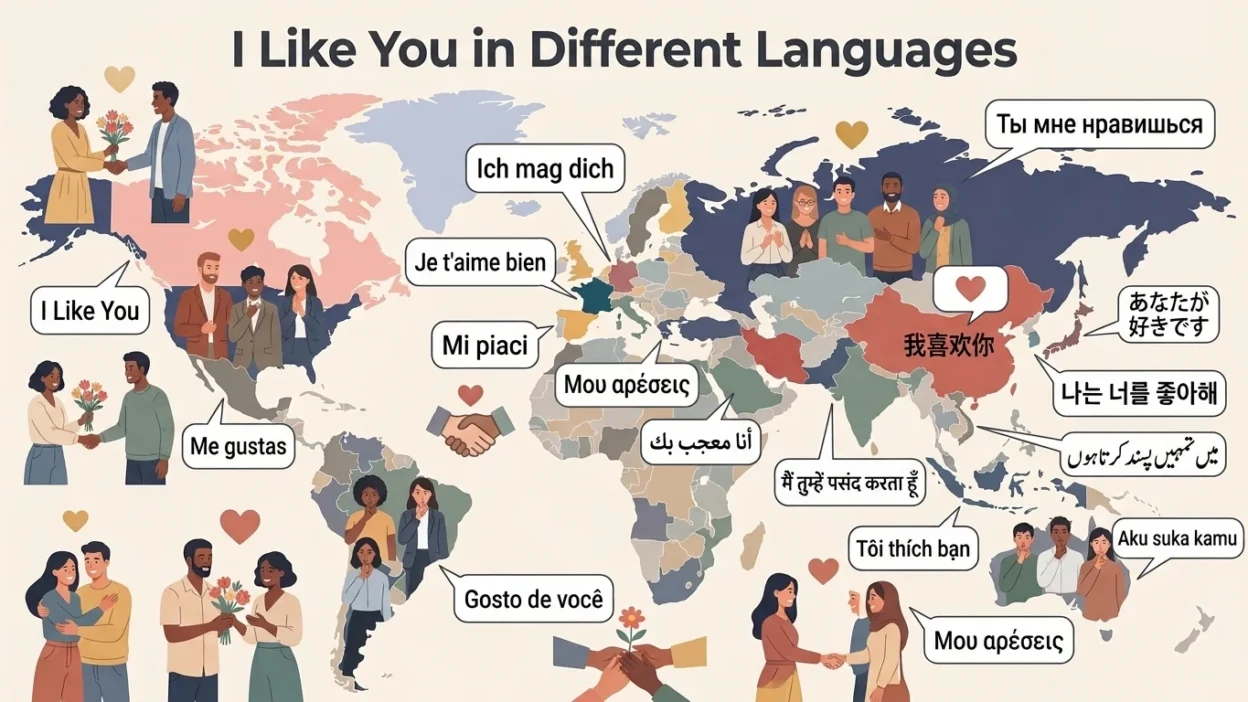
Saying I like you in different languages is a wonderful way to express friendship, admiration, or romantic interest. Whether you’re learning a new language, traveling, or sending a heartfelt message, knowing how to say “I like you” in multiple languages can help you connect with people from different cultures.
This guide features I like you translations with easy English pronunciations. If you’re searching for I like you in all languages or how to say I like you in different languages, this collection is the perfect place to start.
I Like You in Different Languages (1–25)
| Language | Native Phrase | Easy English Pronunciation |
|---|---|---|
| English | I like you | Eye Like You |
| Spanish | Me gustas | Meh GOOS-tas |
| French | Je t’aime bien | Zhuh Tem Bee-EN |
| German | Ich mag dich | Ikh Mahg Dikh |
| Italian | Mi piaci | Mee PYA-chee |
| Portuguese | Gosto de você | GOS-to De Vo-seh |
| Dutch | Ik vind je leuk | Ik Vint Yeh Lurk |
| Swedish | Jag gillar dig | Yag YIL-lar Day |
| Norwegian | Jeg liker deg | Yay LEE-ker Die |
| Danish | Jeg kan lide dig | Yay Kan Lee-the Die |
| Finnish | Minä pidän sinusta | Mee-na Pee-dan See-noos-ta |
| Icelandic | Mér líkar við þig | Myer Lee-kar Vith Thig |
| Irish | Is maith liom thú | Iss Mah Lum Hoo |
| Welsh | Rwy’n dy hoffi di | Roo-in Dee HOFF-ee Dee |
| Scottish Gaelic | Is toil leam thu | Iss Tol Lyam Hoo |
| Polish | Lubię cię | LOO-bye Cheh |
| Czech | Mám tě rád | Maam Tye Raad |
| Slovak | Mám ťa rád | Maam Tya Raad |
| Slovenian | Všeč si mi | Vshech See Mee |
| Croatian | Sviđaš mi se | Svee-jash Mee Seh |
| Serbian | Свиђаш ми се | Svee-jash Mee Seh |
| Bosnian | Sviđaš mi se | Svee-jash Mee Seh |
| Romanian | Te plac | Teh Plak |
| Hungarian | Kedvellek | Ked-vel-lek |
| Greek | Μου αρέσεις | Moo A-RE-sis |
| anguage | Native Phrase | Easy English Pronunciation |
|---|
| Russian | Ты мне нравишься | Ty Mne NRAV-ish-sya |
| Ukrainian | Ти мені подобаєшся | Ty Me-ni Po-do-BA-yesh-sya |
| Belarusian | Ты мне падабаешся | Ty Mne Pa-da-BA-yesh-sya |
| Bulgarian | Харесвам те | Ha-RES-vam Te |
| Macedonian | Ми се допаѓаш | Mee Se Do-PAJ-ash |
| Albanian | Më pëlqen | Muh PEL-chen |
| Turkish | Senden hoşlanıyorum | Sen-den Hosh-la-NI-yo-rum |
| Arabic | أنا معجب بك | Ana Mu’jab Bik |
| Hebrew | אני מחבב אותך | A-ni Me-ha-VEV Ot-kha |
| Persian | ازت خوشم میاد | A-zat Khosham Mi-yad |
| Kurdish | Ez ji te hez dikim | Ez Ji Te Hez Di-kim |
| Hindi | मैं तुम्हें पसंद करता हूँ | Main Tum-hen Pa-sand Kar-ta Hoon |
| Urdu | میں تمہیں پسند کرتا ہوں | Main Tum-hain Pa-sand Kar-ta Hoon |
| Punjabi | ਮੈਂ ਤੈਨੂੰ ਪਸੰਦ ਕਰਦਾ ਹਾਂ | Main Tai-nu Pa-sand Kar-da Haan |
| Bengali | আমি তোমাকে পছন্দ করি | A-mi To-ma-ke Po-chon-do Ko-ri |
| Gujarati | હું તને પસંદ કરું છું | Hoon Ta-ne Pa-sand Ka-run Chhoo |
| Marathi | मला तू आवडतोस | Ma-la Too Aa-vad-tos |
| Nepali | मलाई तिमी मन पर्छ | Ma-lai Ti-mi Man Par-cha |
| Sinhala | මම ඔයාට කැමතියි | Ma-ma O-ya-ta Ka-ma-ti-yi |
| Tamil | நான் உன்னை விரும்புகிறேன் | Naan Un-nai Vi-rum-bu-gi-ren |
| Telugu | నేను నిన్ను ఇష్టపడుతున్నాను | Ne-nu Nin-nu Ish-ta-pa-du-tun-na-nu |
| Kannada | ನಾನು ನಿನ್ನನ್ನು ಇಷ್ಟಪಡುತ್ತೇನೆ | Naa-nu Nin-na-nnu Ish-ta-pa-du-tte-ne |
| Malayalam | എനിക്ക് നിന്നെ ഇഷ്ടമാണ് | E-ni-kku Nin-ne Ish-ta-maan |
| Thai | ฉันชอบคุณ | Chan Chop Khun |
| Vietnamese | Tôi thích bạn | Toy Thik Ban |
| Language | Native Phrase | Easy English Pronunciation |
|---|---|---|
| Indonesian | Aku suka kamu | Ah-koo Soo-ka Ka-moo |
| Malay | Saya suka awak | Sa-ya Soo-ka A-wak |
| Filipino (Tagalog) | Gusto kita | Goo-sto Kee-ta |
| Chinese (Mandarin) | 我喜欢你 | Wo Shi-Hwan Nee |
| Japanese | あなたが好きです | A-na-ta Ga Su-ki Des |
| Korean | 나는 너를 좋아해 | Na-neun Neo-reul Jo-a-hae |
| Mongolian | Чи надад таалагддаг | Chi Na-dad Taa-lag-dag |
| Burmese | မင်းကို သဘောကျတယ် | Min-go Tha-baw Kyae-tal |
| Khmer | ខ្ញុំចូលចិត្តអ្នក | Khnyom Jol-jet Neak |
| Lao | ຂ້ອຍມັກເຈົ້າ | Khoy Mak Jao |
| Swahili | Nakupenda | Na-koo-PEN-da |
| Zulu | Ngiyakuthanda | Ngee-ya-koo-THAN-da |
| Afrikaans | Ek hou van jou | Ek How Fan Yo |
| Amharic | እወድሃለሁ | Eh-we-de-ha-le-hu |
| Yoruba | Mo fẹ́ràn rẹ | Mo Feh-ran Reh |
| Hausa | Ina son ka | Ee-na Son Ka |
| Maori | He pai ki ahau koe | He Pie Kee A-ha-u Koy |
| Hawaiian | Makemake au iā ʻoe | Ma-ka-me-keh Ow Ee-ah O-eh |
| Samoan | Ou te fiafia ia te oe | Oo Te Fia-fia Ee-a Te O-eh |
| Esperanto | Mi ŝatas vin | Mee Sha-tas Veen |
Why Learn “I Like You” in Different Languages?
Learning I like you in different languages is a great way to express friendship, admiration, or affection across cultures. Whether you’re making new friends, learning languages, or traveling, knowing this phrase helps create meaningful connections.
How to Say “I Like You” in Different Languages
If you’re searching for how to say I like you in different languages, practice both the pronunciation and the native script. This helps you speak more naturally and confidently.
I Like You Translations Around the World
These I like you translations are commonly used across Europe, Asia, Africa, the Americas, and Oceania. Some languages have different expressions depending on whether the feeling is friendly or romantic, but the phrases listed above are widely understood.
Related Romantic and Friendly Phrases
After learning I like you in different languages, you may also want to learn:
- I Love You in Different Languages
- Miss You in Different Languages
- Thank You in Different Languages
- Good Morning in Different Languages
- Have a Nice Day in Different Languages
- Happy Birthday in Different Languages
Learning these expressions helps you communicate warmly in many situations.
Tips for Using These Expressions
- Pay attention to pronunciation.
- Learn when the phrase is used casually or romantically.
- Practice with native speakers.
- Respect cultural differences.
- Use the expression sincerely and naturally.
Conclusion
Learning I like you in different languages is a fun way to express appreciation and build relationships with people around the world. These 70 translations will help you communicate your feelings in a thoughtful and culturally respectful way.
Frequently Asked Questions
1. How do you say “I like you” in different languages?
Examples include Me gustas (Spanish), Je t’aime bien (French), Ich mag dich (German), and 我喜欢你 (Wǒ xǐhuān nǐ) in Chinese.
2. Is “I like you” the same as “I love you”?
Not always. In many languages, “I like you” expresses affection or interest without being as strong as “I love you.”
3. Can I use these phrases while traveling?
Yes. They are useful for language learning and understanding conversations, but use them appropriately depending on the situation.
4. Are these translations accurate?
Yes. These are common everyday expressions, though slight regional differences may exist.
5. Should I learn the pronunciation too?
Absolutely. Correct pronunciation helps native speakers understand you and makes your communication more natural.