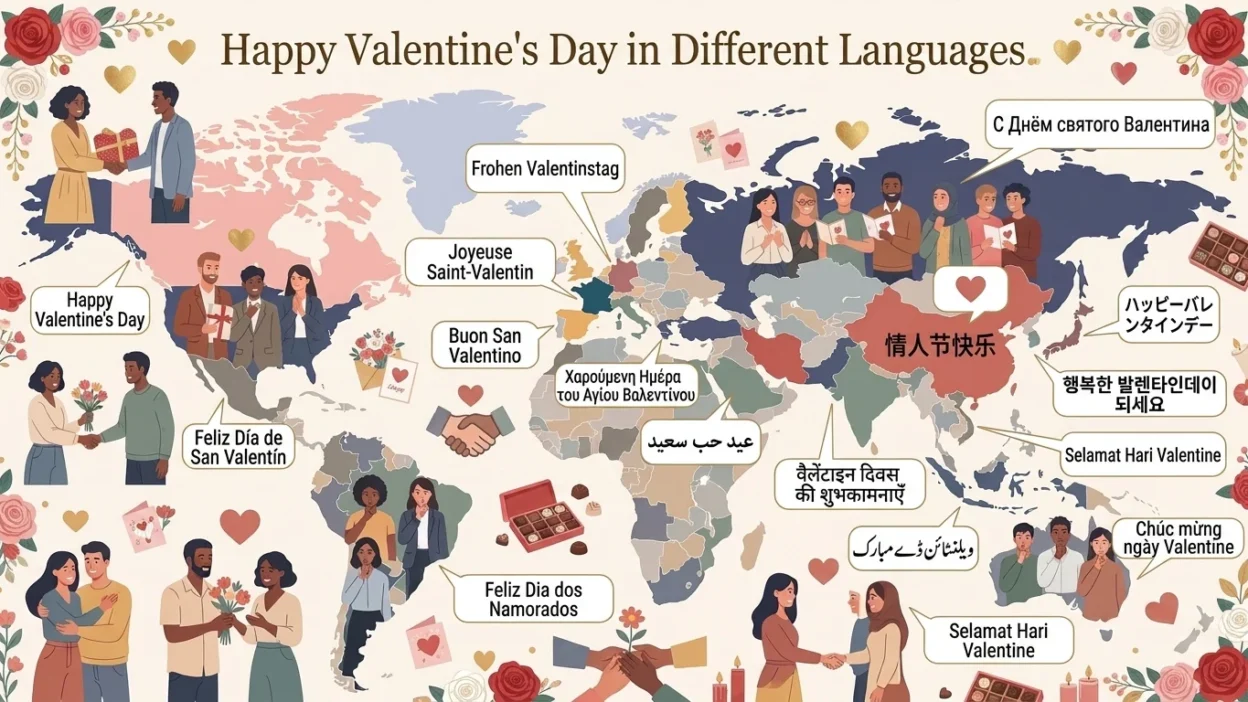
Saying Happy Valentine’s Day in different languages is a heartfelt way to celebrate love, friendship, and appreciation across cultures. Whether you’re writing a Valentine’s card, sending a romantic text, or learning a new language, knowing how to wish someone a happy Valentine’s Day in their native language makes your message even more special.
This guide features Happy Valentine’s Day translations with easy English pronunciations. If you’re searching for Happy Valentine’s Day in all languages or how to say Happy Valentine’s Day in different languages, this collection is the perfect place to begin.
Happy Valentine’s Day in Different Languages (1–25)
| Language | Native Phrase | Easy English Pronunciation |
|---|---|---|
| English | Happy Valentine’s Day | HAP-ee VAL-en-tines Day |
| Spanish | Feliz Día de San Valentín | Feh-LEEZ DEE-a De San Va-len-TEEN |
| French | Joyeuse Saint-Valentin | Zhwa-YUZ San Val-on-TAN |
| German | Frohen Valentinstag | FRO-en Va-len-TEENS-tag |
| Italian | Buon San Valentino | Bwon San Va-len-TEE-no |
| Portuguese | Feliz Dia dos Namorados | Feh-LEEZ DEE-a Dos Na-mo-RA-dos |
| Dutch | Fijne Valentijnsdag | FINE-uh Va-len-TINES-dakh |
| Swedish | Glad Alla hjärtans dag | Glad AL-la YER-tans Dag |
| Norwegian | God Valentinsdag | Good Va-len-TEENS-dag |
| Danish | Glædelig Valentinsdag | GLEH-de-lig Va-len-TEENS-dag |
| Finnish | Hyvää ystävänpäivää | HOO-vaa OOS-ta-van Pie-va |
| Icelandic | Gleðilegan Valentínusardag | GLETH-i-le-gan Va-len-TEE-noos-ar-dag |
| Irish | Lá Fhéile Vailintín sona duit | Law AY-la Va-lin-TEEN So-na Gwitch |
| Welsh | Dydd Santes Dwynwen Hapus | Deeth SAN-tes DWIN-wen HAP-is |
| Scottish Gaelic | Latha Fhèill Bhalaintìona sona | La-ha AYL Va-lan-TEE-na So-na |
| Polish | Szczęśliwych Walentynek | Shchen-SHLEE-vikh Va-len-TI-nek |
| Czech | Šťastného Valentýna | SHTYAST-ne-ho Va-len-TEE-na |
| Slovak | Šťastného Valentína | SHTYAST-ne-ho Va-len-TEE-na |
| Slovenian | Srečno valentinovo | SRECH-no Va-len-TEE-no-vo |
| Croatian | Sretno Valentinovo | SRET-no Va-len-TEE-no-vo |
| Serbian | Срећно Валентиново | SRET-no Va-len-TEE-no-vo |
| Bosnian | Sretno Valentinovo | SRET-no Va-len-TEE-no-vo |
| Romanian | La mulți ani de Ziua Îndrăgostiților | La MOOLTS An De ZEE-wa In-dra-gos-ti-TOR |
| Hungarian | Boldog Valentin-napot | BOL-dog Va-len-TEEN Na-pot |
| Greek | Χαρούμενη Ημέρα του Αγίου Βαλεντίνου | Ha-ROO-me-ni I-ME-ra Too A-yee-ou Va-len-TEE-noo |
| Language | Native Phrase | Easy English Pronunciation |
| Russian | С Днём святого Валентина | S Dnyom Svyatogo Va-len-TEE-na |
| Ukrainian | З Днем святого Валентина | Z Dnem Svyatogo Va-len-TEE-na |
| Belarusian | З Днём святога Валянціна | Z Dnyom Svyatoga Va-lyan-TSEE-na |
| Bulgarian | Честит Свети Валентин | Ches-TEET Sve-TEE Va-len-TEEN |
| Macedonian | Среќен Свети Валентин | SRE-ken Sve-TEE Va-len-TEEN |
| Albanian | Gëzuar Ditën e Shën Valentinit | Geh-ZOO-ar Dee-ten Eh Shen Va-len-TEE-neet |
| Turkish | Mutlu Sevgililer Günü | MOOT-loo Sev-gi-li-ler Goo-noo |
| Arabic | عيد حب سعيد | Eid Hubb Sa-eed |
| Hebrew | יום ולנטיין שמח | Yom Va-len-tine Sa-me-ach |
| Persian | روز ولنتاین مبارک | Rooz Va-len-tine Mo-ba-rak |
| Kurdish | Roja Evîndaran Pîroz Be | Ro-zha Eh-vin-da-ran Pee-ROZ Beh |
| Hindi | वैलेंटाइन दिवस की शुभकामनाएँ | Vai-len-tine Di-vas Ki Shubh-Kaam-na-ye |
| Urdu | ویلنٹائن ڈے مبارک | Valentine Day Mubarak |
| Punjabi | ਵੈਲਨਟਾਈਨ ਡੇ ਮੁਬਾਰਕ | Valentine Day Mubarak |
| Bengali | শুভ ভ্যালেন্টাইনস ডে | Shubho Va-len-tines Day |
| Gujarati | વેલેન્ટાઇન ડે મુબારક | Valentine Day Mubarak |
| Marathi | व्हॅलेंटाइन डेच्या शुभेच्छा | Valentine Day-chya Shu-bhech-cha |
| Nepali | भ्यालेन्टाइन डे को शुभकामना | Bhya-len-tine Day Ko Shubh-Kaam-na |
| Sinhala | සුභ වැලන්ටයින් දිනයක් | Suba Va-len-tine Di-na-yak |
| Tamil | இனிய காதலர் தின வாழ்த்துகள் | Ini-ya Kaa-tha-lar Di-na Vaal-thu-kal |
| Telugu | ప్రేమికుల దినోత్సవ శుభాకాంక్షలు | Pre-mi-ku-la Di-no-tsa-va Shu-bha-Kaank-sha-lu |
| Kannada | ಪ್ರೇಮಿಗಳ ದಿನದ ಶುಭಾಶಯಗಳು | Pre-mi-ga-la Di-na-da Shu-bhaa-sha-ya-ga-lu |
| Malayalam | പ്രണയദിനാശംസകൾ | Pra-na-ya-di-na Aasham-sa-kal |
| Thai | สุขสันต์วันวาเลนไทน์ | Sook-san Wan Va-len-tine |
| Vietnamese | Chúc mừng ngày Valentine | Chook Mung Ngai Va-len-tine |
| Language | Native Phrase | Easy English Pronunciation |
|---|---|---|
| Indonesian | Selamat Hari Valentine | Se-LA-mat Ha-ree Va-len-tine |
| Malay | Selamat Hari Valentine | Se-LA-mat Ha-ree Va-len-tine |
| Filipino (Tagalog) | Maligayang Araw ng mga Puso | Ma-li-GA-yang A-raw Nang Ma-ga Poo-so |
| Chinese (Mandarin) | 情人节快乐 | Ching Ren Jyeh Kuai Le |
| Japanese | ハッピーバレンタインデー | Hap-pii Ba-ren-tain Dee |
| Korean | 행복한 발렌타인데이 되세요 | Haeng-bok-han Bal-len-ta-in De-i Dwe-se-yo |
| Mongolian | Гэгээн Валентины өдрийн мэнд | Ge-gen Va-len-ti-ni Ud-rin Mend |
| Burmese | ပျော်ရွှင်ဖွယ် ချစ်သူများနေ့ | Pyaw-shwin Phwel Chit-thu Myar Nay |
| Khmer | រីករាយថ្ងៃនៃក្តីស្រឡាញ់ | Ree-ka-ray Thngai Nei Kdei Sralanh |
| Lao | ສຸກສັນວັນວາເລນທາຍ | Sook-san Wan Va-len-tai |
| Swahili | Heri ya Siku ya Wapendanao | He-ri Ya See-koo Ya Wa-pen-da-na-o |
| Zulu | Usuku Oluhle Lwezithandani | Oo-soo-koo O-loo-hleh Lwe-zi-than-da-ni |
| Afrikaans | Gelukkige Valentynsdag | Ghe-LUK-khe-gha Va-len-tines-dakh |
| Amharic | መልካም የቫለንታይን ቀን | Mel-kam Ye Va-len-tine Ken |
| Yoruba | E ku ọjọ Valentine | Eh Koo O-jo Va-len-tine |
| Hausa | Barka da Ranar Valentine | Bar-ka Da Ra-nar Va-len-tine |
| Maori | Hari o te Rā o Valentine | Ha-ree O Te Raa O Va-len-tine |
| Hawaiian | Hauʻoli Lā Valentine | How-o-li Lah Va-len-tine |
| Samoan | Manuia le Aso o Valentine | Ma-noo-ee-a Le A-so O Va-len-tine |
| Esperanto | Feliĉan Sankt-Valentena Tagon | Fe-LEE-chan Sankt Va-len-TE-na Ta-gon |
Why Learn “Happy Valentine’s Day” in Different Languages?
Learning Happy Valentine’s Day in different languages is a thoughtful way to express love, appreciation, and friendship across cultures. Whether you’re sending a romantic message, writing a greeting card, or celebrating with someone from another country, using their native language makes your wishes feel more personal.
How to Say Happy Valentine’s Day in Different Languages
If you’re searching for how to say Happy Valentine’s Day in different languages, practice both the pronunciation and the native script. Even a simple greeting in another language can make Valentine’s Day more memorable.
Happy Valentine’s Day Translations Around the World
These Happy Valentine’s Day translations are commonly used in many countries across Europe, Asia, Africa, the Americas, and Oceania. While Valentine’s Day traditions vary by culture, these greetings are widely understood.
Related Love and Celebration Phrases
After learning Happy Valentine’s Day in different languages, you may also enjoy learning:
- I Love You in Different Languages
- I Like You in Different Languages
- Happy Birthday in Different Languages
- Merry Christmas in Different Languages
- Happy New Year in Different Languages
- Thank You in Different Languages
Learning these expressions helps you communicate warmly during holidays and special occasions.
Tips for Using Valentine’s Greetings
- Practice the pronunciation before sending your greeting.
- Match the greeting to the recipient’s language.
- Use the native script whenever possible.
- Pair the greeting with a heartfelt message.
- Respect cultural traditions and customs.
Conclusion
Learning Happy Valentine’s Day in different languages is a meaningful way to celebrate love and friendship around the world. These 70 translations help you send heartfelt wishes that are thoughtful, memorable, and culturally respectful.
Frequently Asked Questions
1. How do you say “Happy Valentine’s Day” in different languages?
Examples include Feliz Día de San Valentín (Spanish), Joyeuse Saint-Valentin (French), Frohen Valentinstag (German), and 情人节快乐 (Qíngrénjié kuàilè) in Chinese.
2. Is Valentine’s Day celebrated worldwide?
Many countries celebrate Valentine’s Day, although traditions and customs vary from place to place.
3. Can I use these greetings in cards and messages?
Yes. These phrases are perfect for greeting cards, text messages, emails, and social media posts.
4. Are these translations accurate?
Yes. They are standard greetings commonly used by native speakers, though minor regional variations may exist.
5. Why learn Valentine’s greetings in other languages?
Learning these greetings helps you connect with people from different cultures and make your messages more personal.