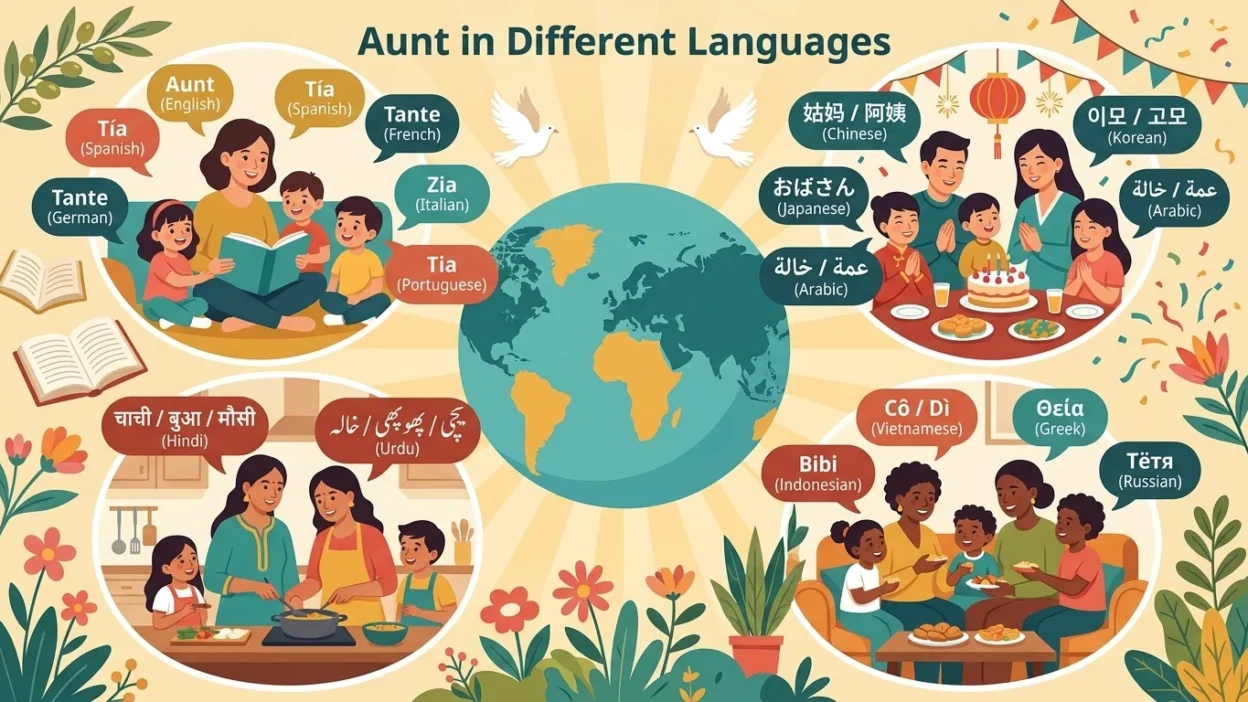
The word aunt is one of the most common family relationship terms used across cultures. Learning aunt in different languages is useful for travelers, students, language learners, and anyone interested in expanding their everyday vocabulary.
This guide includes aunt translations with easy English pronunciations. If you’re searching for aunt in all languages or how to say aunt in different languages, this collection is the perfect place to begin.
Aunt in Different Languages (1–25)
| Language | Native Word | Easy English Pronunciation |
|---|---|---|
| English | Aunt | Ant |
| Spanish | Tía | TEE-ah |
| French | Tante | TAHNT |
| German | Tante | TAHN-tuh |
| Italian | Zia | TSEE-ah |
| Portuguese | Tia | TEE-ah |
| Dutch | Tante | TAHN-tuh |
| Swedish | Moster / Faster | MOS-ter / FAS-ter |
| Norwegian | Tante | TAHN-tuh |
| Danish | Tante | TAHN-tuh |
| Finnish | Täti | TAA-tee |
| Icelandic | Frænka | FRINE-ka |
| Irish | Aintín | An-TEEN |
| Welsh | Modryb | MOD-rib |
| Scottish Gaelic | Piuthar-màthar | PYOO-ar VAA-har |
| Polish | Ciocia | CHO-cha |
| Czech | Teta | TEH-ta |
| Slovak | Teta | TEH-ta |
| Slovenian | Teta | TEH-ta |
| Croatian | Teta | TEH-ta |
| Serbian | Тетка | TET-ka |
| Bosnian | Tetka | TET-ka |
| Romanian | Mătușă | Muh-TOO-sha |
| Hungarian | Néni | NAY-nee |
| Greek | Θεία | Thee-AH |
| Language | Native Word | Easy English Pronunciation |
|---|---|---|
| Russian | Тётя | TYO-tya |
| Ukrainian | Тітка | TEET-ka |
| Belarusian | Цётка | TSYOT-ka |
| Bulgarian | Леля | LEH-lya |
| Macedonian | Тетка | TET-ka |
| Albanian | Hallë / Teze | HAL-luh / TEH-zeh |
| Turkish | Teyze / Hala | TAY-zeh / HA-la |
| Arabic | عمة / خالة | Am-mah / KHA-la |
| Hebrew | דודה | Do-dah |
| Persian | عمه / خاله | Am-meh / Kha-leh |
| Kurdish | Xaltî / Apê | Khal-tee / A-pay |
| Hindi | चाची / बुआ / मौसी | Cha-chee / Boo-ah / Mau-see |
| Urdu | چچی / پھوپھی / خالہ | Cha-chee / Phoo-phee / Kha-la |
| Punjabi | ਚਾਚੀ / ਭੂਆ / ਮਾਸੀ | Cha-chee / Bhoo-ah / Maa-see |
| Bengali | পিসি / মাসি | Pee-shee / Maa-shee |
| Gujarati | કાકી / ફોઈ / માસી | Kaa-kee / Foi / Maa-see |
| Marathi | काकू / आत्या / मावशी | Kaa-koo / Aa-tya / Maav-shee |
| Nepali | काकी / फुपू / माइजु | Kaa-kee / Phoo-poo / My-zoo |
| Sinhala | නැන්දා | Nen-daa |
| Tamil | அத்தை / சித்தி | Ath-thai / Sith-thee |
| Telugu | అత్త / పిన్ని | At-ta / Pin-nee |
| Kannada | ಅತ್ತೆ / ಚಿಕ್ಕಮ್ಮ | At-te / Chik-kam-ma |
| Malayalam | അമ്മായി | Am-maa-yee |
| Thai | ป้า / น้า | Paa / Naa |
| Vietnamese | Cô / Dì | Koh / Yee |
| Language | Native Word | Easy English Pronunciation |
|---|---|---|
| Indonesian | Bibi | Bee-bee |
| Malay | Mak Cik | Mak Cheek |
| Filipino (Tagalog) | Tita | Tee-ta |
| Chinese (Mandarin) | 姑妈 / 阿姨 | Goo Ma / Ah Yee |
| Japanese | おばさん | O-ba-san |
| Korean | 이모 / 고모 | Ee-mo / Go-mo |
| Mongolian | Авга эгч | Av-ga Ech |
| Burmese | အဒေါ် | Ah-daw |
| Khmer | មីង | Meeng |
| Lao | ປ້າ | Paa |
| Swahili | Shangazi | Shan-GAH-zee |
| Zulu | Umalumekazi | Oo-ma-loo-meh-KAH-zee |
| Afrikaans | Tante | TAN-tuh |
| Amharic | አክስት | Ak-sit |
| Yoruba | Anti | AN-tee |
| Hausa | Goggo | GOG-go |
| Maori | Whaea Kēkē | Fa-eh-ah Kay-kay |
| Hawaiian | ʻAnake | Ah-NAH-keh |
| Samoan | Aunty | Ahn-tee |
| Esperanto | Onklino | On-KLEE-no |
Why Learn “Aunt” in Different Languages?
Learning aunt in different languages helps you communicate naturally with people from different cultures and understand family relationships around the world. It’s especially useful for travelers, language learners, and those with multicultural families.
How to Say “Aunt” in Different Languages
If you’re searching for how to say aunt in different languages, remember that some languages use different words depending on whether the aunt is from your mother’s or father’s side of the family.
Aunt Translations Around the World
These aunt translations are commonly used across Europe, Asia, Africa, the Americas, and Oceania. In many Asian and Middle Eastern languages, there are separate terms for maternal and paternal aunts, reflecting the importance of family relationships.
Related Family Vocabulary
After learning aunt in different languages, you may also want to learn:
- Uncle in Different Languages
- Mother in Different Languages
- Father in Different Languages
- Sister in Different Languages
- Brother in Different Languages
- Cousin in Different Languages
Tips for Learning Family Words
- Learn maternal and paternal family terms separately where applicable.
- Practice the pronunciation regularly.
- Use family vocabulary in simple conversations.
- Listen to native speakers to improve accuracy.
- Review commonly used family terms together.
Conclusion
Learning aunt in different languages helps you build practical vocabulary for everyday conversations and understand family relationships across cultures. These 70 translations are valuable for students, travelers, and anyone interested in learning new languages.
Frequently Asked Questions
1. How do you say “aunt” in different languages?
Examples include Tía (Spanish), Tante (French and German), Zia (Italian), 阿姨 (Āyí) (Chinese), and おばさん (Obasan) (Japanese).
2. Do all languages use one word for aunt?
No. Many languages, including Arabic, Hindi, Urdu, Chinese, Korean, and Turkish, use different words depending on whether the aunt is from the mother’s or father’s side.
3. Why do some languages have multiple words for aunt?
Many cultures distinguish relatives based on family lineage, making relationships more specific and respectful.
4. Are these translations commonly used?
Yes. These are standard family terms widely used by native speakers, though some regional variations exist.
5. What should I learn after family words?
You can continue with words like uncle, grandmother, grandfather, cousin, niece, and nephew to expand your family-related vocabulary.