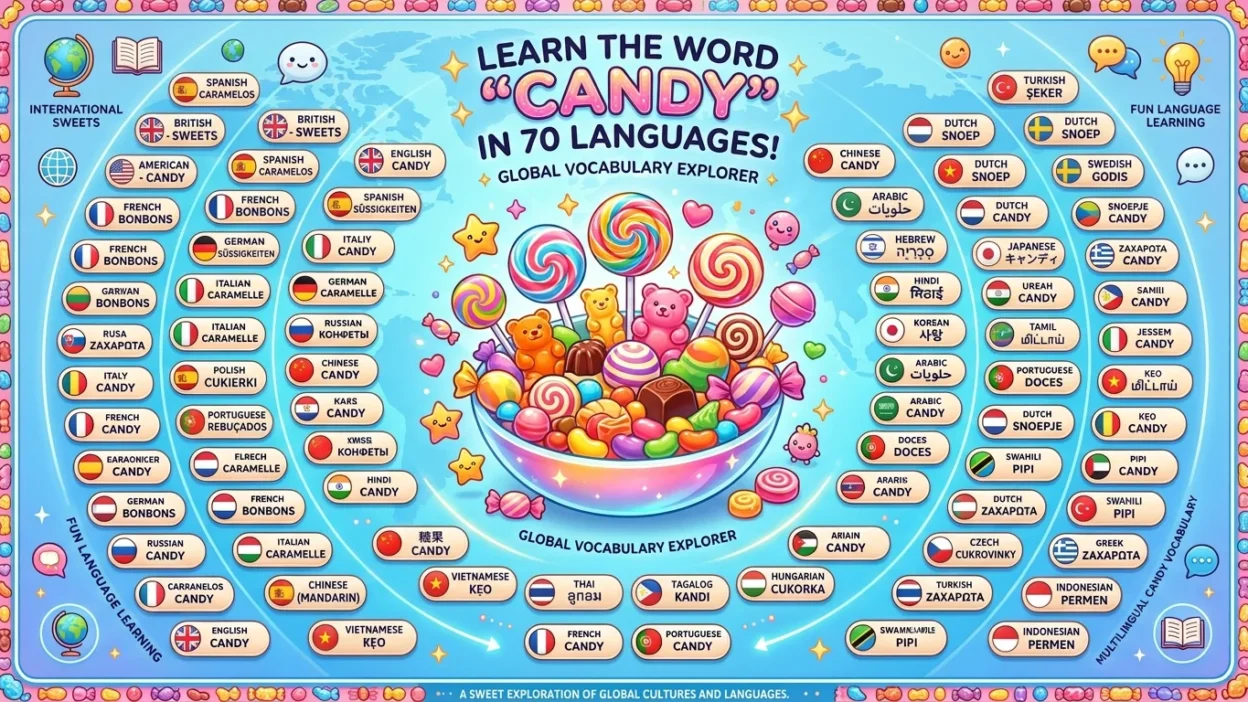
Have you ever wondered how to say “candy” in different languages? Candy is a popular sweet treat enjoyed around the world, but the word used for it can vary from one language and region to another.
In some languages, the translation means candy, sweets, or confectionery, while others use a word that refers more specifically to a particular type of sweet. Here are 70 translations of “candy” with easy English pronunciations.
Candy in 70 Languages
| Language | Native Word | Easy English Pronunciation |
|---|---|---|
| English | Candy | KAN-dee |
| Spanish | Caramelo | Kah-rah-MEH-loh |
| French | Bonbon | Bohn-BOHN |
| German | Süßigkeit | ZOOS-ig-kite |
| Italian | Caramella | Kah-rah-MEL-lah |
| Portuguese | Doce | DOH-seh |
| Dutch | Snoep | SNOOP |
| Swedish | Godis | GOO-dis |
| Norwegian | Godteri | GOO-teh-ree |
| Danish | Slik | SLEEK |
| Finnish | Karkki | KAR-kee |
| Icelandic | Nammi | NAHM-mee |
| Irish | Milseán | MIL-shawn |
| Welsh | Melysion | Meh-LUSS-yohn |
| Scottish Gaelic | Siùcairean | SHOO-kir-an |
| Polish | Cukierek | Tsoo-KYEH-rek |
| Czech | Bonbón | BOM-bohn |
| Slovak | Cukrík | TSOOK-reek |
| Slovenian | Bonbon | BOM-bon |
| Croatian | Bombon | BOM-bon |
| Serbian | Бомбона | BOM-boh-na |
| Bosnian | Bombona | BOM-boh-na |
| Romanian | Bomboană | Bom-BOAH-nuh |
| Hungarian | Cukorka | TSOO-kor-kah |
| Greek | Καραμέλα | Kah-rah-MEH-lah |
| Language | Native Word | Easy English Pronunciation |
|---|---|---|
| Russian | Конфета | Kan-FYEH-ta |
| Ukrainian | Цукерка | Tsoo-KER-kah |
| Belarusian | Цукерка | Tsoo-KYER-kah |
| Bulgarian | Бонбон | Bon-BON |
| Macedonian | Бонбона | Bon-BOH-nah |
| Albanian | Karamele | Kah-rah-MEH-leh |
| Turkish | Şeker | Sheh-KER |
| Arabic | حلوى | HAL-wa |
| Hebrew | ממתק | Mam-TAK |
| Persian | آبنبات | Aab-na-BAAT |
| Kurdish | Şekir | Sheh-KEER |
| Hindi | कैंडी | KAIN-dee |
| Urdu | کینڈی | KAIN-dee |
| Punjabi | ਕੈਂਡੀ | KAIN-dee |
| Bengali | ক্যান্ডি | KAN-dee |
| Gujarati | કેન્ડી | KEN-dee |
| Marathi | कँडी | KAN-dee |
| Nepali | क्यान्डी | KYAN-dee |
| Sinhala | කැන්ඩි | KAN-dee |
| Tamil | மிட்டாய் | MIT-tai |
| Telugu | మిఠాయి | MI-thaa-yee |
| Kannada | ಮಿಠಾಯಿ | MI-thAA-yee |
| Malayalam | മിഠായി | MI-thaa-yee |
| Thai | ลูกอม | Look-OM |
| Vietnamese | Kẹo | KEH-oh |
| Indonesian | Permen | PER-men |
| Language | Native Word | Easy English Pronunciation |
|---|---|---|
| Malay | Gula-gula | GOO-lah GOO-lah |
| Filipino (Tagalog) | Kendi | KEN-dee |
| Chinese (Mandarin) | 糖果 | TAHNG-gwoh |
| Japanese | キャンディー | Kyan-DEE |
| Korean | 사탕 | SAH-tahng |
| Mongolian | Чихэр | CHEE-kher |
| Burmese | သကြားလုံး | Tha-JAR-loon |
| Khmer | ស្ករគ្រាប់ | Skor-KRAAP |
| Lao | ເຂົ້າໜົມ | Khao-NOM |
| Swahili | Pipi | PEE-pee |
| Zulu | Uswidi | Oo-SWEE-dee |
| Afrikaans | Lekkergoed | LEK-er-khoot |
| Amharic | ከረሜላ | Keh-reh-MEH-la |
| Yoruba | Suukiri | Soo-kee-ree |
| Hausa | Alewa | Ah-LEH-wah |
| Māori | Kānara | KAA-nah-rah |
| Hawaiian | Kanakē | Kah-nah-KAY |
| Samoan | Lole | LOH-leh |
| Esperanto | Bombono | Bom-BOH-no |
Note: “Candy” is a broad English term. In some languages, the most natural equivalent is closer to sweets, confectionery, caramel, or a specific type of sweet. Regional usage can also differ.
What Does “Candy” Mean?
Candy is a sweet food usually made with ingredients such as sugar, syrup, chocolate, fruit flavoring, or other sweeteners.
In American English, candy is the common general word. In British English, sweets is more common for many types of candy.
Examples include:
- Hard candy
- Gummy candy
- Chocolate candy
- Lollipops
- Caramels
- Toffees
- Jelly beans
- Candy canes
- Chewy sweets
How Do You Say Candy in Spanish?
In Spanish, caramelo is a common word for candy, especially a piece of hard candy or confection.
Example:
El niño tiene un caramelo. — The child has a candy.
Depending on the country and type of sweet, other words may also be used.
How Do You Say Candy in French?
The French word bonbon is commonly used for candy or sweets.
Example:
J’aime les bonbons. — I like candy.
The word bonbon is especially associated with small sweet confectionery.
How Do You Say Candy in German?
German uses Süßigkeit as a general word for a sweet or confection. Bonbon can also refer to certain types of candy.
Example:
Ich esse eine Süßigkeit. — I am eating a sweet.
How Do You Say Candy in Italian?
The Italian word caramella commonly means candy or a sweet, particularly an individually wrapped sweet.
Example:
Vorrei una caramella. — I would like a candy.
How Do You Say Candy in Arabic?
A common Arabic word for sweets or candy is حلوى (ḥalwā).
The exact vocabulary can vary between Arabic-speaking countries, particularly when referring to specific kinds of sweets.
How Do You Say Candy in Hindi?
In Hindi, कैंडी (candy) is commonly understood as a modern loanword, while मिठाई (mithai) refers more broadly to traditional Indian sweets.
मिठाई is especially important because Indian sweets include many foods that English speakers might classify as desserts or confectionery rather than candy.
How Do You Say Candy in Urdu?
In Urdu, کینڈی (candy) is commonly used for candy in modern everyday contexts.
For traditional South Asian sweets, مٹھائی (mithai) is the broader and more culturally specific term.
How Do You Say Candy in Chinese?
In Mandarin Chinese, candy is commonly called 糖果 (tángguǒ).
- 糖 (táng) = sugar
- 果 (guǒ) = fruit/fruit-like object
糖果 is a general term for candy and confectionery.
How Do You Say Candy in Japanese?
Japanese commonly uses キャンディー (kyandī) for candy, particularly as a loanword.
For sweets more generally, お菓子 (おかし, okashi) is a very common word.
How Do You Say Candy in Korean?
In Korean, 사탕 (satang) commonly means candy, especially a hard candy or boiled sweet.
Example:
사탕을 먹어요. — I eat candy.
Candy vs. Sweets
The words candy and sweets are closely related but have different regional preferences.
| English Variety | Common Term |
|---|---|
| American English | Candy |
| British English | Sweets |
| Australian English | Lollies / sweets |
| Canadian English | Candy |
The exact meaning can depend on the type of confection being discussed.
Candy vs. Chocolate
Candy is a broad category that can include many sweet products.
Chocolate specifically refers to confectionery made primarily with cocoa products.
For example:
- A lollipop = candy
- A gummy bear = candy
- A caramel = candy
- A chocolate bar = chocolate and can also be considered candy
- A chocolate truffle = chocolate confectionery
So, not all candy is chocolate, but some chocolate products can be considered candy.
Why Learn “Candy” in Different Languages?
Learning everyday words such as candy can make language learning more enjoyable and practical.
It can help you:
- Expand your food vocabulary
- Understand menus and food labels
- Communicate while traveling
- Learn words for sweets and desserts
- Practice pronunciation
- Discover cultural differences in food vocabulary
Food words are particularly useful because they appear frequently in everyday conversations.
Related Candy Vocabulary
Once you know how to say candy, try learning these related words:
- Sweet
- Sugar
- Chocolate
- Lollipop
- Gummy
- Caramel
- Toffee
- Marshmallow
- Gum
- Dessert
- Cookie
- Cake
- Cupcake
- Ice cream
- Chocolate bar
- Candy store
- Sweet shop
How to Remember “Candy” in Different Languages
A useful way to remember these translations is to group similar words.
For example, several languages use forms related to bonbon:
French — Bonbon
Czech — Bonbón
Slovenian — Bonbon
Croatian — Bombon
Serbian — Бомбона
Bosnian — Bombona
Other languages have very distinctive words:
German — Süßigkeit
Arabic — حلوى
Chinese — 糖果
Japanese — キャンディー
Korean — 사탕
Swahili — Pipi
Grouping words by sound and meaning makes them easier to memorize.
Quick Reference: Candy in 10 Languages
| Language | Candy |
|---|---|
| English | Candy |
| Spanish | Caramelo |
| French | Bonbon |
| German | Süßigkeit |
| Italian | Caramella |
| Portuguese | Doce |
| Arabic | حلوى |
| Hindi | कैंडी |
| Chinese | 糖果 |
| Japanese | キャンディー |
Frequently Asked Questions
What is candy called in Spanish?
Candy is commonly caramelo in Spanish, although terminology can vary depending on the country and type of sweet.
What is candy called in French?
Candy is commonly bonbon in French.
What is candy called in German?
A general term for candy or sweets is Süßigkeit in German.
What is candy called in Italian?
Candy is commonly caramella in Italian.
What is candy called in Hindi?
कैंडी (candy) is commonly used for candy, while मिठाई (mithai) refers more broadly to Indian sweets.
What is candy called in Urdu?
کینڈی (candy) is commonly used for candy, while مٹھائی (mithai) refers to traditional South Asian sweets.
What is candy called in Chinese?
Candy is 糖果 (tángguǒ) in Mandarin Chinese.
What is candy called in Japanese?
Candy is commonly キャンディー (kyandī) in Japanese. お菓子 (okashi) is a broader term for sweets and snacks.
What is candy called in Korean?
Candy is 사탕 (satang) in Korean.
Is “candy” the same as “sweets”?
They are broadly similar, but candy is more common in American English, while sweets is commonly used in British English.
Conclusion
The word “candy” has many interesting forms around the world. From caramelo in Spanish and bonbon in French to 糖果 in Chinese and 사탕 in Korean, each language gives us a different way to describe a familiar sweet treat.

Daniel Whitmore is a language writer and editor from the United Kingdom who is passionate about making language learning accessible to everyone. He specializes in English grammar, vocabulary, spelling differences, pronunciation, and multilingual communication. His articles break down complex language concepts into clear, practical lessons that readers can apply in everyday conversations and writing. Daniel enjoys exploring the history, culture, and evolution of languages while creating engaging content for students, educators, travelers, and language enthusiasts. His goal is to provide accurate, reader-friendly resources that help people build confidence in learning English and other world languages through simple explanations and real-life examples.