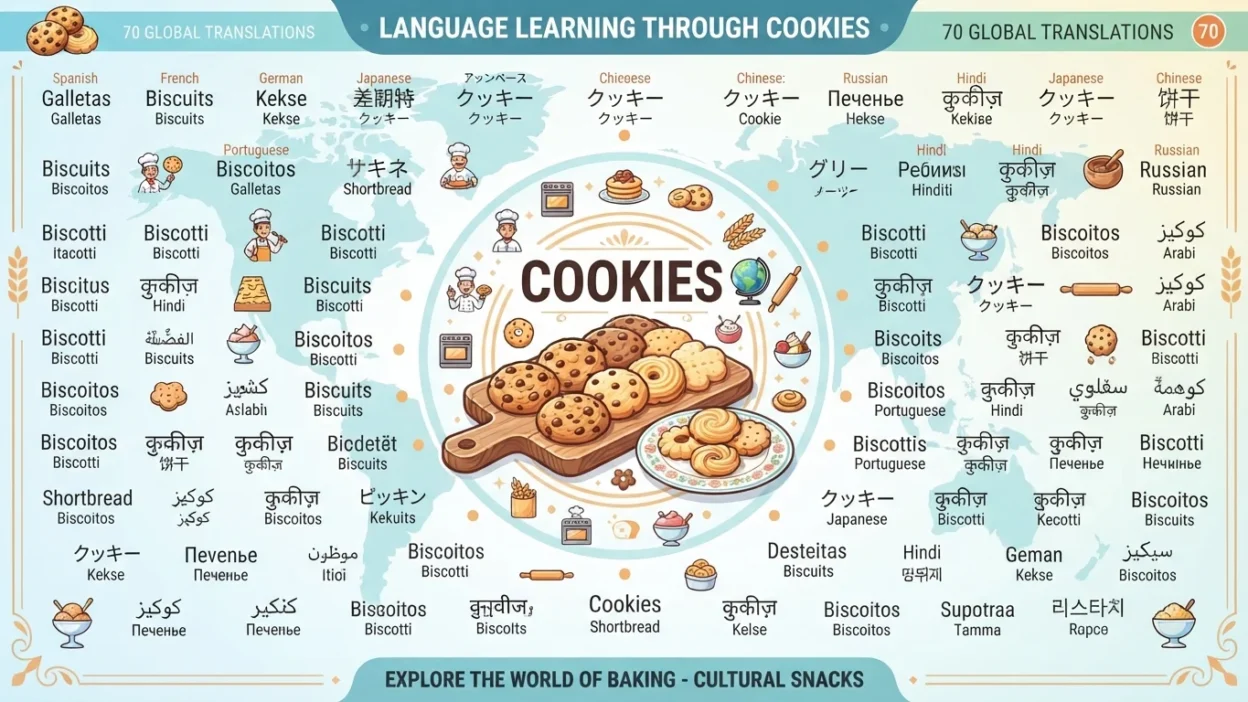
Want to know how to say “cookies” in different languages? Cookies are one of the most popular sweet treats around the world, and almost every culture has its own word for them.
The English word “cookie” can refer to a small, usually sweet baked treat. In some countries, however, the same type of food is called a biscuit, while other languages have completely different words.
Below, you’ll find “cookies” translated into 70 languages, along with easy English pronunciations to make learning and remembering each word easier.
Cookies in 70 Languages
| Language | Native Word | Easy English Pronunciation |
|---|---|---|
| English | Cookies | KOO-keez |
| Spanish | Galletas | Gah-YEH-tas |
| French | Biscuits | Bee-SKEE |
| German | Kekse | KEK-seh |
| Italian | Biscotti | Bee-SKOT-tee |
| Portuguese | Biscoitos | Bees-KOY-tohs |
| Dutch | Koekjes | KOOK-yus |
| Swedish | Kakor | KAH-kor |
| Norwegian | Kjeks | CHEKS |
| Danish | Småkager | SMOH-kay-er |
| Finnish | Keksit | KEK-sit |
| Icelandic | Smákökur | SMAU-kur |
| Irish | Fianáin | FEE-uh-nawn |
| Welsh | Bisgedi | Bis-GEH-dee |
| Scottish Gaelic | Briosgaidean | BREE-us-kee-dan |
| Polish | Ciasteczka | Chas-TECH-kah |
| Czech | Sušenky | SOO-shen-kee |
| Slovak | Sušienky | SOO-shyen-kee |
| Slovenian | Piškoti | PISH-koh-tee |
| Croatian | Keksi | KEK-see |
| Serbian | Кекси | KEK-see |
| Bosnian | Keksi | KEK-see |
| Romanian | Biscuiți | Bees-KWITS |
| Hungarian | Kekszek | KEK-sek |
| Greek | Μπισκότα | Bees-KOH-ta |
| Russian | Печенье | Pee-CHEN-yeh |
| Ukrainian | Печиво | Peh-CHEE-voh |
| Belarusian | Печыва | Peh-CHY-va |
| Bulgarian | Бисквити | Bees-KVEE-tee |
| Macedonian | Колачиња | Koh-LAH-chee-nyah |
| Albanian | Biskota | Bees-KOH-ta |
| Turkish | Kurabiyeler | Koo-rah-bee-YEH-ler |
| Arabic | بسكويت | Bis-KWEET |
| Hebrew | עוגיות | Oo-GYOT |
| Persian | کلوچه | KOO-loh-cheh |
| Kurdish | Biskuvît | Bees-koo-VEET |
| Hindi | कुकीज़ | KOO-keez |
| Urdu | کوکیز | KOO-keez |
| Punjabi | ਕੂਕੀਜ਼ | KOO-keez |
| Bengali | কুকিজ | KOO-keez |
| Gujarati | કૂકીઝ | KOO-keez |
| Marathi | कुकीज | KOO-keez |
| Nepali | कुकीज | KOO-keez |
| Sinhala | කුකීස් | KOO-kees |
| Tamil | குக்கீஸ் | KOO-kees |
| Telugu | కుకీస్ | KOO-kees |
| Kannada | ಕುಕೀಸ್ | KOO-kees |
| Malayalam | കുക്കീസ് | KOO-kees |
| Thai | คุกกี้ | KOO-gee |
| Vietnamese | Bánh quy | BAN kwee |
| Indonesian | Kue kering | KOO-eh kuh-RING |
| Malay | Biskut | BIS-koot |
| Filipino (Tagalog) | Biskwit | BIS-kwit |
| Chinese (Mandarin) | 曲奇 | CHYOO-chee |
| Japanese | クッキー | KOO-kee |
| Korean | 쿠키 | KOO-kee |
| Mongolian | Жигнэмэг | JIG-neh-meg |
| Burmese | ကွတ်ကီး | KWUT-kee |
| Khmer | ខូគី | KOO-kee |
| Lao | ຄຸກກີ້ | KOO-kee |
| Swahili | Biskuti | Bis-KOO-tee |
| Zulu | Amakhukhi | Ah-ma-KHOO-khee |
| Afrikaans | Koekies | KOO-kees |
| Amharic | ኩኪ | KOO-kee |
| Yoruba | Bisikiti | Bee-see-KEE-tee |
| Hausa | Biskit | BIS-kit |
| Māori | Pihikete | Pee-hee-KEH-teh |
| Hawaiian | Kuki | KOO-kee |
| Samoan | Kuki | KOO-kee |
| Esperanto | Kuketoj | Koo-keh-TOY |
What Does “Cookies” Mean?
Cookies are small baked foods usually made from ingredients such as flour, sugar, butter, eggs, chocolate, nuts, or dried fruit.
Cookies can be:
- Chocolate chip cookies
- Sugar cookies
- Oatmeal cookies
- Butter cookies
- Ginger cookies
- Peanut butter cookies
- Shortbread cookies
- Sandwich cookies
- Chocolate cookies
- Fortune cookies
Different countries have their own traditional varieties, so the exact meaning can sometimes depend on the type of baked treat being discussed.
Cookies vs. Biscuits
One of the most interesting differences is between American English and British English.
In American English, cookie is the common word for many small sweet baked treats.
In British English, biscuit is often used for what Americans would call a cookie.
For example:
- American English: Chocolate chip cookie
- British English: Chocolate chip biscuit
However, American English also uses biscuit for a different type of soft, savory baked bread.
How Do You Say Cookies in Spanish?
In Spanish, galletas is the common word for cookies or biscuits.
Example:
Me gustan las galletas.
= I like cookies.
The singular form is galleta.
How Do You Say Cookies in French?
In French, biscuits is commonly used for cookies or biscuits.
The singular form is biscuit.
Example:
J’aime les biscuits.
= I like cookies.
How Do You Say Cookies in German?
German uses Kekse for cookies.
The singular form is Keks.
Example:
Ich esse gerne Kekse.
= I like eating cookies.
How Do You Say Cookies in Italian?
In Italian, biscotti is widely used for biscuits or cookies.
The singular form is biscotto.
Example:
Mi piacciono i biscotti.
= I like cookies.
How Do You Say Cookies in Portuguese?
In Portuguese, biscoitos means cookies or biscuits.
The singular form is biscoito.
Example:
Eu gosto de biscoitos.
= I like cookies.
How Do You Say Cookies in Arabic?
A common Arabic word is بسكويت (biskweet).
It is widely understood for biscuits or cookies, although regional terminology can vary.
How Do You Say Cookies in Hindi?
In Hindi, the English-derived word कुकीज़ (kūkeez) is commonly used for modern cookies.
Traditional or broader biscuit terminology can also be expressed with words related to बिस्कुट (biskut).
How Do You Say Cookies in Urdu?
In Urdu, کوکیز (cookies) is commonly used, particularly for Western-style cookies.
Example:
مجھے کوکیز پسند ہیں۔
= I like cookies.
How Do You Say Cookies in Chinese?
In Mandarin Chinese, 曲奇 (qūqí) is commonly used for cookies, particularly Western-style cookies.
Another broader term is 饼干 (bǐnggān), meaning biscuits, cookies, or crackers depending on context.
How Do You Say Cookies in Japanese?
Japanese uses the loanword クッキー (kukkī) for cookies.
Example:
クッキーが好きです。
= I like cookies.
Japanese also has ビスケット (bisuketto) for biscuits.
How Do You Say Cookies in Korean?
In Korean, cookies are 쿠키 (kuki).
The word is borrowed from English and is especially common for Western-style cookies.
How Do You Say Cookies in Turkish?
In Turkish, kurabiye refers to cookies or small baked pastries, and kurabiyeler is the plural form.
Examples include chocolate, butter, and nut-filled varieties.
Cookies Around the World
Cookies may look and taste different depending on the country.
For example:
- United States: Chocolate chip cookies are especially popular.
- France: Biscuits and butter-based cookies are common.
- Italy: Biscotti are famous for their crisp texture.
- Germany: Various types of Kekse are enjoyed, especially around Christmas.
- Spain: Galletas are common everyday treats.
- Japan: Western-style cookies are commonly called クッキー.
- China: 曲奇 is widely used for Western-style cookies.
- India: Cookies and biscuits are both popular, with British influence on the word “biscuit.”
- Middle East: Many traditional sweets resemble or overlap with the broader category of cookies and biscuits.
Why Learn “Cookies” in Different Languages?
Learning food vocabulary is one of the easiest ways to build useful language skills.
Knowing how to say cookies can help you:
- Order food while traveling
- Understand menus
- Talk about favorite desserts
- Learn cultural food vocabulary
- Communicate with international friends
- Build everyday vocabulary
Food words are also easy to remember because you can connect them with familiar tastes, smells, and experiences.
Related Cookie Vocabulary
After learning cookies, try learning these related words:
- Cookie
- Biscuit
- Cake
- Cupcake
- Dessert
- Chocolate
- Sugar
- Flour
- Butter
- Dough
- Oven
- Bakery
- Sweet
- Chocolate chip
- Vanilla
- Nuts
- Sprinkles
- Frosting
- Recipe
- Homemade
How to Remember “Cookies” in Different Languages
Some translations are easy to recognize because they are borrowed from English.
For example:
Japanese: クッキー
Korean: 쿠키
Khmer: ខូគី
Lao: ຄຸກກີ້
Hawaiian: Kuki
Samoan: Kuki
Other languages have their own traditional words:
Spanish: Galletas
French: Biscuits
German: Kekse
Italian: Biscotti
Russian: Печенье
Chinese: 曲奇
Try grouping the words by similarity rather than memorizing all 70 individually.
Quick Reference: Cookies in 10 Languages
| Language | Translation |
|---|---|
| English | Cookies |
| Spanish | Galletas |
| French | Biscuits |
| German | Kekse |
| Italian | Biscotti |
| Portuguese | Biscoitos |
| Turkish | Kurabiyeler |
| Arabic | بسكويت |
| Hindi | कुकीज़ |
| Chinese | 曲奇 |
Frequently Asked Questions
What is “cookies” in Spanish?
“Cookies” is galletas in Spanish.
What is “cookies” in French?
“Cookies” is commonly biscuits in French.
What is “cookies” in German?
“Cookies” is Kekse in German.
What is “cookies” in Italian?
“Cookies” is biscotti in Italian.
What is “cookies” in Hindi?
Modern Western-style cookies are commonly called कुकीज़ (kūkeez) in Hindi.
What is “cookies” in Urdu?
Cookies are commonly called کوکیز (cookies) in Urdu.
What is “cookies” in Arabic?
A common word is بسكويت (biskweet).
What is “cookies” in Chinese?
曲奇 (qūqí) is commonly used for cookies, while 饼干 (bǐnggān) is a broader term for biscuits, cookies, and similar baked snacks.
What is “cookies” in Japanese?
Cookies are クッキー (kukkī) in Japanese.
What is “cookies” in Korean?
Cookies are 쿠키 (kuki) in Korean.
Are cookies and biscuits the same thing?
It depends on the variety of English being used. In American English, cookies and biscuits are different foods. In British English, biscuit is often the normal word for what Americans call a cookie.
Conclusion
The word “cookies” has many interesting translations around the world. Some languages have their own traditional terms, such as galletas, biscuits, Kekse, and biscotti, while others use words borrowed from English.
Learning cookies in different languages is a fun way to expand food vocabulary while discovering how different cultures describe familiar treats. Whether you are learning a language, traveling, or simply curious about international words, these 70 translations give you a useful starting point.