
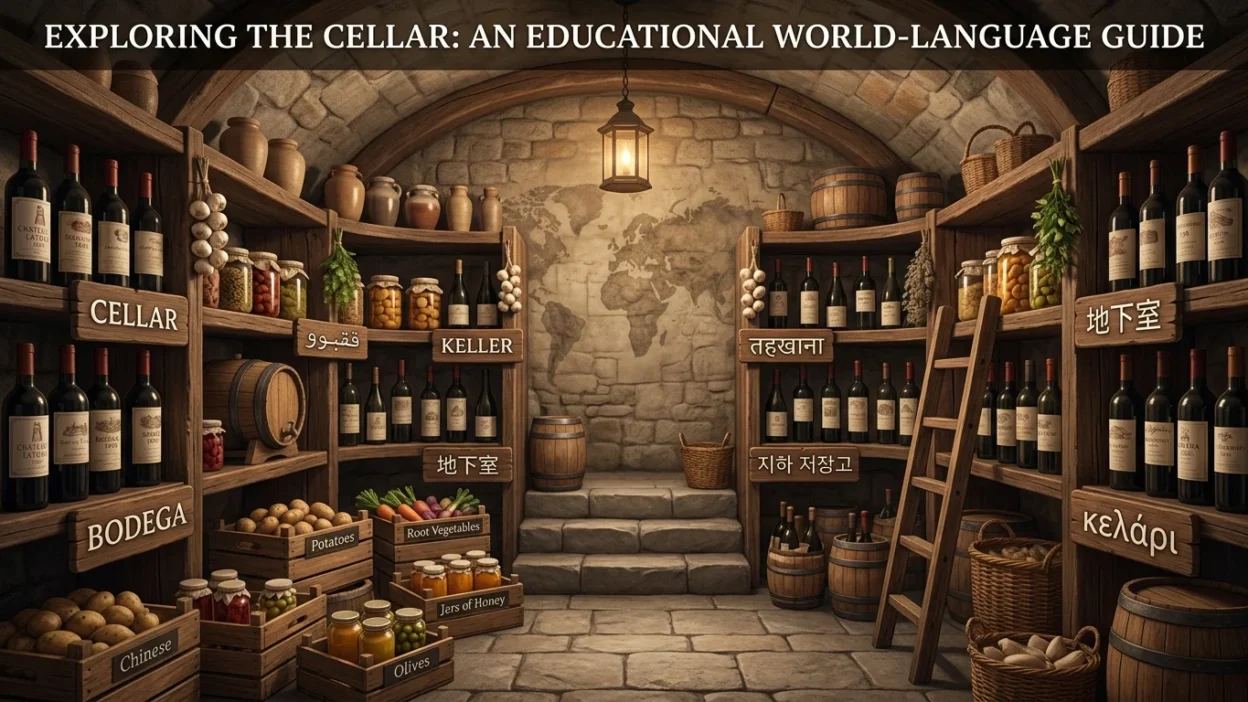
If you mean “cellar” as a room or underground space used for storing wine, food, or other items, here are the translations in 70 languages.
| Language | Native Word | Easy English Pronunciation |
|---|---|---|
| English | Cellar | SEL-er |
| Spanish | Bodega | Boh-DEH-ga |
| French | Cave | KAV |
| German | Keller | KEL-er |
| Italian | Cantina | Kan-TEE-na |
| Portuguese | Adega | Ah-DEH-ga |
| Dutch | Kelder | KEL-der |
| Swedish | Källare | CHEL-la-reh |
| Norwegian | Kjeller | CHEL-er |
| Danish | Kælder | KEL-der |
| Finnish | Kellari | KEL-la-ree |
| Icelandic | Kjallari | KYAT-la-ree |
| Irish | Cellar | SEL-er |
| Welsh | Seler | SEH-ler |
| Scottish Gaelic | Seilear | SHEL-er |
| Polish | Piwnica | Peev-NEET-sa |
| Czech | Sklep | SKLEP |
| Slovak | Pivnica | PIV-nee-tsa |
| Slovenian | Klet | KLET |
| Croatian | Podrum | POH-droom |
| Serbian | Подрум | POH-droom |
| Bosnian | Podrum | POH-droom |
| Romanian | Pivniță | PEEV-neets-ah |
| Hungarian | Pince | PEEN-tseh |
| Greek | Κελάρι | Keh-LA-ree |
| Language | Native Word | Easy English Pronunciation |
|---|---|---|
| Russian | Погреб | POH-greb |
| Ukrainian | Підвал | Peed-VAL |
| Belarusian | Падвал | Pad-VAL |
| Bulgarian | Изба | IZ-ba |
| Macedonian | Подрум | POHD-room |
| Albanian | Bodrum | BOH-droom |
| Turkish | Mahzen | MAHZ-en |
| Arabic | قبو | QAB-oo |
| Hebrew | מרתף | Mar-TAF |
| Persian | زیرزمین | Zeer-zah-MEEN |
| Kurdish | Jêrzemîn | ZHEHR-zeh-MEEN |
| Hindi | तहखाना | Teh-KHA-na |
| Urdu | تہہ خانہ | Teh-KHA-na |
| Punjabi | ਤਹਿਖਾਨਾ | Teh-khaa-na |
| Bengali | ভাণ্ডারঘর | BHAAN-daar-ghor |
| Gujarati | ભોંયરું | Bhon-YAH-roo |
| Marathi | तळघर | Tal-GHAR |
| Nepali | तहखाना | Teh-KHA-na |
| Sinhala | යටමහල | Ya-ta-ma-ha-la |
| Tamil | நிலவறை | Ni-la-va-RYE |
| Telugu | నేలమాళిగ | Nay-la-MAA-li-ga |
| Kannada | ನೆಲಮಾಳಿಗೆ | Nay-la-MAA-li-geh |
| Malayalam | നിലവറ | Ni-la-va-ra |
| Thai | ห้องใต้ดิน | Hong TAI-din |
| Vietnamese | Hầm | HUH-m |
| # | Language | “Cellar” | Easy Pronunciation |
|---|---|---|---|
| 51 | Indonesian | Ruang bawah tanah | Roo-ang bah-wah tan-ah |
| 52 | Malay | Ruang bawah tanah | Roo-ang bah-wah tan-ah |
| 53 | Filipino (Tagalog) | Bodega | Boh-deh-ga |
| 54 | Chinese (Mandarin) | 地窖 | Dee-jyaow |
| 55 | Japanese | 地下室 | Chee-ka-shitsu |
| 56 | Korean | 지하실 | Jee-ha-shil |
| 57 | Mongolian | Зоорь | Zoor |
| 58 | Burmese | မြေအောက်ခန်း | Myeh-auk-khan |
| 59 | Khmer | បន្ទប់ក្រោមដី | Bon-top kraom-dey |
| 60 | Lao | ຫ້ອງໃຕ້ດິນ | Hong-tai-din |
| 61 | Swahili | Pishi | Pee-shee |
| 62 | Zulu | Igumbi elingaphansi komhlaba | Ee-goom-bee eh-ling-ah-pan-see kom-hlah-bah |
| 63 | Afrikaans | Kelder | Kel-der |
| 64 | Amharic | ምድር ቤት | Mee-dir bet |
| 65 | Yoruba | Yàrá abẹ́ ilẹ̀ | Yah-rah ah-beh eh-leh |
| 66 | Hausa | Ɗakin ƙasa | Dah-kin kah-sah |
| 67 | Māori | Puhera | Poo-heh-rah |
| 68 | Hawaiian | Hale lalo | Hah-leh lah-loh |
| 69 | Samoan | Potu i lalo | Poh-too ee lah-loh |
| 70 | Esperanto | Kelo | Keh-loh |
Why Learn “Cellar” in Different Languages?
Learning the word cellar in different languages is useful when exploring international vocabulary, travel expressions, literature, architecture, and food or wine culture.
The exact translation can vary depending on whether you mean a general underground room, storage area, basement, or wine cellar.
Cellar vs. Basement
Although these words are sometimes used interchangeably, they can have slightly different meanings.
- Cellar: Usually an underground space used for storage, food, wine, or household supplies.
- Basement: A lower level of a building that may be used for living, working, storage, or utilities.
- Wine cellar: A specially designed space for storing wine under suitable conditions.
For example:
“The old house has a cool cellar where they store vegetables.”
Related Cellar Vocabulary
When learning cellar translations, these related words can also be helpful:
- Basement
- Storage room
- Underground room
- Wine cellar
- Wine storage
- Pantry
- Underground storage
- House cellar
In some languages, the same word may cover both cellar and basement, while other languages have separate terms.
How to Remember “Cellar” Around the World
A simple way to remember the vocabulary is to group similar words together.
European examples:
- German — Keller
- Dutch — Kelder
- Afrikaans — Kelder
- Esperanto — Kelo
South Asian examples:
- Hindi — तहखाना
- Urdu — تہہ خانہ
- Punjabi — ਤਹਿਖਾਨਾ
- Nepali — तहखाना
East Asian examples:
- Mandarin — 地窖
- Japanese — 地下室
- Korean — 지하실
This grouping makes it easier to recognize patterns between related languages.
Cellar in All Languages: Quick Reference
Across the full 70-language list, cellar can be expressed using words for an underground room, storage area, basement, or cellar itself.
Some especially recognizable forms include:
- Spanish: Bodega
- French: Cave
- German: Keller
- Italian: Cantina
- Polish: Piwnica
- Russian: Погреб
- Arabic: قبو
- Hindi: तहखाना
- Urdu: تہہ خانہ
- Chinese: 地窖
- Japanese: 地下室
- Korean: 지하실
- Afrikaans: Kelder
- Esperanto: Kelo
Why Is “Cellar” an Interesting Word?
The word cellar is especially interesting because different cultures may describe the space according to its function.
A European language might have a dedicated word for a cellar, while another language may describe it literally as an underground room or underground storage area.
That is why translations should be understood in context rather than treated as perfect one-to-one equivalents.
FAQs About “Cellar” in Different Languages
What is “cellar” in Spanish?
“Cellar” is commonly translated as bodega in Spanish.
What is “cellar” in French?
In French, cave means cellar and can also refer to an underground storage space.
What is “cellar” in German?
The German word for cellar is Keller.
What is “cellar” in Hindi?
“Cellar” can be translated as तहखाना (tahkhana) in Hindi.
What is “cellar” in Urdu?
In Urdu, cellar is تہہ خانہ (teh khana).
What is “cellar” in Mandarin Chinese?
A common word is 地窖 (dìjiào), especially for an underground storage cellar.
What is “cellar” in Japanese?
A general term is 地下室 (chikashitsu), meaning an underground room or basement. A wine cellar may also be called ワインセラー.
What is “cellar” in Korean?
지하실 (jihasil) can refer to a basement or cellar.
Is a cellar the same as a basement?
Not always. A cellar is generally associated with underground storage, while a basement can serve many other purposes.
Conclusion
Knowing how to say “cellar” in different languages gives you a useful piece of vocabulary for discussing homes, buildings, storage, food, wine, and architecture around the world. 🌎
From Keller in German to 地窖 in Mandarin and Kelo in Esperanto, the translations show how different languages describe this familiar underground space.
Focus Keyword: cellar in different languages
Suggested Slug: cellar-in-different-languages

Daniel Whitmore is a language writer and editor from the United Kingdom who is passionate about making language learning accessible to everyone. He specializes in English grammar, vocabulary, spelling differences, pronunciation, and multilingual communication. His articles break down complex language concepts into clear, practical lessons that readers can apply in everyday conversations and writing. Daniel enjoys exploring the history, culture, and evolution of languages while creating engaging content for students, educators, travelers, and language enthusiasts. His goal is to provide accurate, reader-friendly resources that help people build confidence in learning English and other world languages through simple explanations and real-life examples.