
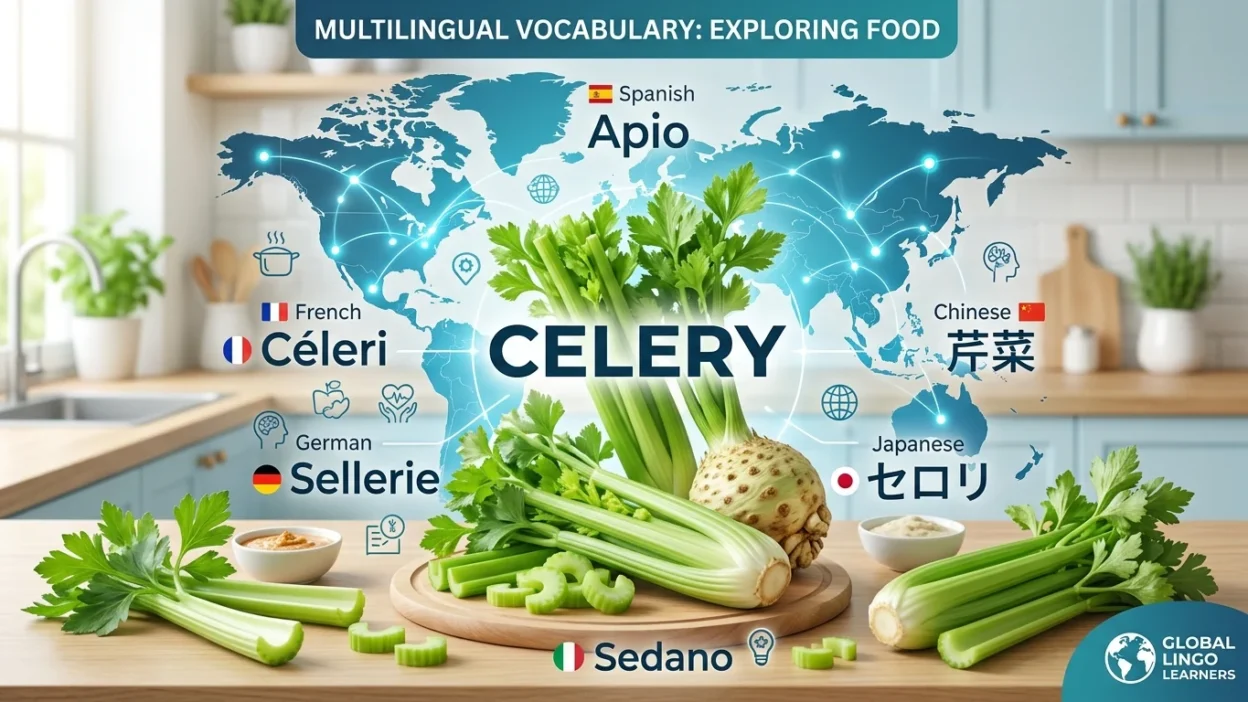
Celery is a crunchy green vegetable commonly used in salads, soups, stews, juices, and many cooked dishes. It is known for its fresh flavor, crisp stalks, and distinctive aroma.
If you are learning food vocabulary, traveling, cooking international recipes, or building your multilingual vocabulary, knowing how to say “celery” in different languages can be very useful. Below, you’ll find celery translated into 70 languages, with native spellings and easy English pronunciations.
Celery in Different Languages — Part 1
| Language | Native Word | Easy English Pronunciation |
|---|---|---|
| English | Celery | SELL-uh-ree |
| Spanish | Apio | AH-pee-oh |
| French | Céleri | SAY-leh-ree |
| German | Sellerie | Zell-uh-REE |
| Italian | Sedano | Seh-DAH-noh |
| Portuguese | Aipo | EYE-poh |
| Dutch | Selderij | SELL-duh-ray |
| Swedish | Selleri | SELL-uh-ree |
| Norwegian | Selleri | SELL-uh-ree |
| Danish | Selleri | SELL-uh-ree |
| Finnish | Selleri | SELL-uh-ree |
| Icelandic | Sellerí | SELL-eh-ree |
| Irish | Soilire | SULL-ih-reh |
| Welsh | Seleri | Seh-LEH-ree |
| Scottish Gaelic | Soilire | SUL-uh-reh |
| Polish | Seler | SEH-ler |
| Czech | Celer | TSEH-ler |
| Slovak | Zeler | ZEH-ler |
| Slovenian | Zelena | ZEH-leh-na |
| Croatian | Celer | TSEH-ler |
| Serbian | Целер | TSEH-ler |
| Bosnian | Celer | TSEH-ler |
| Romanian | Țelină | Tseh-LEE-nuh |
| Hungarian | Zeller | ZEH-ler |
| Greek | Σέλινο | SEH-lee-noh |
Celery in Russian, Ukrainian, Arabic, and More
| Language | Native Word | Easy English Pronunciation |
|---|---|---|
| Russian | Сельдерей | Sel-deh-RAY |
| Ukrainian | Селера | Seh-LEH-ra |
| Belarusian | Салера | Sa-LEH-ra |
| Bulgarian | Целина | Tseh-LEE-na |
| Macedonian | Целер | TSEH-ler |
| Albanian | Selino | Seh-LEE-noh |
| Turkish | Kereviz | Keh-reh-VEEZ |
| Arabic | كرفس | Kar-AFS |
| Hebrew | סלרי | Seh-LEH-ree |
| Persian | کرفس | Kar-AFS |
| Kurdish | Kerefes | Keh-reh-FES |
| Hindi | अजमोद | Aj-MOD |
| Urdu | اجوائن | Aj-WAIN |
| Punjabi | ਅਜਵਾਇਨ | Aj-WAIN |
| Bengali | সেলারি | Seh-la-ree |
| Gujarati | સેલરી | Seh-la-ree |
| Marathi | सेलरी | Seh-la-ree |
| Nepali | अजमोद | Aj-MOD |
| Sinhala | සැල්දිරි | Sal-dee-ree |
| Tamil | செலரி | Seh-la-ree |
| Telugu | సెలెరీ | Seh-leh-ree |
| Kannada | ಸೆಲರಿ | Seh-la-ree |
| Malayalam | സെലറി | Seh-la-ree |
| Thai | ขึ้นฉ่าย | Kheun-CHAI |
| Vietnamese | Cần tây | Kun TAY |
Note: Some languages have different words depending on whether the speaker means celery stalks, celery root, or a related herb. South Asian everyday usage can also vary by region, so the forms above are practical vocabulary equivalents rather than universal regional terms.
Celery in Asian Languages
| Language | Native Word | Easy English Pronunciation |
|---|---|---|
| Indonesian | Seledri | Seh-LEHD-ree |
| Malay | Saderi | Sa-DEH-ree |
| Filipino (Tagalog) | Kintsay | KIN-tsai |
| Chinese (Mandarin) | 芹菜 | CHEEN-tsai |
| Japanese | セロリ | Seh-ROH-ree |
| Korean | 셀러리 | SELL-uh-ree |
| Mongolian | Селөдерей | Seh-loh-deh-RAY |
| Burmese | တရုတ်နံနံ | Ya-Yoke nan-nan |
| Khmer | សេលេរី | Seh-leh-ree |
| Lao | ຂຶ້ນສ່າຍ | Kheun-sai |
Celery in African Languages
| Language | Native Word | Easy English Pronunciation |
|---|---|---|
| Swahili | Selery | Seh-leh-ree |
| Zulu | Iseleri | Ee-seh-LEH-ree |
| Afrikaans | Seldery | SELL-duh-ree |
| Amharic | ሴሌሪ | Seh-LEH-ree |
| Yoruba | Sẹ́lérì | Seh-LEH-ree |
| Hausa | Seleri | Seh-LEH-ree |
Celery in Pacific and Other Languages
| Language | Native Word | Easy English Pronunciation |
|---|---|---|
| Māori | Herewi | HEH-reh-wee |
| Hawaiian | Seleri | Seh-LEH-ree |
| Samoan | Seleri | Seh-LEH-ree |
| Esperanto | Celerio | Tseh-leh-REE-oh |
What Does Celery Mean? 🥬
Celery is a plant belonging to the parsley family. Its crisp stalks are commonly eaten raw or cooked, while its leaves can also be used to add flavor to dishes.
Celery has a fresh, slightly earthy taste and is particularly common in soups, salads, stocks, sauces, stir-fries, and vegetable dishes.
The word can refer to the entire plant or, in everyday cooking, especially to its edible stalks.
How Do You Say Celery in Spanish?
In Spanish, celery is called apio.
Pronunciation: AH-pee-oh
Example:
Necesito apio para la sopa.
Meaning: “I need celery for the soup.”
How Do You Say Celery in French?
In French, celery is céleri.
Pronunciation: SAY-leh-ree
The word is frequently seen in French recipes and food-related conversations.
How Do You Say Celery in German?
In German, celery is Sellerie.
Pronunciation: Zell-uh-REE
German recipes may distinguish between celery stalks and celery root, which are used somewhat differently in cooking.
How Do You Say Celery in Italian?
In Italian, celery is sedano.
Pronunciation: Seh-DAH-noh
Celery is a common ingredient in Italian cooking and can be used as part of a vegetable base for sauces, soups, and stews.
How Do You Say Celery in Portuguese?
In Portuguese, celery is aipo.
Pronunciation: EYE-poh
The word is used for the vegetable in Portuguese-speaking regions.
How Do You Say Celery in Arabic?
In Arabic, celery is commonly called كرفس.
Pronunciation: Kar-AFS
Arabic food terminology can vary between countries and dialects, but كرفس is a widely recognized term for celery.
How Do You Say Celery in Hindi?
For celery, Hindi food vocabulary can vary according to context and region. अजमोद (ajmod) is a traditional Hindi/Sanskrit-derived term associated with celery and related plants.
Pronunciation: Aj-MOD
However, in modern Indian markets and recipes, the English-derived word सेलरी (seleri) is also commonly encountered, especially in recipes aimed at urban or international audiences.
How Do You Say Celery in Urdu?
In Urdu, celery can be referred to using traditional terms such as اجمود, while سیلری (celery) is also used in modern culinary contexts.
The exact term can vary depending on the type of celery and regional usage.
How Do You Say Celery in Chinese?
In Mandarin Chinese, celery is 芹菜.
Pinyin: qíncài
Easy pronunciation: CHEEN-tsai
This is the standard everyday Chinese term for celery.
How Do You Say Celery in Japanese?
In Japanese, celery is セロリ.
Pronunciation: Seh-ROH-ree
It is written in katakana because the modern Japanese word is borrowed from a foreign language.
How Do You Say Celery in Korean?
In Korean, celery is 셀러리.
Pronunciation: SELL-uh-ree
It is another example of a food word that has been adopted into Korean from English.
Celery vs. Celery Root
One useful distinction when learning food vocabulary is the difference between celery and celery root.
| Celery | Celery Root |
|---|---|
| Usually refers to the stalks | Refers to the enlarged root |
| Crisp and juicy | Firm and knobby |
| Often eaten raw | Usually cooked or grated |
| Used in salads and soups | Used in soups, purées, and roasted dishes |
| Green stalks and leaves | Brownish root exterior |
They come from the same plant species but are used differently in cooking.
Celery vs. Parsley
Celery and parsley belong to the same plant family, so their flavors can sometimes seem related. However, they are different vegetables/herbs.
Celery is particularly valued for its crunchy stalks and distinctive savory flavor, while parsley is primarily used as a leafy herb.
Both can appear together in soups, sauces, stocks, and other recipes.
Related Celery Vocabulary 🥗
If you are learning food vocabulary, these words are useful alongside celery:
- Celery stalk
- Celery leaves
- Celery root
- Celery seed
- Celery juice
- Celery soup
- Celery salad
- Chopped celery
- Fresh celery
- Crispy celery
- Vegetable
- Herb
- Salad
- Soup
- Stock
- Vegetable broth
Why Learn “Celery” in Different Languages?
Learning the word celery in different languages can be helpful for several reasons.
🥬 Cooking: International recipes may list ingredients in different languages.
🌍 Travel: Knowing food vocabulary makes shopping and dining abroad easier.
📚 Language learning: Food words are practical vocabulary that you can use frequently.
🛒 Grocery shopping: Multilingual ingredient names can help when buying imported foods.
👨🍳 Recipes: Chefs and food bloggers often work with international ingredients and recipes.
How to Remember Celery in Other Languages
One interesting thing about celery is that many languages use words that sound somewhat similar to the English word.
For example:
- English — Celery
- French — Céleri
- German — Sellerie
- Swedish — Selleri
- Danish — Selleri
- Finnish — Selleri
- Japanese — セロリ
- Korean — 셀러리
These similarities make the word easier to recognize when reading recipes or food labels.
Celery in 70 Languages — Quick Reference
Here is a quick alphabetical-style reference based on the language sequence used above:
English: Celery
Spanish: Apio
French: Céleri
German: Sellerie
Italian: Sedano
Portuguese: Aipo
Dutch: Selderij
Swedish: Selleri
Norwegian: Selleri
Danish: Selleri
Finnish: Selleri
Icelandic: Sellerí
Irish: Soilire
Welsh: Seleri
Scottish Gaelic: Soilire
Polish: Seler
Czech: Celer
Slovak: Zeler
Slovenian: Zelena
Croatian: Celer
Serbian: Целер
Bosnian: Celer
Romanian: Țelină
Hungarian: Zeller
Greek: Σέλινο
Russian: Сельдерей
Ukrainian: Селера
Belarusian: Салера
Bulgarian: Целина
Macedonian: Целер
Albanian: Selino
Turkish: Kereviz
Arabic: كرفس
Hebrew: סלרי
Persian: کرفس
Kurdish: Kerefes
Hindi: अजमोद
Urdu: اجمود / سیلری
Punjabi: ਅਜਮੋਦ / ਸੈਲਰੀ
Bengali: সেলারি
Gujarati: સેલરી
Marathi: सेलरी
Nepali: अजमोद
Sinhala: සැල්දිරි
Tamil: செலரி
Telugu: సెలెరీ
Kannada: ಸೆಲರಿ
Malayalam: സെലറി
Thai: ขึ้นฉ่าย
Vietnamese: Cần tây
Indonesian: Seledri
Malay: Saderi
Filipino: Kintsay
Chinese: 芹菜
Japanese: セロリ
Korean: 셀러리
Mongolian: Селөдерей
Burmese: တရုတ်နံနံ
Khmer: សេលេរី
Lao: ຂຶ້ນສ່າຍ
Swahili: Selery
Zulu: Iseleri
Afrikaans: Seldery
Amharic: ሴሌሪ
Yoruba: Sẹ́lérì
Hausa: Seleri
Māori: Herewi
Hawaiian: Seleri
Samoan: Seleri
Esperanto: Celerio
Frequently Asked Questions
What is celery called in different languages?
Celery has many different names around the world. It is apio in Spanish, céleri in French, sedano in Italian, aipo in Portuguese, Sellerie in German, and 芹菜 (qíncài) in Mandarin Chinese.
What is celery called in Spanish?
Celery is called apio in Spanish and is pronounced approximately AH-pee-oh.
What is celery called in French?
Celery is céleri in French, pronounced approximately SAY-leh-ree.
What is celery called in German?
Celery is called Sellerie in German and is pronounced approximately Zell-uh-REE.
What is celery called in Italian?
Celery is sedano in Italian, pronounced approximately Seh-DAH-noh.
What is celery called in Chinese?
Celery is 芹菜 (qíncài) in Mandarin Chinese, pronounced approximately CHEEN-tsai.
What is celery called in Japanese?
Celery is セロリ (serori) in Japanese, pronounced approximately Seh-ROH-ree.
Is celery a vegetable?
Yes. Celery is commonly treated as a vegetable, particularly because its stalks are widely eaten in salads, soups, stews, and other dishes.
Are celery and celery root the same?
They come from the same plant species, but they are different culinary forms. Celery usually refers to the stalks, while celery root refers to the enlarged edible root.
Conclusion 🌍🥬
From apio in Spanish and sedano in Italian to 芹菜 in Chinese and セロリ in Japanese, celery has many interesting names around the world.
Learning celery in different languages is a simple way to expand your food vocabulary while discovering how different languages describe familiar ingredients. Whether you’re reading international recipes, traveling, grocery shopping, or learning a new language, these translations can help you recognize celery wherever you go.