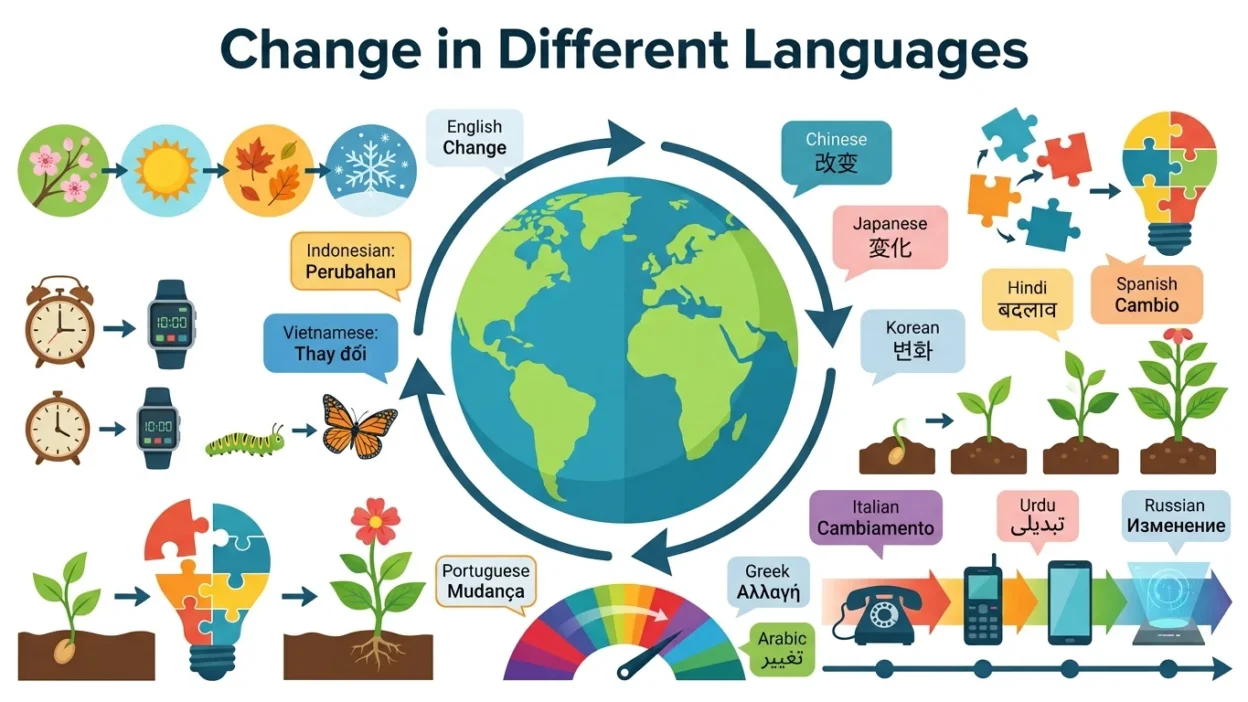
The word change can mean to make something different, replace something, exchange one thing for another, or undergo a transformation. Because its meaning depends on context, different languages may use different words for different types of change.
| Language | Native Word | Easy English Pronunciation |
|---|---|---|
| English | Change | CHAYNJ |
| Spanish | Cambio | KAM-byoh |
| French | Changement | Shahnj-MAHN |
| German | Veränderung | Fer-EN-deh-roong |
| Italian | Cambiamento | Kam-byah-MEN-toh |
| Portuguese | Mudança | Moo-DAN-sa |
| Dutch | Verandering | Fer-AN-deh-ring |
| Swedish | Förändring | Fur-EN-dring |
| Norwegian | Endring | EN-dring |
| Danish | Forandring | For-AN-dring |
| Finnish | Muutos | MOO-tos |
| Icelandic | Breyting | BRAY-ting |
| Irish | Athrú | AH-roo |
| Welsh | Newid | NAY-id |
| Scottish Gaelic | Atharrachadh | AH-ha-ruh-loch |
| Polish | Zmiana | ZMYA-na |
| Czech | Změna | ZMYEH-na |
| Slovak | Zmena | ZMEH-na |
| Slovenian | Sprememba | Sprem-EM-ba |
| Croatian | Promjena | PRO-myeh-na |
| Serbian | Промена | PRO-meh-na |
| Bosnian | Promjena | PRO-myeh-na |
| Romanian | Schimbare | Skim-BA-reh |
| Hungarian | Változás | VAAL-toh-zhaash |
| Greek | Αλλαγή | Al-la-GHEE |
| Language | Native Word | Easy English Pronunciation |
|---|---|---|
| Russian | Изменение | Iz-meh-NEE-yeh |
| Ukrainian | Зміна | ZMI-na |
| Belarusian | Змена | ZME-na |
| Bulgarian | Промяна | Pro-MYA-na |
| Macedonian | Промена | Pro-MEH-na |
| Albanian | Ndryshim | NDRI-shim |
| Turkish | Değişim | Deh-yee-SHEEM |
| Arabic | تغيير | Tagh-YEER |
| Hebrew | שינוי | Shin-NOO-ee |
| Persian | تغییر | Tagh-YEER |
| Kurdish | Guhertin | Goo-HER-tin |
| Hindi | बदलाव | Bad-LAAV |
| Urdu | تبدیلی | Tab-DEE-lee |
| Punjabi | ਤਬਦੀਲੀ | Tab-DEE-lee |
| Bengali | পরিবর্তন | Por-i-BOR-ton |
| Gujarati | ફેરફાર | Fair-faar |
| Marathi | बदल | Ba-dal |
| Nepali | परिवर्तन | Par-i-var-TAN |
| Sinhala | වෙනස්කම | Veh-nas-ka-ma |
| Tamil | மாற்றம் | Maat-tam |
| Telugu | మార్పు | Maar-pu |
| Kannada | ಬದಲಾವಣೆ | Ba-da-laa-va-ne |
| Malayalam | മാറ്റം | Maat-tam |
| Thai | การเปลี่ยนแปลง | Gaan Plian Plaeng |
| Vietnamese | Thay đổi | Tie Doy |
| Language | Native Word | Easy English Pronunciation |
|---|---|---|
| Indonesian | Perubahan | Per-u-BA-han |
| Malay | Perubahan | Per-u-BA-han |
| Filipino (Tagalog) | Pagbabago | Pag-ba-BA-go |
| Chinese (Mandarin) | 变化 | Byen-hwa |
| Japanese | 変化 | HEN-ka |
| Korean | 변화 | Byun-hwa |
| Mongolian | Өөрчлөлт | Oorch-lult |
| Burmese | ပြောင်းလဲမှု | Pyaung-leh-mhoo |
| Khmer | ការផ្លាស់ប្តូរ | Kar Phlas Bdao |
| Lao | ການປ່ຽນແປງ | Kan Pien Paeng |
| Swahili | Mabadiliko | Ma-ba-di-LEE-ko |
| Zulu | Ushintsho | Oo-SHEEN-tsho |
| Afrikaans | Verandering | Fer-AN-deh-ring |
| Amharic | ለውጥ | Lewt |
| Yoruba | Àyípadà | Ah-yee-pa-DA |
| Hausa | Canji | CHAN-jee |
| Māori | Huringa | Hoo-rin-ga |
| Hawaiian | Hoʻololi | Ho-oh-LOH-lee |
| Samoan | Suiga | Soo-EE-ga |
| Esperanto | Ŝanĝo | SHAN-zho |
Why Learn “Change” in Different Languages? 🌍
Learning the word “change” across languages is useful for travelers, language learners, writers, students, and anyone interested in global communication. It also helps you understand how different languages describe transformation, replacement, modification, and new situations.
How to Say “Change” in Different Languages
From cambio in Spanish and changement in French to perubahan in Indonesian and pagbabago in Filipino, the word appears in many interesting forms around the world.
Remember that some languages distinguish between the noun “change” and the verb “to change.” For example, Mandarin commonly uses 变化 (biànhuà) for change or transformation, while 改变 (gǎibiàn) is commonly used as a verb meaning “to change.”
Change as a Noun and Verb
In English:
- Noun: “The change was unexpected.”
- Verb: “People change over time.”
- Replacement: “I need to change my shirt.”
- Money: “Here is your change.”
- Transformation: “The city has undergone major change.”
Because of these different meanings, a direct one-word translation isn’t always appropriate.
Related Vocabulary
If you are learning “change,” these related words can also be useful:
- Transform — make something significantly different
- Modify — make a small adjustment
- Alter — make a change
- Replace — put something new in place of something else
- Adapt — adjust to a new situation
- Improve — make something better
- Develop — grow or change over time
- Transition — move from one state or situation to another
Tips for Learning the Word “Change” 🧠
Try learning change together with a short phrase rather than memorizing the word alone. For example, learn phrases equivalent to “change your mind,” “change the plan,” “change over time,” and “make a change.”
This makes it easier to understand how the word actually works in everyday conversation.
Conclusion ✨
The word “change” may look simple in English, but its translations reveal fascinating differences between languages. From zmiana in Polish to ushintsho in Zulu, every language gives the concept its own character.
Whether you’re learning languages, creating multilingual content, or simply exploring words from around the world, knowing how to say “change” in 70 languages is a great little addition to your vocabulary.
Frequently Asked Questions
What is “change” in Spanish?
Change in Spanish is cambio, pronounced approximately KAM-byoh.
What is “change” in French?
In French, change can be changement, pronounced approximately shahnj-MAHN.
What is “change” in German?
The German word commonly used for change is Veränderung, pronounced approximately fer-EN-deh-roong.
What is “change” in Hindi?
Change can be translated as बदलाव (badlaav) in Hindi, pronounced approximately bad-LAAV.
What is “change” in Urdu?
In Urdu, change is commonly expressed as تبدیلی (tabdeeli), pronounced approximately tab-DEE-lee.
What is “change” in Japanese?
Japanese commonly uses 変化 (henka) for change or transformation. The verb forms depend on the specific meaning and grammatical context.
What is “change” in Chinese?
In Mandarin, 变化 (biànhuà) commonly means change or transformation, while 改变 (gǎibiàn) is commonly used for to change/alter something.
How many languages are included in this list?
This series includes 70 languages, covering languages from Europe, Asia, Africa, Oceania, and beyond.

Daniel Whitmore is a language writer and editor from the United Kingdom who is passionate about making language learning accessible to everyone. He specializes in English grammar, vocabulary, spelling differences, pronunciation, and multilingual communication. His articles break down complex language concepts into clear, practical lessons that readers can apply in everyday conversations and writing. Daniel enjoys exploring the history, culture, and evolution of languages while creating engaging content for students, educators, travelers, and language enthusiasts. His goal is to provide accurate, reader-friendly resources that help people build confidence in learning English and other world languages through simple explanations and real-life examples.