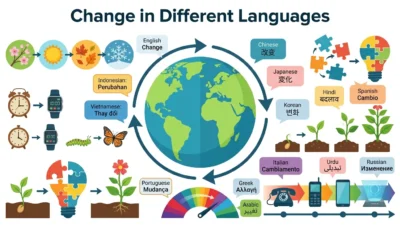
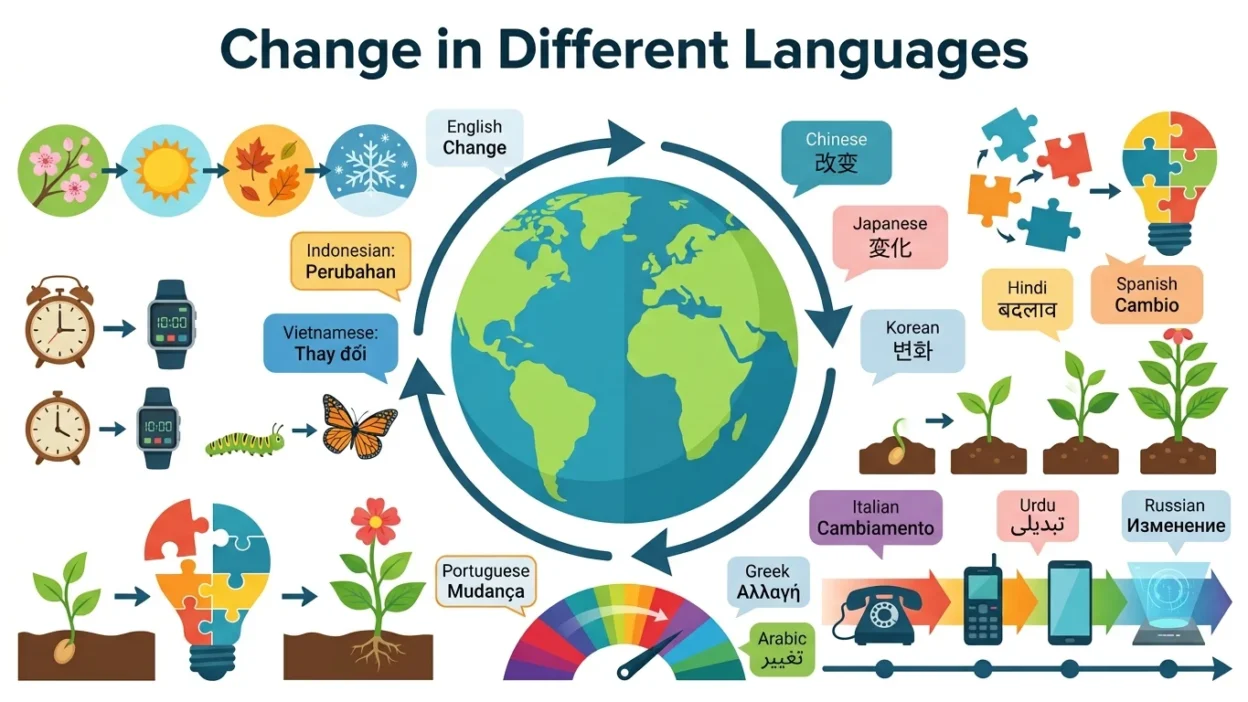
The word change can mean to make something different, replace something, exchange one thing for another, or experience a transformation. Because its meaning changes with context, translations can vary between languages.
Change in Different Languages
| Language | Native Word | Easy English Pronunciation |
|---|---|---|
| English | Change | CHAYNJ |
| Spanish | Cambio | KAHM-byoh |
| French | Changement | Shahnj-MAHN |
| German | Veränderung | Fair-EN-deh-roong |
| Italian | Cambiamento | Kam-bya-MEN-toh |
| Portuguese | Mudança | Moo-DAN-sa |
| Dutch | Verandering | Fair-AN-deh-ring |
| Swedish | Förändring | Fur-EN-dring |
| Norwegian | Endring | EN-dring |
| Danish | Forandring | For-AN-dring |
| Finnish | Muutos | MOO-tos |
| Icelandic | Breyting | BRAY-ting |
| Irish | Athrú | AH-roo |
| Welsh | Newid | NOY-id |
| Scottish Gaelic | Atharrachadh | AH-ar-uh-kh |
| Polish | Zmiana | ZMYA-na |
| Czech | Změna | ZMYEH-na |
| Slovak | Zmena | ZMEH-na |
| Slovenian | Sprememba | SPREM-em-ba |
| Croatian | Promjena | PRO-mye-na |
| Serbian | Промена | PRO-me-na |
| Bosnian | Promjena | PRO-mye-na |
| Romanian | Schimbare | Skim-BA-reh |
| Hungarian | Változás | VAAL-toh-zhaash |
| Greek | Αλλαγή | A-la-GHEE |
| Language | Native Word | Easy English Pronunciation |
|---|---|---|
| Russian | Изменение | Iz-meh-NEE-ye |
| Ukrainian | Зміна | ZMI-na |
| Belarusian | Змена | ZME-na |
| Bulgarian | Промяна | Pro-MYA-na |
| Macedonian | Промена | Pro-MEH-na |
| Albanian | Ndryshim | NDRI-shim |
| Turkish | Değişim | Deh-GHEE-shim |
| Arabic | تغيير | Tagh-YEER |
| Hebrew | שינוי | Shin-NOO-ee |
| Persian | تغییر | Tagh-YEER |
| Kurdish | Guhertin | Goo-her-TEEN |
| Hindi | बदलाव | Ba-laav |
| Urdu | تبدیلی | Tab-DEE-lee |
| Punjabi | ਤਬਦੀਲੀ | Tab-dee-lee |
| Bengali | পরিবর্তন | Po-ri-bor-TON |
| Gujarati | ફેરફાર | Fair-faar |
| Marathi | बदल | Ba-dal |
| Nepali | परिवर्तन | Pa-ri-var-TAN |
| Sinhala | වෙනස | Veh-na-sa |
| Tamil | மாற்றம் | Maat-tam |
| Telugu | మార్పు | Maar-pu |
| Kannada | ಬದಲಾವಣೆ | Ba-da-laa-va-ne |
| Malayalam | മാറ്റം | Maat-tam |
| Thai | การเปลี่ยนแปลง | Gaan Bplìan Bplàeng |
| Vietnamese | Thay đổi | Tie Doy |
| Language | Native Word | Easy English Pronunciation |
|---|---|---|
| Indonesian | Perubahan | Peh-roo-BA-han |
| Malay | Perubahan | Peh-roo-BA-han |
| Filipino (Tagalog) | Pagbabago | Pag-ba-BA-go |
| Chinese (Mandarin) | 改变 | Gǎibiàn |
| Japanese | 変化 | Hen-ka |
| Korean | 변화 | Byeon-hwa |
| Mongolian | Өөрчлөлт | Oorch-lult |
| Burmese | ပြောင်းလဲမှု | Pyaung-leh-mu |
| Khmer | ការផ្លាស់ប្តូរ | Ka Plah-bdor |
| Lao | ການປ່ຽນແປງ | Gaan Bpian Bpaeng |
| Swahili | Mabadiliko | Ma-ba-di-LEE-ko |
| Zulu | Ushintsho | Oo-SHINT-sho |
| Afrikaans | Verandering | Fair-AN-deh-ring |
| Amharic | ለውጥ | Le-wut |
| Yoruba | Ìyípadà | Ee-yee-pa-DA |
| Hausa | Canji | CHAN-jee |
| Māori | Huringa | HOO-ri-nga |
| Hawaiian | Hoʻololi | Ho-oh-LO-lee |
| Samoan | Suiga | Soo-EE-ga |
| Esperanto | Ŝanĝo | SHAN-jo |
Why Learn “Change” in Different Languages?
Learning change in different languages is useful because it is one of the most common words in everyday communication. It can describe changes in life, weather, plans, habits, prices, appearance, technology, or circumstances.
How to Say “Change” in Different Languages
The translation of change depends heavily on context. For example, “change your clothes,” “change your mind,” “a change in weather,” and “spare change” may require different words or expressions in another language.
Change as a Noun and Verb
In English, change can work as both a noun and a verb.
- Verb: I want to change my plans.
- Noun: The change was unexpected.
- Money: Do you have any change?
- Transformation: The city has undergone major changes.
Change in Everyday Conversation
The word change appears in many common expressions, such as:
- Change your mind
- Change your plans
- Change your clothes
- Change the subject
- Change the date
- Change your habits
Related Vocabulary
After learning change in different languages, you may also want to explore:
- Different in Different Languages
- New in Different Languages
- Same in Different Languages
- Transform in Different Languages
- Difference in Different Languages
- Improve in Different Languages
Tips for Learning “Change”
- Learn both the noun and verb forms.
- Practice the word in different contexts.
- Pay attention to formal and informal expressions.
- Learn related words such as new, different, replace, and transform.
- Use complete sentences to remember the meaning.
Conclusion
Learning change in different languages is a useful way to expand everyday vocabulary. These 70 translations cover languages from Europe, Asia, Africa, Oceania, and beyond, while showing how different cultures express the idea of transformation and difference.
Frequently Asked Questions
1. What is “change” in Spanish?
Cambio means change in Spanish. It can refer to a change, exchange, or alteration depending on context.
2. What is “change” in French?
Changement is a common French noun meaning change.
3. What is “change” in Hindi?
बदलाव (Badlaav) commonly means change or alteration in Hindi.
4. What is “change” in Urdu?
تبدیلی (Tabdeeli) means change or alteration in Urdu.
5. What is “change” in Arabic?
تغيير (Taghyīr) commonly means change or alteration in Arabic.
6. What is “change” in Japanese?
変化 (Henka) means change, variation, or transformation in Japanese.
7. What should I learn after “change”?
You can learn different, same, new, old, improve, transform, and difference in different languages.

Daniel Whitmore is a language writer and editor from the United Kingdom who is passionate about making language learning accessible to everyone. He specializes in English grammar, vocabulary, spelling differences, pronunciation, and multilingual communication. His articles break down complex language concepts into clear, practical lessons that readers can apply in everyday conversations and writing. Daniel enjoys exploring the history, culture, and evolution of languages while creating engaging content for students, educators, travelers, and language enthusiasts. His goal is to provide accurate, reader-friendly resources that help people build confidence in learning English and other world languages through simple explanations and real-life examples.