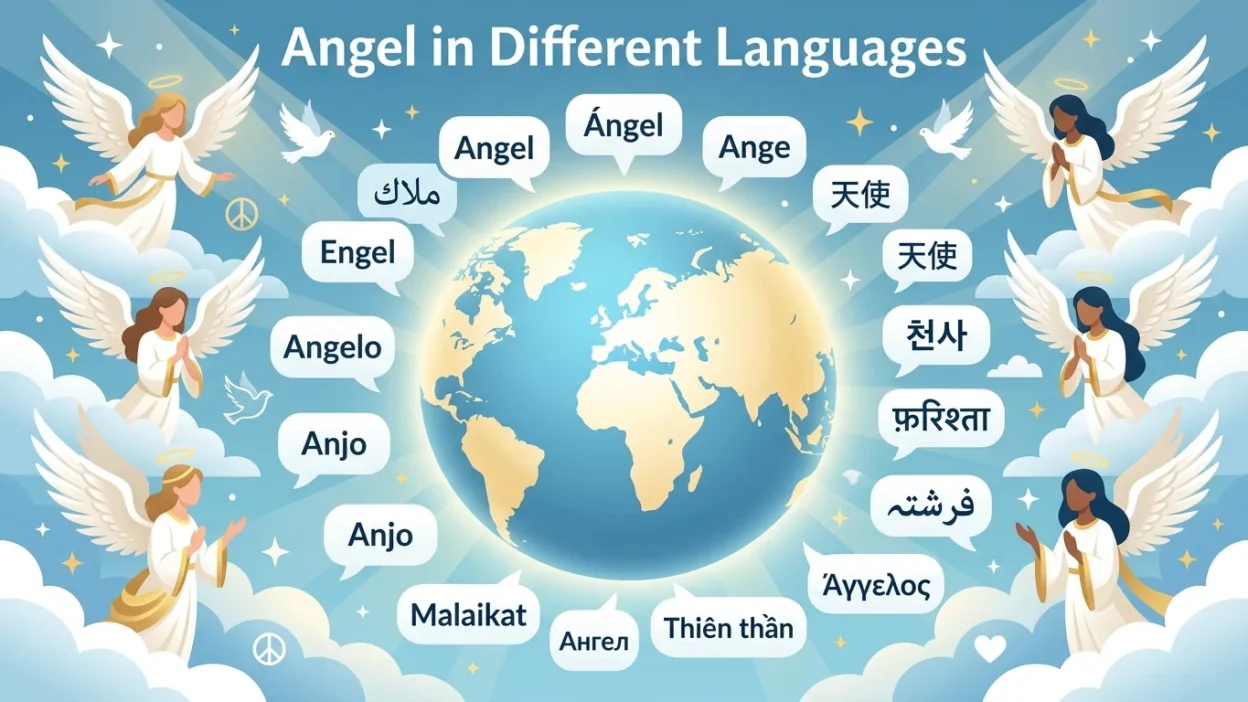
An angel is a spiritual or heavenly being found in many religions and cultures. The word is also used to describe someone who is kind, gentle, caring, or beautiful. Learning angel in different languages is useful for language learners, travelers, writers, and anyone interested in world cultures and religions.
This guide includes angel translations with easy English pronunciations. If you’re searching for angel in all languages or how to say angel in different languages, this collection is the perfect place to begin.
Angel in Different Languages (1–25)
| Language | Native Word | Easy English Pronunciation |
|---|---|---|
| English | Angel | AYN-jel |
| Spanish | Ángel | AHN-hel |
| French | Ange | AHNZH |
| German | Engel | ENG-el |
| Italian | Angelo | AN-je-lo |
| Portuguese | Anjo | AHN-zhoo |
| Dutch | Engel | ENG-el |
| Swedish | Ängel | ENG-el |
| Norwegian | Engel | ENG-el |
| Danish | Engel | ENG-el |
| Finnish | Enkeli | EN-ke-lee |
| Icelandic | Engill | EN-gitl |
| Irish | Aingeal | AN-gyal |
| Welsh | Angel | AN-gel |
| Scottish Gaelic | Aingeal | AN-gyal |
| Polish | Anioł | AN-yow |
| Czech | Anděl | AN-dyel |
| Slovak | Anjel | AN-yel |
| Slovenian | Angel | AN-gel |
| Croatian | Anđeo | AN-jeh-oh |
| Serbian | Анђео | AN-jeh-oh |
| Bosnian | Anđeo | AN-jeh-oh |
| Romanian | Înger | EEN-jer |
| Hungarian | Angyal | AN-dyal |
| Greek | Άγγελος | AN-ghe-los |
Angel in Different Languages (26–50)
| Language | Native Word | Easy English Pronunciation |
|---|---|---|
| Russian | Ангел | AN-gel |
| Ukrainian | Ангел | AN-gel |
| Belarusian | Анёл | An-YOL |
| Bulgarian | Ангел | AN-gel |
| Macedonian | Ангел | AN-gel |
| Albanian | Engjëll | En-GYELL |
| Turkish | Melek | Meh-LEK |
| Arabic | ملاك | Ma-LAAK |
| Hebrew | מלאך | Mal-AKH |
| Persian | فرشته | Fe-RESH-teh |
| Kurdish | Ferişte | Fe-REESH-teh |
| Hindi | फ़रिश्ता | Fa-RISH-ta |
| Urdu | فرشتہ | Fa-RISH-ta |
| Punjabi | ਫ਼ਰਿਸ਼ਤਾ | Fa-RISH-ta |
| Bengali | ফেরেশতা | Fe-RESH-ta |
| Gujarati | દેવદૂત | Dev-DOOT |
| Marathi | देवदूत | Dev-DOOT |
| Nepali | स्वर्गदूत | Swar-ga-DOOT |
| Sinhala | දේවදූතයා | Day-va-DOO-ta-ya |
| Tamil | தேவதை | De-va-thai |
| Telugu | దేవదూత | De-va-DOO-ta |
| Kannada | ದೇವದೂತ | De-va-DOO-ta |
| Malayalam | മാലാഖ | Ma-la-KHA |
| Thai | นางฟ้า | Nang Fa |
| Vietnamese | Thiên thần | Thi-en Than |
Angel in Different Languages (51–70)
| Language | Native Word | Easy English Pronunciation |
|---|---|---|
| Indonesian | Malaikat | Ma-lai-kat |
| Malay | Malaikat | Ma-lai-kat |
| Filipino (Tagalog) | Anghel | Ang-HEL |
| Chinese (Mandarin) | 天使 | Tiān Shǐ |
| Japanese | 天使 | Ten-shi |
| Korean | 천사 | Cheon-sa |
| Mongolian | Тэнгэр элч | Ten-ger Elch |
| Burmese | ကောင်းကင်တမန် | Kaung-Kin Ta-Man |
| Khmer | ទេវតា | Te-ve-da |
| Lao | ເທວະດາ | The-wa-da |
| Swahili | Malaika | Ma-lai-ka |
| Zulu | Ingelosi | In-ge-LO-si |
| Afrikaans | Engel | ENG-el |
| Amharic | መልአክ | Mel-ak |
| Yoruba | Áńgẹ́lì | AN-ge-li |
| Hausa | Mala’ika | Ma-la-ee-ka |
| Maori | Anahera | A-na-HE-ra |
| Hawaiian | ʻAnela | Ah-NEH-la |
| Samoan | Agelu | Ah-NGEH-loo |
| Esperanto | Anĝelo | An-JEH-lo |
Why Learn “Angel” in Different Languages?
Learning angel in different languages helps you explore religious traditions, literature, art, and everyday expressions. In many cultures, the word angel is also used as a compliment for someone who is kind, caring, or beautiful.
How to Say “Angel” in Different Languages
If you’re searching for how to say angel in different languages, learning both the native spelling and pronunciation will help you recognize the word in books, songs, religious texts, and conversations around the world.
Angel Translations Around the World
These angel translations are widely used across Europe, Asia, Africa, the Americas, and Oceania. While many languages derive the word from ancient religious traditions, others have unique native terms with the same meaning.
Related Spiritual Vocabulary
After learning angel in different languages, you may also want to learn:
- Heaven in Different Languages
- God in Different Languages
- Prayer in Different Languages
- Peace in Different Languages
- Blessing in Different Languages
- Faith in Different Languages
Tips for Learning Spiritual Vocabulary
- Practice pronunciation with native speakers.
- Learn the cultural and religious context of each word.
- Read stories and literature using these terms.
- Compare similar words across related languages.
- Review vocabulary regularly for long-term retention.
Conclusion
Learning angel in different languages is a meaningful way to expand your vocabulary while discovering religious, cultural, and literary traditions from around the world. These 70 translations provide a valuable resource for students, travelers, writers, and language enthusiasts.
Frequently Asked Questions
1. How do you say “angel” in different languages?
Examples include Ángel (Spanish), Ange (French), Engel (German), 天使 (Tiānshǐ) (Chinese), and 天使 (Tenshi) (Japanese).
2. Are these translations commonly used?
Yes. These are standard words recognized and used by native speakers in both religious and everyday contexts.
3. Is “angel” always used in a religious sense?
No. In many languages, angel is also used to describe someone who is kind, gentle, innocent, or exceptionally caring.
4. Do all cultures have the concept of angels?
Many religions and cultures have similar concepts of heavenly or spiritual messengers, although the names and beliefs may differ.
5. What should I learn after “angel”?
You can continue with words like heaven, faith, prayer, peace, hope, and blessing to expand your spiritual vocabulary.

Oliver Bennett is a UK-based language writer and editor with a passion for making language learning simple and engaging. He specializes in English grammar, vocabulary, spelling differences, and multilingual communication. His articles focus on practical language tips, clear explanations, and real-world examples that help students, writers, and English learners improve their skills. Oliver enjoys exploring the connections between different languages and cultures while creating educational content that is accurate, easy to understand, and reader-friendly. Through his work, he aims to make learning languages accessible and enjoyable for everyone.