
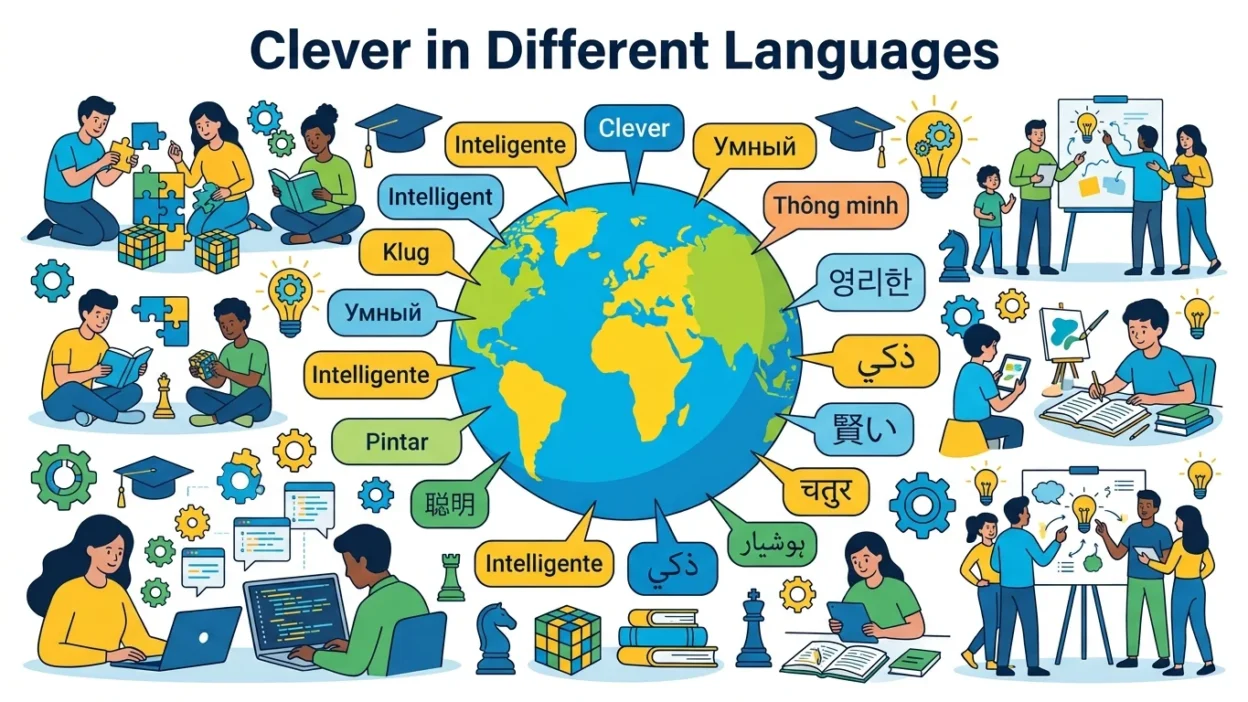
The word clever describes someone who is intelligent, smart, quick-thinking, resourceful, or skillful. It is commonly used to compliment a person’s ability to solve problems, learn quickly, or think creatively. Learning clever in different languages helps you expand your everyday vocabulary and communicate positive qualities across cultures.
This guide includes clever translations with easy English pronunciations. If you’re searching for clever in all languages or how to say clever in different languages, this collection is the perfect place to begin.
Clever in Different Languages (1–25)
Clever in Different Languages (26–50)
| Language | Native Word | Easy English Pronunciation |
|---|---|---|
| Russian | Умный | OOM-niy |
| Ukrainian | Розумний | Ro-ZOOM-nee |
| Belarusian | Разумны | Ra-ZOOM-nih |
| Bulgarian | Умен | OO-men |
| Macedonian | Паметен | PA-me-ten |
| Albanian | I zgjuar | Ee ZGYOO-ar |
| Turkish | Zeki | Zeh-KEE |
| Arabic | ذكي | Dha-KEE |
| Hebrew | חכם | Kha-KHAM |
| Persian | باهوش | Ba-HOOSH |
| Kurdish | Zîrek | Zee-REK |
| Hindi | चतुर | Cha-TUR |
| Urdu | ہوشیار | Ho-shi-YAAR |
| Punjabi | ਹੁਸ਼ਿਆਰ | Hu-shi-YAAR |
| Bengali | চতুর | Cho-TUR |
| Gujarati | હોશિયાર | Ho-shi-YAAR |
| Marathi | हुशार | Hu-SHAAR |
| Nepali | चलाख | Cha-LAAKH |
| Sinhala | බුද්ධිමත් | Bud-dhi-math |
| Tamil | புத்திசாலி | Put-thi-saa-lee |
| Telugu | తెలివైన | Te-li-VAI-na |
| Kannada | ಬುದ್ಧಿವಂತ | Bud-dhi-van-ta |
| Malayalam | ബുദ്ധിമാൻ | Bud-dhi-maan |
| Thai | ฉลาด | Cha-Laat |
| Vietnamese | Thông minh | Thong Min |
Clever in Different Languages (51–70)
| Language | Native Word | Easy English Pronunciation |
|---|---|---|
| Indonesian | Pintar | Pin-tar |
| Malay | Pintar | Pin-tar |
| Filipino (Tagalog) | Matalino | Ma-ta-LEE-no |
| Chinese (Mandarin) | 聪明 | Cōng Míng |
| Japanese | 賢い | Ka-shi-KOI |
| Korean | 영리한 | Yeong-ri-han |
| Mongolian | Ухаалаг | Oo-khaa-lag |
| Burmese | ဉာဏ်ကောင်း | Nyan-Kaung |
| Khmer | ឆ្លាត | Chhlat |
| Lao | ສະຫຼາດ | Sa-Laat |
| Swahili | Mwenye akili | Mwen-yeh Ah-KEE-lee |
| Zulu | Hlakaniphile | Hla-ka-ni-PHEE-le |
| Afrikaans | Slim | Slim |
| Amharic | ጥበበኛ | Ti-be-be-nya |
| Yoruba | Ọlọ́gbọ́n | O-lor-gbon |
| Hausa | Mai hankali | My Han-ka-lee |
| Maori | Mātau | Maa-tow |
| Hawaiian | Naʻauao | Na-ah-oo-AH-oh |
| Samoan | Atamai | A-ta-MY |
| Esperanto | Saĝa | SAH-ja |
Why Learn “Clever” in Different Languages?
Learning clever in different languages helps you compliment people’s intelligence, creativity, and problem-solving abilities. It’s a useful adjective for everyday conversations, education, travel, and language learning.
How to Say “Clever” in Different Languages
If you’re searching for how to say clever in different languages, these translations cover some of the world’s most widely spoken languages. In some languages, the same word can also mean smart, wise, or intelligent, depending on the context.
Clever Translations Around the World
These clever translations are commonly used across Europe, Asia, Africa, the Americas, and Oceania. While many languages have a direct equivalent, others may choose different words based on whether someone is academically intelligent, practically skilled, or quick-witted.
Related Vocabulary
After learning clever in different languages, you may also want to learn:
- Smart in Different Languages
- Intelligent in Different Languages
- Wise in Different Languages
- Creative in Different Languages
- Genius in Different Languages
- Knowledge in Different Languages
Tips for Learning Adjectives
- Learn adjectives together with their opposites.
- Practice using them in everyday conversations.
- Listen to native speakers for natural pronunciation.
- Create simple example sentences for each word.
- Review vocabulary regularly to improve retention.
Conclusion
Learning clever in different languages is a great way to expand your descriptive vocabulary and communicate compliments across cultures. These 70 translations are useful for students, travelers, educators, and language enthusiasts.
Frequently Asked Questions
1. How do you say “clever” in different languages?
Examples include Inteligente (Spanish), Intelligent (French), Klug (German), 聪明 (Cōngmíng) (Chinese), and 賢い (Kashikoi) (Japanese).
2. Is “clever” the same as “smart”?
Often, yes. However, clever usually emphasizes quick thinking or ingenuity, while smart can refer more broadly to intelligence or knowledge.
3. Are these translations commonly used?
Yes. These are standard words widely used by native speakers, though some languages may have additional words for different types of intelligence.
4. Why should I learn descriptive adjectives?
Descriptive adjectives help you express opinions, give compliments, and communicate more naturally in everyday conversations.
5. What should I learn after “clever”?
You can continue with smart, wise, creative, kind, brave, and friendly to build your descriptive vocabulary.

Ethan John is a content writer from the United Kingdom who focuses on language education and effective communication. He writes informative articles about grammar, pronunciation, translation, idioms, and language comparisons to help readers develop confidence in their reading and writing abilities. Ethan believes that learning a language should be practical, enjoyable, and relevant to everyday life. His content is designed for learners of all levels, offering clear guidance and useful insights into both English and other widely spoken languages around the world.