The word clouds refers to visible masses of water droplets or ice crystals floating in the sky. Clouds are an important part of weather, nature, and the water cycle. Learning clouds in different languages is useful for students, travelers, writers, and language learners.
Clouds in Different Languages (1–25)
| Language | Native Word | Easy English Pronunciation |
|---|---|---|
| English | Clouds | Klowdz |
| Spanish | Nubes | NOO-bes |
| French | Nuages | Nwee-AHZH |
| German | Wolken | VOL-ken |
| Italian | Nuvole | NOO-vo-le |
| Portuguese | Nuvens | NOO-vens |
| Dutch | Wolken | VOL-ken |
| Swedish | Moln | Moln |
| Norwegian | Skyer | SKOO-er |
| Danish | Skyer | SKOO-er |
| Finnish | Pilvet | PEEL-vet |
| Icelandic | Ský | Skee |
| Irish | Scamaill | SKAM-il |
| Welsh | Cymylau | Kum-uh-LIE |
| Scottish Gaelic | Sgòthan | SKOH-han |
| Polish | Chmury | HMOOR-y |
| Czech | Mraky | MRAH-kee |
| Slovak | Mraky | MRAH-kee |
| Slovenian | Oblaki | Ob-LAH-kee |
| Croatian | Oblaci | Ob-LAH-tsee |
| Serbian | Облаци | Ob-LAH-tsee |
| Bosnian | Oblaci | Ob-LAH-tsee |
| Romanian | Nori | NOR-ee |
| Hungarian | Felhők | FEL-hurk |
| Greek | Σύννεφα | SEEN-eh-fa |
| Language | Native Word | Easy English Pronunciation |
|---|---|---|
| Russian | Облака | Ab-la-KA |
| Ukrainian | Хмари | KHMA-ry |
| Belarusian | Воблакі | Vo-BLA-kee |
| Bulgarian | Облаци | Ob-LA-tsi |
| Macedonian | Облаци | Ob-LA-tsee |
| Albanian | Retë | REH-tuh |
| Turkish | Bulutlar | Boo-LOOT-lar |
| Arabic | سحب | Su-HUB |
| Hebrew | עננים | A-na-NEEM |
| Persian | ابرها | Abr-HA |
| Kurdish | Hewr | Hehr |
| Hindi | बादल | BAA-dal |
| Urdu | بادل | BAA-dal |
| Punjabi | ਬੱਦਲ | BAD-dal |
| Bengali | মেঘ | Megh |
| Gujarati | વાદળો | VAA-da-lo |
| Marathi | ढग | Dhug |
| Nepali | बादलहरू | BAA-dal-ha-roo |
| Sinhala | වලාකුළු | Va-la-KOO-loo |
| Tamil | மேகங்கள் | May-gang-gal |
| Telugu | మేఘాలు | May-ghaa-loo |
| Kannada | ಮೋಡಗಳು | Mo-da-ga-loo |
| Malayalam | മേഘങ്ങൾ | May-ghang-gal |
| Thai | เมฆ | Mayk |
| Vietnamese | Mây | May |
| Language | Native Word | Easy English Pronunciation |
|---|---|---|
| Indonesian | Awan | Ah-wan |
| Malay | Awan | Ah-wan |
| Filipino (Tagalog) | Mga ulap | Ma-nga Oo-lap |
| Chinese (Mandarin) | 云 | Yún |
| Japanese | 雲 | Kumo |
| Korean | 구름 | Goo-reum |
| Mongolian | Үүл | Ool |
| Burmese | တိမ် | Taim |
| Khmer | ពពក | Po-pok |
| Lao | ເມກ | Mek |
| Swahili | Mawingu | Ma-WEEN-goo |
| Zulu | Amafu | A-ma-FOO |
| Afrikaans | Wolke | VOL-kuh |
| Amharic | ደመናዎች | De-me-na-woch |
| Yoruba | Awọsanma | A-woh-SAN-ma |
| Hausa | Gizagizai | Gee-za-GEE-zai |
| Maori | Kapua | Ka-POO-a |
| Hawaiian | Ao | AH-oh |
| Samoan | Ao | AH-oh |
| Esperanto | Nuboj | NOO-boy |
Why Learn “Clouds” in Different Languages?
Learning clouds in different languages is useful for talking about weather, nature, travel, photography, and everyday observations. It also gives language learners an easy way to build practical vocabulary.
How to Say “Clouds” in Different Languages
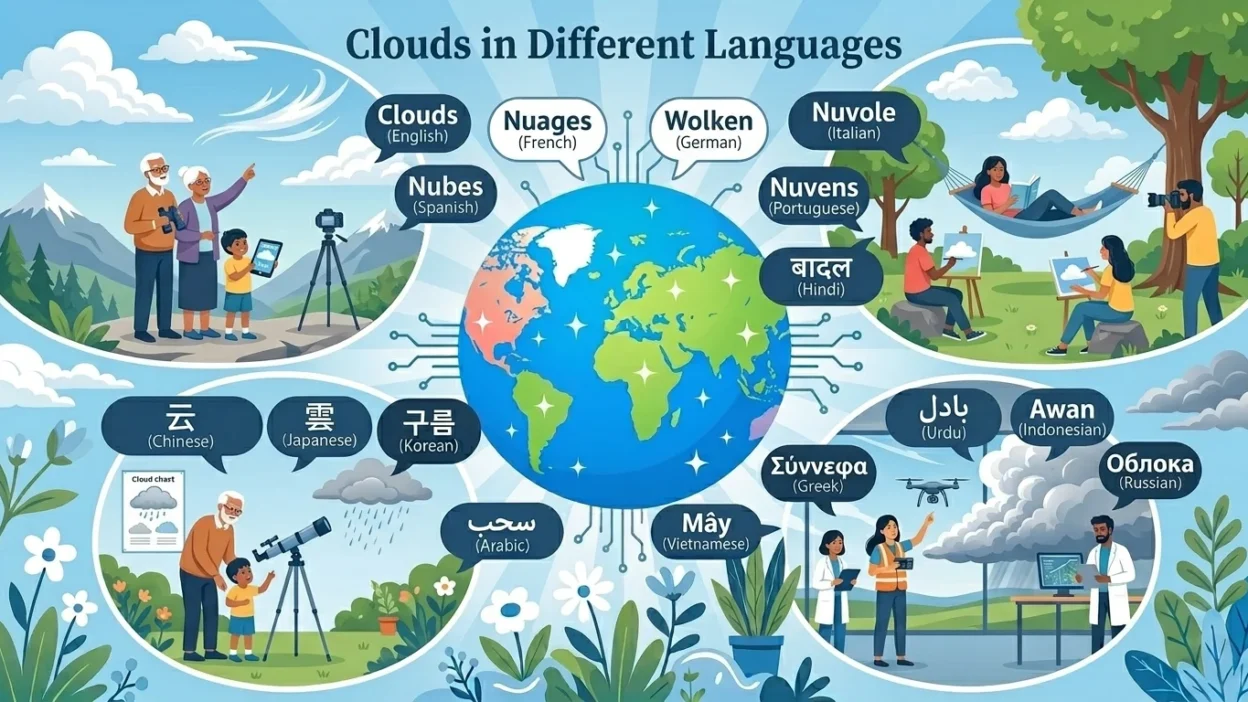
If you’re searching for how to say clouds in different languages, the table above provides the native word together with an easy pronunciation guide. This makes it easier to recognize and practice the vocabulary.
Clouds Translations Around the World
The word clouds has different forms across languages. Some languages have a specific plural form, while others use a collective noun or a word that can refer to clouds generally.
Related Weather Vocabulary
After learning clouds in different languages, you may also want to learn:
- Sky in Different Languages
- Rain in Different Languages
- Sun in Different Languages
- Wind in Different Languages
- Storm in Different Languages
- Snow in Different Languages
Tips for Learning Weather Words
- Practice the words while looking at the sky.
- Learn cloud and clouds together.
- Listen to weather forecasts in your target language.
- Create simple sentences about the weather.
- Review related nature vocabulary regularly.
Conclusion
Learning clouds in different languages is a fun and practical way to expand your weather vocabulary. These 70 translations can help students, travelers, writers, and language enthusiasts describe the sky in languages from around the world.
Frequently Asked Questions
1. How do you say “clouds” in different languages?
Examples include Nubes in Spanish, Nuages in French, Wolken in German, 云 (Yún) in Chinese, and 雲 (Kumo) in Japanese.
2. What is “clouds” in Arabic?
A common Arabic word for clouds is سحب (Suḥub).
3. What is “clouds” in Hindi?
बादल (Baadal) means cloud or clouds, depending on the context.
4. What is “clouds” in Urdu?
بادل (Baadal) is commonly used for cloud or clouds.
5. What is “clouds” in Japanese?
雲 (Kumo) means cloud and can refer to clouds depending on the sentence.
6. Why learn weather vocabulary?
Weather vocabulary is useful when traveling, making conversation, reading forecasts, and describing nature.
7. What should I learn after “clouds”?
Try learning rain, sky, sun, wind, snow, storm, and fog to build a larger weather vocabulary.