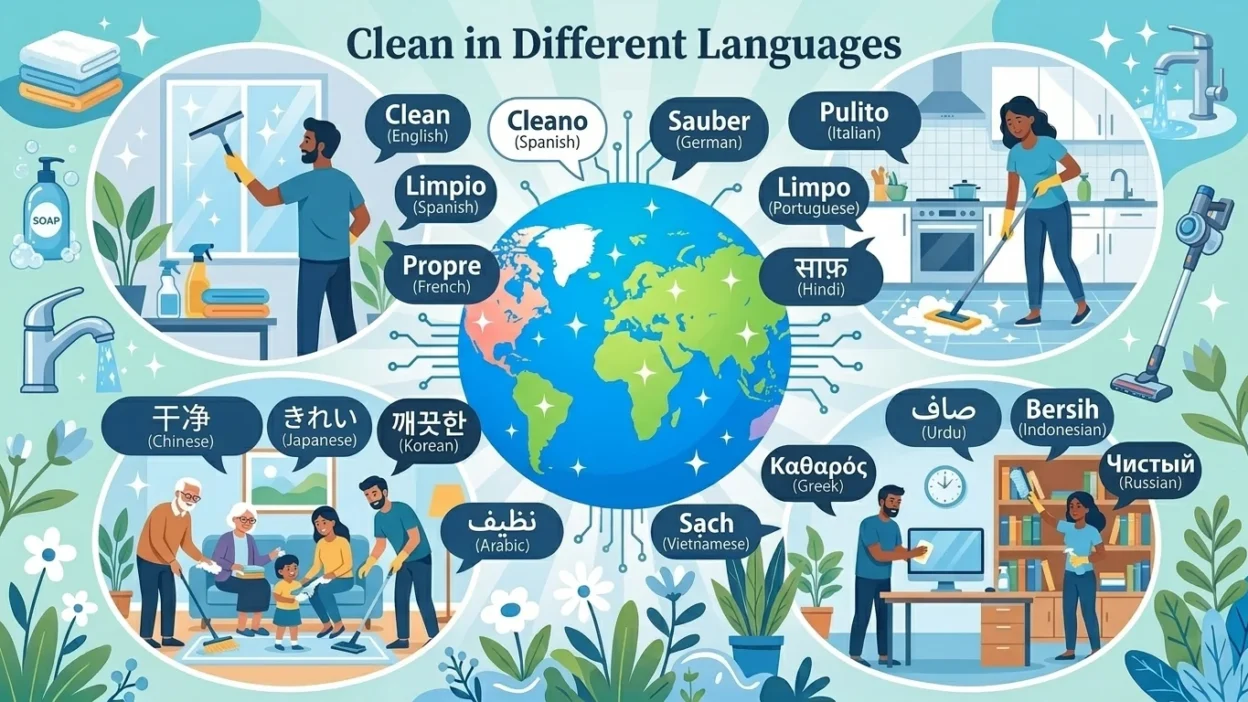
The word clean can describe something that is free from dirt, stains, or impurities. It can also mean neat, hygienic, or tidy. Learning clean in different languages is useful for travelers, students, and language learners.
Clean in Different Languages (1–25)
| Language | Native Word | Easy English Pronunciation |
|---|---|---|
| English | Clean | Kleen |
| Spanish | Limpio | LEEM-pyo |
| French | Propre | PRO-pruh |
| German | Sauber | ZOW-ber |
| Italian | Pulito | Poo-LEE-to |
| Portuguese | Limpo | LEEM-poo |
| Dutch | Schoon | Skhohn |
| Swedish | Ren | Ren |
| Norwegian | Ren | Ren |
| Danish | Ren | Ren |
| Finnish | Puhdas | POO-das |
| Icelandic | Hreinn | Hrayn |
| Irish | Glan | Glan |
| Welsh | Glân | Glaan |
| Scottish Gaelic | Glan | Glan |
| Polish | Czysty | CHIS-tee |
| Czech | Čistý | CHIS-tee |
| Slovak | Čistý | CHIS-tee |
| Slovenian | Čist | Cheest |
| Croatian | Čist | Cheest |
| Serbian | Чист | Cheest |
| Bosnian | Čist | Cheest |
| Romanian | Curat | Koo-RAT |
| Hungarian | Tiszta | TEES-taw |
| Greek | Καθαρός | Ka-tha-ROS |
| Language | Native Word | Easy English Pronunciation |
|---|---|---|
| Russian | Чистый | CHEES-ty |
| Ukrainian | Чистий | CHYS-tyy |
| Belarusian | Чысты | CHIS-ty |
| Bulgarian | Чист | Chist |
| Macedonian | Чист | Chist |
| Albanian | I pastër | Ee PAS-ter |
| Turkish | Temiz | Teh-MEEZ |
| Arabic | نظيف | Na-ZEEF |
| Hebrew | נקי | Na-KEE |
| Persian | تمیز | Ta-MEEZ |
| Kurdish | Paqij | Pa-KEEJ |
| Hindi | साफ़ | Saaf |
| Urdu | صاف | Saaf |
| Punjabi | ਸਾਫ਼ | Saaf |
| Bengali | পরিষ্কার | Po-ri-SHKAR |
| Gujarati | સ્વચ્છ | Swachh |
| Marathi | स्वच्छ | Swachh |
| Nepali | सफा | Sa-fa |
| Sinhala | පිරිසිදු | Pi-ri-si-du |
| Tamil | சுத்தமான | Sut-tha-maa-na |
| Telugu | శుభ్రమైన | Shu-bhra-mai-na |
| Kannada | ಸ್ವಚ್ಛ | Swa-chha |
| Malayalam | വൃത്തിയുള്ള | Vrit-thi-yul-la |
| Thai | สะอาด | Sa-at |
| Vietnamese | Sạch | Sak |
| Language | Native Word | Easy English Pronunciation |
|---|---|---|
| Indonesian | Bersih | Ber-seeh |
| Malay | Bersih | Ber-seeh |
| Filipino (Tagalog) | Malinis | Ma-li-NEES |
| Chinese (Mandarin) | 干净 | Gān-jìng |
| Japanese | きれい | Kee-reh-ee |
| Korean | 깨끗한 | Kkae-kkeut-han |
| Mongolian | Цэвэр | Tse-ver |
| Burmese | သန့်ရှင်း | Thant-shin |
| Khmer | ស្អាត | S’at |
| Lao | ສະອາດ | Sa-at |
| Swahili | Safi | SA-fee |
| Zulu | Hlanzekile | Hlan-zeh-KEH-leh |
| Afrikaans | Skoon | Skoohn |
| Amharic | ንጹህ | Nit-sooh |
| Yoruba | Mímọ́ | Mee-moh |
| Hausa | Tsabta | TSAB-ta |
| Maori | Mā | Maa |
| Hawaiian | Maʻemaʻe | Mah-eh-mah-eh |
| Samoan | Mamā | Ma-MAA |
| Esperanto | Pura | POO-ra |
Why Learn “Clean” in Different Languages?
Learning clean in different languages helps you talk about hygiene, household chores, travel, hotels, restaurants, and everyday situations. It is one of the most useful basic adjectives for language learners.
How to Say “Clean” in Different Languages
If you’re searching for how to say clean in different languages, learning the native spelling and pronunciation makes it easier to recognize the word in conversations, signs, instructions, and travel situations.
Clean Translations Around the World
These clean translations cover languages from Europe, Asia, Africa, and Oceania. Some languages use different words depending on whether clean means physically clean, tidy, pure, or hygienic.
Related Vocabulary
After learning clean in different languages, you may also want to explore:
- Cleanse in Different Languages
- Wash in Different Languages
- Soap in Different Languages
- Water in Different Languages
- Tidy in Different Languages
- Dirty in Different Languages
Tips for Learning “Clean”
- Practice the word in short sentences.
- Learn clean together with its opposite, dirty.
- Listen to native speakers for pronunciation.
- Use the word while describing rooms and objects.
- Review the vocabulary regularly.
Conclusion
Learning clean in different languages is a simple and practical way to expand your everyday vocabulary. These 70 translations can help students, travelers, writers, and language enthusiasts communicate more naturally around the world.
Frequently Asked Questions
1. How do you say “clean” in different languages?
Examples include Limpio in Spanish, Propre in French, Sauber in German, 干净 (Gānjìng) in Chinese, and きれい (Kirei) in Japanese.
2. Is “clean” always an adjective?
No. Clean can also be a verb. For example, “Please clean the room.”
3. What is “clean” in Arabic?
Clean can be translated as نظيف (Naẓīf), commonly used for something that is clean.
4. What is “clean” in Hindi?
A common translation is साफ़ (Saaf).
5. What is “clean” in Chinese?
干净 (Gānjìng) means clean or free from dirt.
6. What is the opposite of “clean”?
The most common opposite is dirty.
7. What should I learn next?
Useful related words include dirty, wash, soap, water, fresh, tidy, and hygiene.