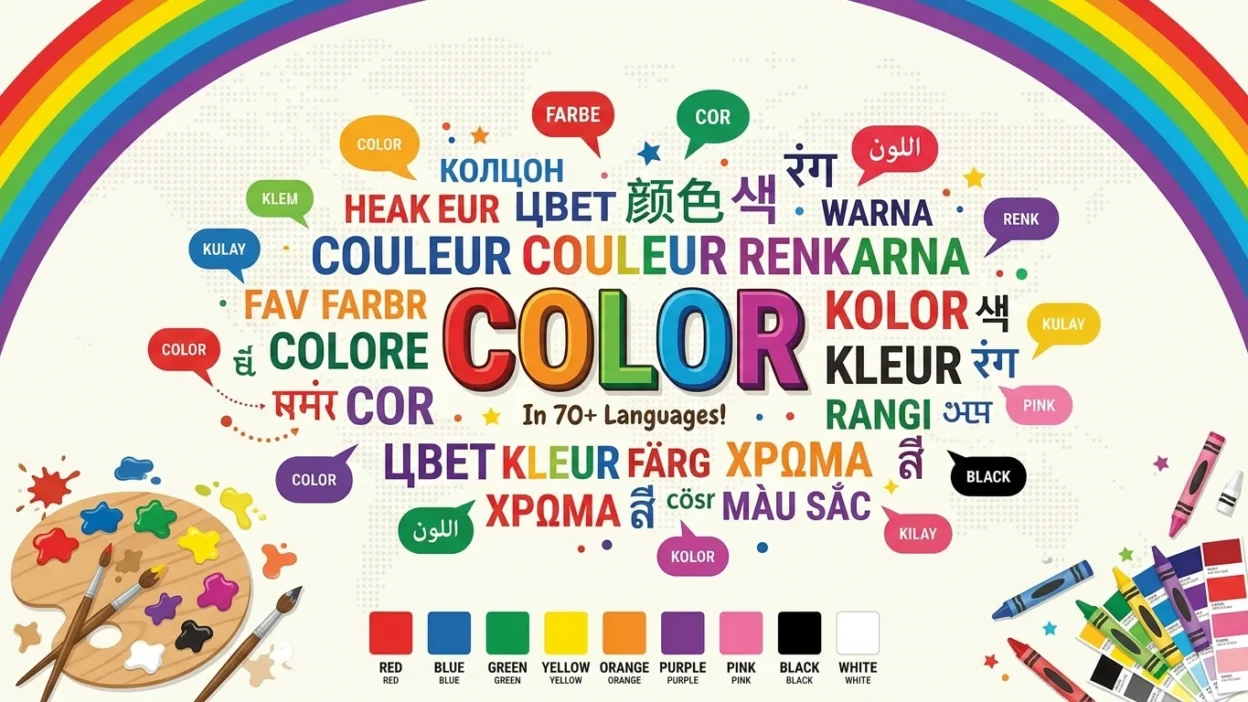
Color is an important part of everyday life. We use colors to describe clothes, flowers, food, nature, art, and almost everything we see around us. Learning how to say color in different languages is a fun way to improve your vocabulary and discover how people around the world communicate.
The word color has different translations depending on the language. For example, Spanish uses color, French uses couleur, German uses Farbe, and Japanese uses 色 (iro). Although the words sound different, they all refer to the colors and shades we see in the world.
In this guide, you will learn how to say color in 70 languages, explore native words, and discover easy pronunciations to help you remember each translation.
Color in 70 Different Languages
The following table includes the word for color in 70 languages, along with its native spelling and an easy English pronunciation guide. Pronunciations are approximate and may vary by region.
| Language | Native Word | Easy English Pronunciation |
|---|---|---|
| 1. English | Color | KUH-ler |
| 2. Spanish | Color | Koh-LOR |
| 3. French | Couleur | Koo-LUHR |
| 4. German | Farbe | FAR-buh |
| 5. Italian | Colore | Koh-LOH-reh |
| 6. Portuguese | Cor | KOR |
| 7. Dutch | Kleur | KLUHR |
| 8. Swedish | Färg | FEHR-y |
| 9. Norwegian | Farge | FAR-guh |
| 10. Danish | Farve | FAR-vuh |
| 11. Finnish | Väri | VAIR-ee |
| 12. Icelandic | Litur | LEE-tur |
| 13. Irish | Dath | DAH |
| 14. Welsh | Lliw | HLEE-oo |
| 15. Scottish Gaelic | Dath | DAH |
| 16. Polish | Kolor | KOH-lor |
| 17. Czech | Barva | BAR-vah |
| 18. Slovak | Farba | FAR-bah |
| 19. Slovenian | Barva | BAR-vah |
| 20. Croatian | Boja | BOH-yah |
| 21. Serbian | Боја | BOH-yah |
| 22. Bosnian | Boja | BOH-yah |
| 23. Romanian | Culoare | Koo-LWAH-reh |
| 24. Hungarian | Szín | SEEN |
| 25. Greek | Χρώμα | KHROH-mah |
| 26. Russian | Цвет | TSVYET |
| 27. Ukrainian | Колір | Koh-LEER |
| 28. Belarusian | Колер | KOH-lyer |
| 29. Bulgarian | Цвят | TSVYAT |
| 30. Macedonian | Боја | BOH-yah |
| 31. Albanian | Ngjyrë | NJUH-ruh |
| 32. Turkish | Renk | RENK |
| 33. Arabic | لون | LAWN |
| 34. Hebrew | צבע | TSEH-vah |
| 35. Persian | رنگ | RANG |
| 36. Kurdish | Reng | RENG |
| 37. Hindi | रंग | RUNG |
| 38. Urdu | رنگ | RUNG |
| 39. Punjabi | ਰੰਗ | RUNG |
| 40. Bengali | রং | RONG |
| 41. Gujarati | રંગ | RUNG |
| 42. Marathi | रंग | RUNG |
| 43. Nepali | रङ | RUNG |
| 44. Sinhala | වර්ණය | VAR-nah-yah |
| 45. Tamil | நிறம் | NEE-ram |
| 46. Telugu | రంగు | RUNG-goo |
| 47. Kannada | ಬಣ್ಣ | BUN-nah |
| 48. Malayalam | നിറം | NEE-ram |
| 49. Thai | สี | SEE |
| 50. Vietnamese | Màu sắc | MOW sahk |
| 51. Indonesian | Warna | WAR-nah |
| 52. Malay | Warna | WAR-nah |
| 53. Filipino (Tagalog) | Kulay | KOO-lie |
| 54. Chinese (Mandarin) | 颜色 | YAN-suh |
| 55. Japanese | 色 | EE-roh |
| 56. Korean | 색깔 | SAEK-kkal |
| 57. Mongolian | Өнгө | UN-guh |
| 58. Burmese | အရောင် | AH-yaung |
| 59. Khmer | ពណ៌ | PŌ |
| 60. Lao | ສີ | SEE |
| 61. Swahili | Rangi | RAHN-gee |
| 62. Zulu | Umbala | OOM-bah-lah |
| 63. Afrikaans | Kleur | KLUHR |
| 64. Amharic | ቀለም | KUH-lem |
| 65. Yoruba | Àwọ̀ | AH-woh |
| 66. Hausa | Launi | LOW-nee |
| 67. Māori | Tae | TIE |
| 68. Hawaiian | Kala | KAH-lah |
| 69. Samoan | Lanu | LAH-noo |
| 70. Esperanto | Koloro | Koh-LOH-roh |
What Does Color Mean?
Color is the visual quality we perceive when light reaches our eyes. It helps us identify objects, notice differences, express emotions, and describe the world around us.
For example, the sky may look blue, roses may be red, grass is often green, and a ripe banana is usually yellow.
The word can also have figurative meanings. Someone might say that a story has “color” when it is lively, interesting, or full of detail.
How to Say Color in Popular Languages
Here are some useful translations of the word color in widely spoken languages.
Color in Spanish
In Spanish, color is color, pronounced approximately koh-LOR.
Example: Me gusta este color.
Meaning: I like this color.
Color in French
The French word for color is couleur, pronounced approximately koo-LUHR.
Example: J’aime cette couleur.
Meaning: I like this color.
Color in German
In German, color is Farbe, pronounced approximately FAR-buh.
Example: Welche Farbe magst du?
Meaning: Which color do you like?
Color in Italian
The Italian word is colore, pronounced approximately koh-LOH-reh.
Example: Mi piace questo colore.
Meaning: I like this color.
Color in Arabic
In Arabic, color is لون, commonly transliterated as lawn.
Example: ما لون هذا؟
Meaning: What color is this?
Color in Hindi and Urdu
Hindi and Urdu both use रंग (rang) and رنگ (rang), respectively.
Example in Hindi: यह कौन सा रंग है?
Example in Urdu: یہ کون سا رنگ ہے؟
Meaning: What color is this?
Color in Chinese
In Mandarin Chinese, the word for color is 颜色 (yánsè), pronounced approximately yen-suh.
Example: 你喜欢什么颜色?
Meaning: What color do you like?
Color in Japanese
In Japanese, color is 色 (いろ, iro).
Example: 何色が好きですか?
Meaning: What color do you like?
Color in Korean
In Korean, color is commonly expressed as 색깔 (saekkkal).
Example: 무슨 색깔을 좋아해요?
Meaning: What color do you like?
Color in Portuguese
In Portuguese, cor means color. It is pronounced approximately kor.
Example: Qual é a sua cor favorita?
Meaning: What is your favorite color?
Color vs. Colour: What Is the Difference?
Color and colour have the same meaning. The difference is spelling, not definition.
- Color: The standard spelling in American English.
- Colour: The standard spelling in British English and many other varieties, including Australian and Canadian English.
Examples:
- American English: My favorite color is blue.
- British English: My favourite colour is blue.
Both forms are correct. Choose the spelling that matches your audience, and use it consistently throughout your writing.
Common Color Words in Different Languages
Once you know how to say color, learning the names of individual colors is the next step.
| English | Spanish | French | German | Italian |
|---|---|---|---|---|
| Red | Rojo | Rouge | Rot | Rosso |
| Blue | Azul | Bleu | Blau | Blu |
| Green | Verde | Vert | Grün | Verde |
| Yellow | Amarillo | Jaune | Gelb | Giallo |
| Black | Negro | Noir | Schwarz | Nero |
| White | Blanco | Blanc | Weiß | Bianco |
| Orange | Naranja | Orange | Orange | Arancione |
| Purple | Morado | Violet | Lila | Viola |
| Pink | Rosa | Rose | Rosa | Rosa |
| Brown | Marrón | Marron | Braun | Marrone |
These words are useful for describing objects, shopping for clothes, discussing artwork, and practicing everyday conversations.
Why Learn Color Words in Different Languages?
Learning color vocabulary can make language practice more practical and enjoyable.
- Improve everyday conversations: Describe clothes, food, vehicles, and other objects.
- Build vocabulary: Learn words that are easy to practice with objects around you.
- Explore other cultures: Discover how different languages express familiar ideas.
- Support travel: Ask about colors when shopping, ordering items, or choosing products.
- Help children learn: Use colorful toys, drawings, and flashcards to teach new words.
Easy Tips to Remember Color Translations
1. Use objects around you. Look at a red apple, a blue shirt, or a green plant and practice the relevant color word.
2. Learn words in groups. Study three to five colors at a time rather than memorizing a long list in one sitting.
3. Say each word aloud. Pronunciation practice helps you recognize and remember unfamiliar sounds.
4. Make flashcards. Put a color on one side and its translation on the other.
5. Practice with short sentences. Instead of learning only the word red, practice saying “The car is red” in your target language.
Frequently Asked Questions
How do you say color in different languages?
The word varies by language. Examples include color in Spanish, couleur in French, Farbe in German, rang in Hindi and Urdu, and iro in Japanese.
What is the most common translation of color?
There is no single translation shared by every language. Many European languages use words related to color or colour, while other languages have distinct native terms.
Is color spelled differently in British and American English?
Yes. Color is American English, while colour is British English. Both spellings are correct.
How do you say color in Japanese?
The Japanese word is 色 (iro), meaning color.
How do you say color in Chinese?
In Mandarin Chinese, color is 颜色 (yánsè).
How do you say color in Hindi and Urdu?
The word is rang: रंग in Hindi and رنگ in Urdu.
Why are color words different across languages?
Languages develop through different histories, cultures, and sound systems. As a result, familiar concepts often have different words and pronunciations across languages.
What is the best way to learn color words?
Start with common colors such as red, blue, green, yellow, black, and white. Practice them with real objects, pronunciation exercises, and short sentences.
Conclusion
Learning how to say color in 70 different languages is a simple way to expand your vocabulary and appreciate linguistic diversity. From couleur in French to Farbe in German and 色 (iro) in Japanese, each word offers another way to describe the world around us.
Start with a few languages, practice the words aloud, and connect them to objects you see every day. With regular practice, you can remember more color words and use them confidently in conversations, travel, and language learning.