Clothes are an essential part of everyday life. We wear them for comfort, protection, personal style, and cultural expression. From T-shirts and jeans to traditional dresses and formal suits, clothing plays an important role in every culture.
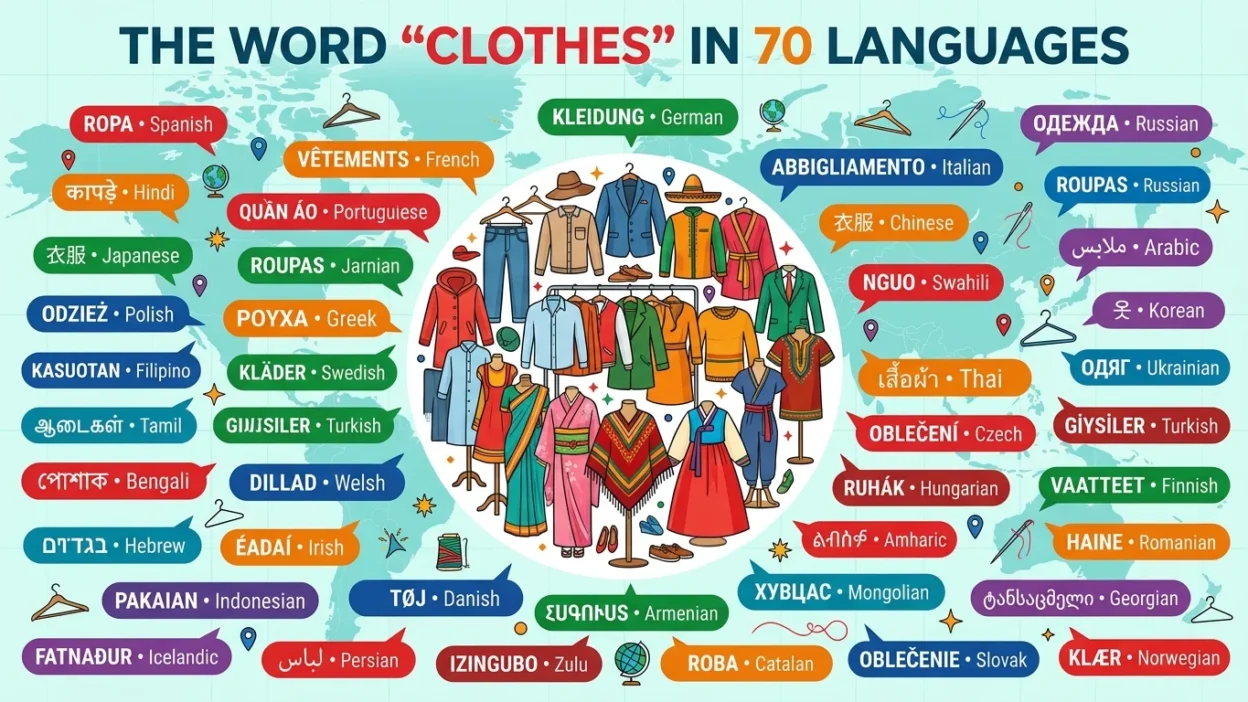
Learning how to say clothes in different languages is useful for travelers, students, language learners, and anyone interested in exploring other cultures. The word for clothes varies from one language to another. For example, Spanish uses ropa, French uses vêtements, German uses Kleidung, and Japanese uses 服 (fuku).
In this guide, you will discover how to say clothes in 70 languages, learn the native words, practice easy English pronunciations, and explore useful clothing vocabulary for everyday conversations.
Clothes in 70 Different Languages
The table below lists the word for clothes or clothing in 70 languages. Pronunciations are approximate guides for English speakers, and some languages use different words depending on the type of clothing or context.
| Language | Native Word | Easy English Pronunciation |
|---|---|---|
| 1. English | Clothes | KLOHZ |
| 2. Spanish | Ropa | ROH-pah |
| 3. French | Vêtements | VET-mahn |
| 4. German | Kleidung | KLY-dung |
| 5. Italian | Vestiti | Ves-TEE-tee |
| 6. Portuguese | Roupas | HOH-pas |
| 7. Dutch | Kleding | KLAY-ding |
| 8. Swedish | Kläder | KLEH-der |
| 9. Norwegian | Klær | KLAIR |
| 10. Danish | Tøj | TOY |
| 11. Finnish | Vaatteet | VAA-teht |
| 12. Icelandic | Föt | FUHT |
| 13. Irish | Éadaí | AY-dee |
| 14. Welsh | Dillad | DEE-thad |
| 15. Scottish Gaelic | Aodach | OO-dakh |
| 16. Polish | Ubrania | Oo-BRAH-nyah |
| 17. Czech | Oblečení | Ob-leh-CHEH-nee |
| 18. Slovak | Oblečenie | Ob-leh-CHEH-nyeh |
| 19. Slovenian | Oblačila | Ob-lah-CHEE-lah |
| 20. Croatian | Odjeća | OD-yeh-cha |
| 21. Serbian | Одећа | OD-yeh-cha |
| 22. Bosnian | Odjeća | OD-yeh-cha |
| 23. Romanian | Haine | HIGH-neh |
| 24. Hungarian | Ruhák | ROO-haak |
| 25. Greek | Ρούχα | ROO-kha |
| 26. Russian | Одежда | Ah-DYEZH-dah |
| 27. Ukrainian | Одяг | OH-dyah |
| 28. Belarusian | Адзенне | Ah-DZEN-nyeh |
| 29. Bulgarian | Дрехи | DREH-hee |
| 30. Macedonian | Облека | Ob-LEH-kah |
| 31. Albanian | Rroba | ROH-bah |
| 32. Turkish | Giysiler | GHEE-see-ler |
| 33. Arabic | ملابس | Ma-LAA-bis |
| 34. Hebrew | בגדים | Beh-gah-DEEM |
| 35. Persian | لباسها | Le-BAAS-haa |
| 36. Kurdish | Cil û berg | Jeel oo berg |
| 37. Hindi | कपड़े | KAP-ray |
| 38. Urdu | کپڑے | KAP-ray |
| 39. Punjabi | ਕੱਪੜੇ | KAP-ray |
| 40. Bengali | পোশাক | POH-shak |
| 41. Gujarati | કપડાં | KAP-daan |
| 42. Marathi | कपडे | KAP-day |
| 43. Nepali | लुगा | LOO-gaa |
| 44. Sinhala | ඇඳුම් | AN-dum |
| 45. Tamil | உடைகள் | Oo-dai-gal |
| 46. Telugu | బట్టలు | BUT-ta-loo |
| 47. Kannada | ಬಟ್ಟೆ | BUT-teh |
| 48. Malayalam | വസ്ത്രങ്ങൾ | VAS-tra-ngal |
| 49. Thai | เสื้อผ้า | Suea-phaa |
| 50. Vietnamese | Quần áo | KWHUN OW |
| 51. Indonesian | Pakaian | Pa-KAI-an |
| 52. Malay | Pakaian | Pa-KAI-an |
| 53. Filipino (Tagalog) | Damit | DAH-mit |
| 54. Chinese (Mandarin) | 衣服 | EE-foo |
| 55. Japanese | 服 | FOO-koo |
| 56. Korean | 옷 | OHT |
| 57. Mongolian | Хувцас | KHOOV-tsas |
| 58. Burmese | အဝတ်အစား | Ah-WUT-ah-ZAA |
| 59. Khmer | សម្លៀកបំពាក់ | Som-LEE-uhk-bom-PEAK |
| 60. Lao | ເຄື່ອງນຸ່ງ | Kheuang-noong |
| 61. Swahili | Nguo | NGWoh |
| 62. Zulu | Izingubo | Ee-zeen-GOO-boh |
| 63. Afrikaans | Klere | KLEE-ruh |
| 64. Amharic | ልብስ | Libs |
| 65. Yoruba | Aṣọ | Ah-SHAW |
| 66. Hausa | Tufafi | Too-FAH-fee |
| 67. Māori | Kākahu | KAA-kaa-hoo |
| 68. Hawaiian | Lole | LOH-leh |
| 69. Samoan | ʻOfu | OH-foo |
| 70. Esperanto | Vestoj | Ves-TOY |
What Does Clothes Mean?
Clothes are items people wear on their bodies, including shirts, trousers, skirts, dresses, jackets, coats, and other garments.
The word is commonly used as a plural noun in English. For example, we say “My clothes are clean,” rather than “My clothes is clean.”
The word clothing has a similar meaning but is often used as a general or uncountable noun. For example, “The store sells clothing for children.”
How to Say Clothes in Popular Languages
Here are some examples of how the word for clothes appears in everyday conversations across different languages.
Clothes in Spanish
In Spanish, clothes is ropa.
Example: Necesito comprar ropa nueva.
Meaning: I need to buy new clothes.
Clothes in French
In French, clothes is vêtements.
Example: J’achète des vêtements.
Meaning: I am buying clothes.
Clothes in German
In German, clothes or clothing is Kleidung.
Example: Ich brauche neue Kleidung.
Meaning: I need new clothes.
Clothes in Italian
In Italian, clothes is vestiti.
Example: Devo comprare dei vestiti.
Meaning: I need to buy some clothes.
Clothes in Arabic
In Arabic, clothes is ملابس (malābis).
Example: أحتاج إلى ملابس جديدة.
Meaning: I need new clothes.
Clothes in Hindi and Urdu
In Hindi, clothes is कपड़े (kapde). In Urdu, it is کپڑے (kapray).
Hindi example: मुझे नए कपड़े चाहिए।
Urdu example: مجھے نئے کپڑے چاہئیں۔
Meaning: I need new clothes.
Clothes in Chinese
In Mandarin Chinese, clothes is 衣服 (yīfu).
Example: 我想买新衣服。
Meaning: I want to buy new clothes.
Clothes in Japanese
In Japanese, clothes is 服 (fuku).
Example: 新しい服を買いたいです。
Meaning: I want to buy new clothes.
Clothes in Korean
In Korean, clothes is 옷 (ot).
Example: 새 옷을 사고 싶어요.
Meaning: I want to buy new clothes.
Clothes in Portuguese
In Portuguese, clothes is roupas.
Example: Preciso comprar roupas novas.
Meaning: I need to buy new clothes.
Common Types of Clothes in Different Languages
Knowing individual clothing names can help you shop, describe outfits, and talk about your personal style.
| English | Spanish | French | German | Italian |
|---|---|---|---|---|
| Shirt | Camisa | Chemise | Hemd | Camicia |
| T-shirt | Camiseta | T-shirt | T-Shirt | Maglietta |
| Trousers / Pants | Pantalones | Pantalon | Hose | Pantaloni |
| Dress | Vestido | Robe | Kleid | Vestito |
| Skirt | Falda | Jupe | Rock | Gonna |
| Jacket | Chaqueta | Veste | Jacke | Giacca |
| Coat | Abrigo | Manteau | Mantel | Cappotto |
| Shoes | Zapatos | Chaussures | Schuhe | Scarpe |
| Socks | Calcetines | Chaussettes | Socken | Calzini |
| Hat | Sombrero | Chapeau | Hut | Cappello |
Note: Some translations depend on the garment and regional usage. For example, French uses chemise for a shirt and pantalon for trousers, while English distinguishes between shirts, T-shirts, pants, and trousers.
Clothes vs. Clothing: What Is the Difference?
The words clothes and clothing are closely related, but they are used a little differently.
- Clothes: Common in everyday conversation when referring to the things people wear.
- Clothing: Often used in general descriptions, formal writing, retail, and product categories.
Examples:
- Clothes: “I put my clothes in the wardrobe.”
- Clothing: “The shop sells winter clothing.”
Another related word is garment, which refers to a single item of clothing. A shirt, dress, or jacket can each be called a garment.
Why Learn Clothes in Different Languages?
Learning clothing vocabulary offers several practical benefits.
- Travel more confidently: Ask for clothes in shops and markets while visiting another country.
- Improve conversations: Describe what you are wearing or ask about another person’s outfit.
- Shop internationally: Understand clothing labels and basic product descriptions.
- Explore cultural traditions: Learn the names of traditional garments worn around the world.
- Build vocabulary: Connect new words to items you already use every day.
Easy Tips to Remember Clothing Words
1. Label your wardrobe. Write the word for shirt, trousers, jacket, and shoes in the language you are learning.
2. Practice while getting dressed. Name each item of clothing as you put it on.
3. Learn related words together. Study clothes, colors, sizes, and shopping phrases as one vocabulary group.
4. Use short sentences. Practice phrases such as “I need a shirt” or “These shoes are comfortable.”
5. Review regularly. Spend a few minutes each day revisiting words you have already learned.
Frequently Asked Questions
How do you say clothes in different languages?
The word varies by language. Examples include ropa in Spanish, vêtements in French, Kleidung in German, kapde in Hindi, and fuku in Japanese.
What is the most common word for clothes?
There is no single word used across all languages. Each language has its own vocabulary, and some use different terms depending on whether they mean garments in general or particular items.
How do you say clothes in French?
The French word is vêtements, pronounced approximately VET-mahn.
How do you say clothes in Spanish?
The Spanish word is ropa, pronounced approximately ROH-pah.
What is the difference between clothes and clothing?
Both refer to items people wear. Clothes is common in everyday conversation, while clothing is often used as a general category or in more formal contexts.
How do you say clothes in Japanese?
The common Japanese word is 服 (fuku).
How do you say clothes in Hindi and Urdu?
Hindi uses कपड़े (kapde), while Urdu uses کپڑے (kapray).
Why should I learn clothing words in other languages?
Clothing vocabulary is useful for shopping, traveling, describing outfits, understanding labels, and having everyday conversations with speakers of other languages.
Conclusion
Learning how to say clothes in 70 different languages is a practical way to expand your vocabulary and explore cultures around the world. From ropa in Spanish and vêtements in French to 衣服 (yīfu) in Chinese and कपड़े (kapde) in Hindi, every language offers its own way to describe the things we wear.
Start with familiar items such as shirts, trousers, dresses, and shoes. Practice their names in a few languages, use them in simple sentences, and review them regularly to build confidence.

Oliver Bennett is a UK-based language writer and editor with a passion for making language learning simple and engaging. He specializes in English grammar, vocabulary, spelling differences, and multilingual communication. His articles focus on practical language tips, clear explanations, and real-world examples that help students, writers, and English learners improve their skills. Oliver enjoys exploring the connections between different languages and cultures while creating educational content that is accurate, easy to understand, and reader-friendly. Through his work, he aims to make learning languages accessible and enjoyable for everyone.