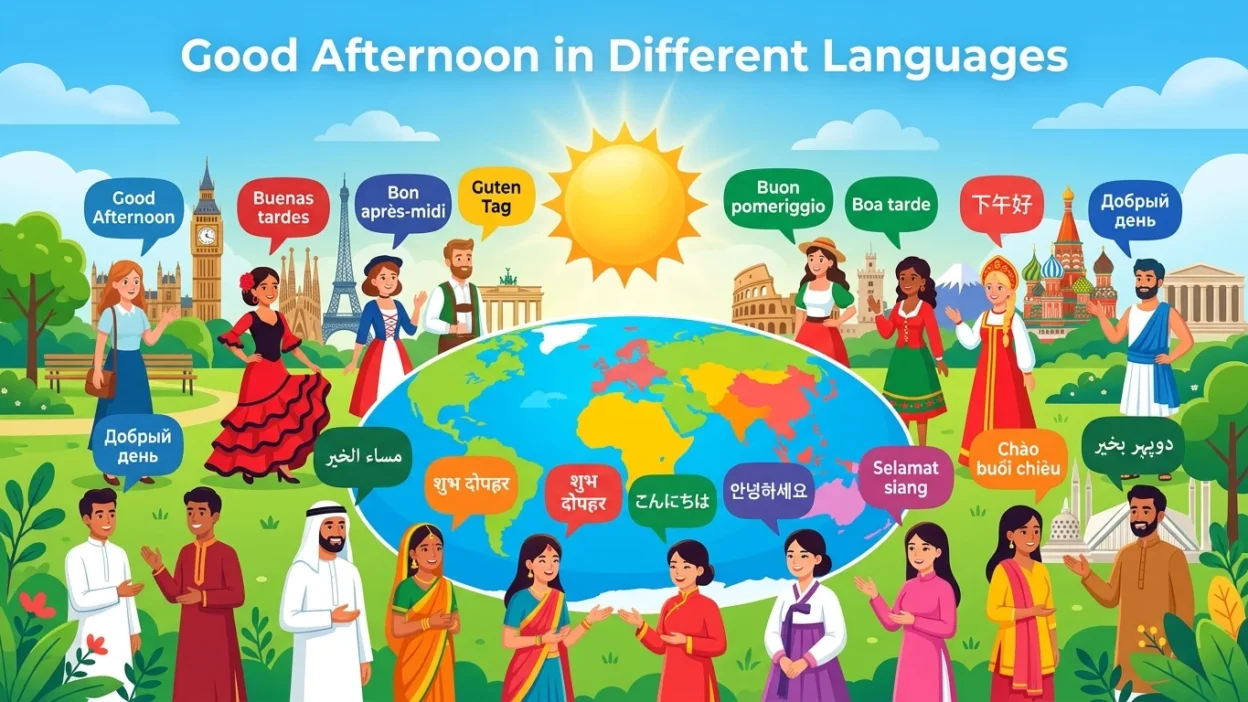
Saying good afternoon in different languages is a great way to greet people politely during the middle of the day. Whether you’re traveling, learning a new language, working with international colleagues, or simply exploring world cultures, knowing how to say “good afternoon” can help you communicate with confidence.
This guide includes good afternoon translations from around the world with easy English pronunciations. If you’re searching for good afternoon in all languages or how to say good afternoon in different languages, this list is the perfect place to start.
Good Afternoon in Different Languages (1–25)
| Language | Native Phrase | Easy English Pronunciation |
|---|---|---|
| English | Good afternoon | Good AF-ter-noon |
| Spanish | Buenas tardes | BWEH-nas TAR-des |
| French | Bon après-midi | Bon Ah-pray Mee-DEE |
| German | Guten Tag | GOO-ten Tahk |
| Italian | Buon pomeriggio | Bwon Poh-meh-REE-joh |
| Portuguese | Boa tarde | BO-ah TAR-je |
| Dutch | Goedemiddag | HOO-duh-MID-dakh |
| Swedish | God eftermiddag | Goo EF-ter-mid-dag |
| Norwegian | God ettermiddag | Goo ET-ter-mid-dag |
| Danish | God eftermiddag | Goo EF-ter-mid-dag |
| Finnish | Hyvää iltapäivää | HOO-vaa EEL-ta-pie-va |
| Icelandic | Góðan dag | GO-than Dahg |
| Irish | Tráthnóna maith | TRAW-no-na mah |
| Welsh | Prynhawn da | PRUN-hown dah |
| Scottish Gaelic | Feasgar math | FES-gar mah |
| Polish | Dzień dobry | Jen DOB-ri |
| Czech | Dobré odpoledne | DO-breh ODP-oh-led-neh |
| Slovak | Dobré popoludnie | DO-breh PO-po-lood-nye |
| Slovenian | Dober dan | DO-ber dan |
| Croatian | Dobar dan | DO-bar dan |
| Serbian | Добар дан | DO-bar dan |
| Bosnian | Dobar dan | DO-bar dan |
| Romanian | Bună ziua | BOO-na ZEE-wa |
| Hungarian | Jó napot | Yo NA-pot |
| Greek | Καλό απόγευμα | Ka-LO A-po-GHEV-ma |
| Language | Native Phrase | Easy English Pronunciation |
|---|---|---|
| Russian | Добрый день | DOB-riy DYEN |
| Ukrainian | Добрий день | DOB-ryi DEN |
| Belarusian | Добры дзень | DOB-ri DZEN |
| Bulgarian | Добър ден | DO-bar DEN |
| Macedonian | Добар ден | DO-bar DEN |
| Albanian | Mirëdita | Mee-re-DEE-ta |
| Turkish | Tünaydın | Too-NAI-dun |
| Arabic | مساء الخير | Ma-saa al-KHAIR |
| Hebrew | אחר צהריים טובים | A-khar TSO-ha-ra-yim To-veem |
| Persian | عصر بخیر | Asr be-kheyr |
| Kurdish | Êvar baş | EH-var bash |
| Hindi | शुभ दोपहर | Shubh Do-PA-har |
| Urdu | دوپہر بخیر | Do-pehar ba-khair |
| Punjabi | ਸ਼ੁੱਭ ਦੁਪਹਿਰ | Shubh Du-pe-hir |
| Bengali | শুভ অপরাহ্ন | Shubho O-po-RAHN-no |
| Gujarati | શુભ બપોર | Shubh Ba-por |
| Marathi | शुभ दुपार | Shubh Du-paar |
| Nepali | शुभ दिउँसो | Shubh Di-un-so |
| Sinhala | සුභ දහවල් | Suba Da-ha-wal |
| Tamil | இனிய பிற்பகல் | Iniya Pir-pa-kal |
| Telugu | శుభ మధ్యాహ్నం | Shubha Madh-yaa-hnam |
| Kannada | ಶುಭ ಮಧ್ಯಾಹ್ನ | Shubha Madh-yaa-hna |
| Malayalam | ശുഭ ഉച്ചയ്ക്ക് ശേഷം | Shubha Uch-cha-kku She-sham |
| Thai | สวัสดีตอนบ่าย | Sa-wat-dee Ton Bai |
| Vietnamese | Chào buổi chiều | Chow BOO-ee Chee-oo |
| Language | Native Phrase | Easy English Pronunciation |
|---|
| Indonesian | Selamat siang | Se-LA-mat SEE-ang |
| Malay | Selamat tengah hari | Se-LA-mat TENG-ah HA-ree |
| Filipino (Tagalog) | Magandang hapon | Ma-GAN-dang HA-pon |
| Chinese (Mandarin) | 下午好 | Shyah-Woo How |
| Japanese | こんにちは | Kon-ni-chi-wa |
| Korean | 안녕하세요 | An-nyeong-ha-se-yo |
| Mongolian | Өдрийн мэнд | Ur-drin Mend |
| Burmese | မင်္ဂလာနေ့လယ်ခင်းပါ | Ming-ga-la Nay-le Khin-ba |
| Khmer | សួស្តីពេលរសៀល | Suosdei Pel Re-siel |
| Lao | ສະບາຍດີຕອນບ່າຍ | Sa-bai-dee Ton Bai |
| Swahili | Habari za mchana | Ha-BA-ri za MCHA-na |
| Zulu | Sawubona ntambama | Sa-woo-BO-na Ntam-BA-ma |
| Afrikaans | Goeiemiddag | HOO-ee-MID-dakh |
| Amharic | እንደምን ዋላችሁ | En-de-min Wa-la-chew |
| Yoruba | E kaasan | Eh KAA-san |
| Hausa | Barka da rana | BAR-ka da RA-na |
| Maori | Kia ahiahi | Kee-ah A-hee-a-hee |
| Hawaiian | Aloha awakea | A-lo-ha A-wa-KE-a |
| Samoan | Manuia le aoauli | Ma-noo-ee-a leh A-o-au-li |
| Esperanto | Bonan posttagmezon | BO-nan Post-tag-MEH-zon |
Why Learn Good Afternoon in Different Languages?
Learning good afternoon in different languages helps you greet people politely during the middle of the day. It’s useful for travel, business meetings, language learning, and building better relationships with people from different cultures.
A simple afternoon greeting can make conversations feel more welcoming and respectful.
How to Say Good Afternoon in Different Languages
If you’re searching for how to say good afternoon in different languages, begin by learning the pronunciation and practicing the phrases daily. Repeating them in real conversations helps improve your confidence and speaking skills.
Good Afternoon Translations Around the World
These good afternoon translations are commonly used across Europe, Asia, Africa, the Americas, and the Middle East. Some languages have a unique phrase specifically for the afternoon, while others use a greeting that also works throughout the day.
Morning, Afternoon, Evening, and Night Greetings
Many learners study good morning, good afternoon, good evening, and good night in different languages together. Knowing all four greetings helps you communicate naturally at any time of day.
Tips for Learning Afternoon Greetings
- Learn a few greetings every week.
- Listen to native speakers for pronunciation.
- Practice with friends or language partners.
- Connect each phrase to its country.
- Review greetings regularly to remember them.
Conclusion
Learning good afternoon in different languages is an enjoyable way to explore world cultures and improve your communication skills. Whether you’re traveling, studying languages, or meeting international friends, these greetings help you make a positive and respectful impression.
Frequently Asked Questions
1. How do you say good afternoon in different languages?
Common examples include Buenas tardes (Spanish), Bon après-midi (French), Guten Tag (German), and こんにちは (Konnichiwa) in Japanese.
2. Why should I learn good afternoon in different languages?
It helps you communicate politely, understand different cultures, and greet people appropriately during the afternoon.
3. Is good afternoon different from good evening?
Yes. Good afternoon is used after noon until the early evening, while good evening is used later in the day.
4. Are these good afternoon translations accurate?
Yes. These are standard greetings widely used by native speakers, though regional variations may exist.
5. Can I use these greetings while traveling?
Absolutely. Using the local afternoon greeting is a respectful way to communicate and often creates a positive first impression.