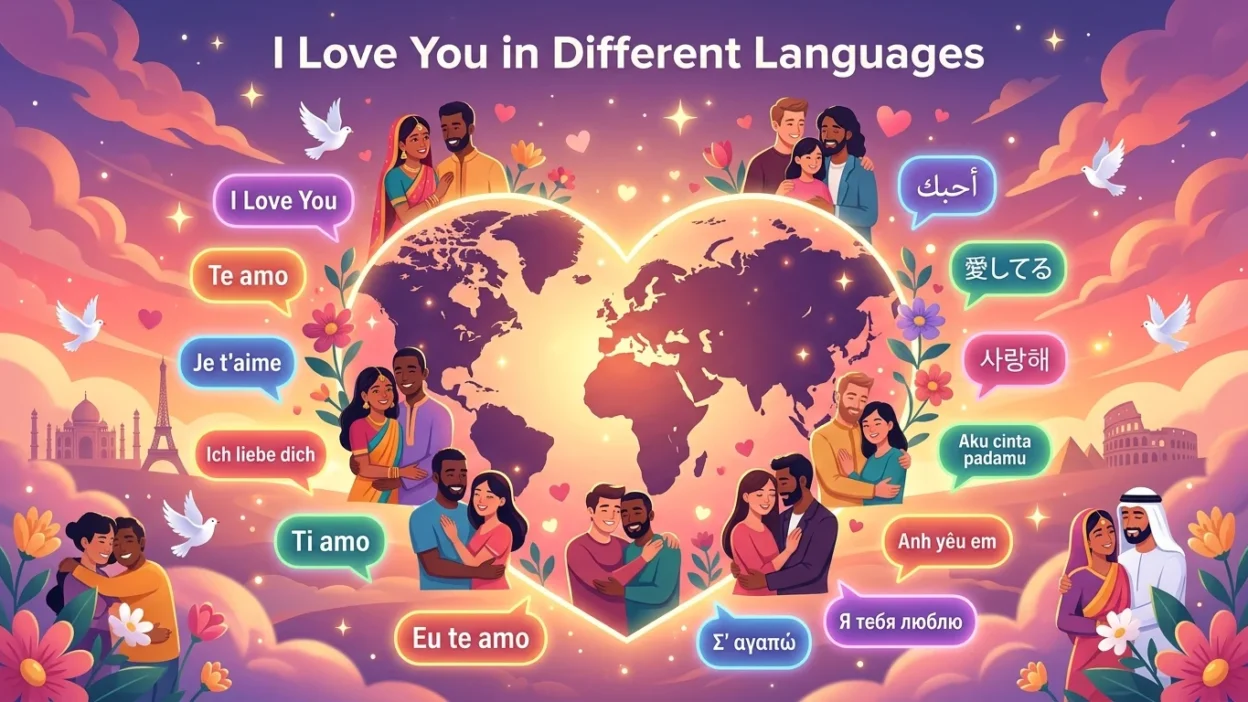
Saying I love you in different languages is a beautiful way to express affection and connect with people from different cultures. Whether you’re learning a new language, writing a heartfelt message, traveling, or simply curious about romantic expressions around the world, knowing how to say “I love you” in multiple languages can make your words even more meaningful.
This guide includes I love you translations with easy English pronunciations. If you’re searching for I love you in all languages or how to say I love you in different languages, this list is the perfect place to begin.
I Love You in Different Languages (1–25)
| Language | Native Phrase | Easy English Pronunciation |
|---|---|---|
| English | I love you | Eye Love You |
| Spanish | Te amo | Tay AH-mo |
| French | Je t’aime | Zhuh TEM |
| German | Ich liebe dich | Ikh LEE-buh Dikh |
| Italian | Ti amo | Tee AH-mo |
| Portuguese | Eu te amo | Eh-oo Tee AH-mo |
| Dutch | Ik hou van jou | Ik How Van Yow |
| Swedish | Jag älskar dig | Yag EL-skar Day |
| Norwegian | Jeg elsker deg | Yai EL-sker Die |
| Danish | Jeg elsker dig | Yai EL-sker Die |
| Finnish | Minä rakastan sinua | Mee-na RA-kas-tan See-noo-a |
| Icelandic | Ég elska þig | Yeg EL-ska Thig |
| Irish | Tá grá agam ort | Taw Graw Ag-um Urt |
| Welsh | Rwy’n dy garu di | Roo-in Duh GA-ri Dee |
| Scottish Gaelic | Tha gaol agam ort | Ha Gool Ag-um Ort |
| Polish | Kocham cię | KO-ham Chye |
| Czech | Miluji tě | MEE-loo-yi Tye |
| Slovak | Ľúbim ťa | LOO-bim Tya |
| Slovenian | Ljubim te | Lyoo-bim Te |
| Croatian | Volim te | VO-lim Te |
| Serbian | Волим те | VO-lim Te |
| Bosnian | Volim te | VO-lim Te |
| Romanian | Te iubesc | Te Yoo-BESK |
| Hungarian | Szeretlek | SE-ret-lek |
| Greek | Σ’ αγαπώ | Sa A-ga-PO |
| Language | Native Phrase | Easy English Pronunciation |
|---|
| Russian | Я тебя люблю | Ya Te-BYA Lyu-BLYU |
| Ukrainian | Я тебе кохаю | Ya Te-BE Ko-HA-yu |
| Belarusian | Я цябе кахаю | Ya Tsya-BE Ka-HA-yu |
| Bulgarian | Обичам те | O-bi-CHAM Te |
| Macedonian | Те сакам | Te SA-kam |
| Albanian | Të dua | Tuh DOO-ah |
| Turkish | Seni seviyorum | Se-ni Sev-ee-YO-rum |
| Arabic | أحبك | U-hib-bak (male) / U-hib-bik (female) |
| Hebrew | אני אוהב אותך | A-ni O-hev Ot-kha |
| Persian | دوستت دارم | Doos-tet Da-ram |
| Kurdish | Ez te hez dikim | Ez Te Hez Dee-kim |
| Hindi | मैं तुमसे प्यार करता हूँ | Main Tum-se Pyaar Kar-ta Hoon |
| Urdu | میں تم سے محبت کرتا ہوں | Main Tum Se Mohabbat Kar-ta Hoon |
| Punjabi | ਮੈਂ ਤੈਨੂੰ ਪਿਆਰ ਕਰਦਾ ਹਾਂ | Main Tai-nu Pyaar Kar-da Haan |
| Bengali | আমি তোমাকে ভালোবাসি | A-mi To-ma-ke Bha-lo-ba-shi |
| Gujarati | હું તને પ્રેમ કરું છું | Hoon Ta-ne Prem Ka-run Chhoo |
| Marathi | मी तुझ्यावर प्रेम करतो | Mee Tujh-ya-var Prem Kar-to |
| Nepali | म तिमीलाई माया गर्छु | Ma Ti-mi-lai Ma-ya Garchhu |
| Sinhala | මම ඔයාට ආදරෙයි | Ma-ma O-ya-ta Aa-da-rei |
| Tamil | நான் உன்னை காதலிக்கிறேன் | Naan Un-nai Kaa-tha-lik-ki-ren |
| Telugu | నేను నిన్ను ప్రేమిస్తున్నాను | Ne-nu Nin-nu Pre-min-stun-na-nu |
| Kannada | ನಾನು ನಿನ್ನನ್ನು ಪ್ರೀತಿಸುತ್ತೇನೆ | Naa-nu Nin-na-nnu Pree-ti-sut-tee-ne |
| Malayalam | ഞാൻ നിന്നെ സ്നേഹിക്കുന്നു | Njaan Nin-ne Sne-hi-kku-nnu |
| Thai | ฉันรักคุณ | Chan Rak Khun |
| Vietnamese | Anh yêu em / Em yêu anh | Anh Yew Em / Em Yew Anh |
| Language | Native Phrase | Easy English Pronunciation |
|---|---|---|
| Indonesian | Aku cinta padamu | Ah-koo CHIN-ta Pa-da-moo |
| Malay | Saya cinta padamu | Sa-ya CHIN-ta Pa-da-moo |
| Filipino (Tagalog) | Mahal kita | Ma-HAL Ki-ta |
| Chinese (Mandarin) | 我爱你 | Wo Ai Ni |
| Japanese | 愛してる | Ai Shi Te Ru |
| Korean | 사랑해 | Sa-rang-hae |
| Mongolian | Би чамд хайртай | Bee Chamd Khair-tai |
| Burmese | ငါနင့်ကိုချစ်တယ် | Nga Nin Ko Chit Tal |
| Khmer | ខ្ញុំស្រឡាញ់អ្នក | Khnyom Srolanh Neak |
| Lao | ຂ້ອຍຮັກເຈົ້າ | Khoy Hak Jao |
| Swahili | Nakupenda | Na-koo-PEN-da |
| Zulu | Ngiyakuthanda | Ngee-ya-koo-THAN-da |
| Afrikaans | Ek is lief vir jou | Ek Is Leef Fer Yow |
| Amharic | እወድሃለሁ | E-wed-ha-le-hu |
| Yoruba | Mo nifẹ rẹ | Mo Nee-feh Reh |
| Hausa | Ina son ka | Ee-na Son Ka |
| Maori | Aroha ahau ki a koe | A-ro-ha A-ha-u Kee A Ko-e |
| Hawaiian | Aloha au iā ʻoe | A-lo-ha Ow Ee-ah O-eh |
| Samoan | Ou te alofa ia te oe | Oo Te A-lo-fa Ee-a Te O-eh |
| Esperanto | Mi amas vin | Mee A-mas Vin |
Why Learn “I Love You” in Different Languages?
Learning I love you in different languages is a meaningful way to express affection across cultures. Whether you’re speaking to a partner, spouse, family member, or close friend, using someone’s native language can make your message feel more personal and heartfelt.
How to Say I Love You in Different Languages
If you’re wondering how to say I love you in different languages, begin by learning the pronunciation along with the native script. Practice saying each phrase naturally, especially if you’re planning a romantic surprise or traveling abroad.
I Love You Translations Around the World
These I love you translations are commonly used in countries across Europe, Asia, Africa, the Americas, and Oceania. Some languages even have different forms depending on the speaker’s gender or the level of formality.
Romantic Phrases in Different Languages
People who search for I love you in different languages also enjoy learning phrases such as good morning, good night, thank you, and happy birthday in different languages to communicate more naturally.
Tips for Remembering Love Phrases
- Learn a few phrases at a time.
- Listen to native pronunciation.
- Practice with language-learning apps or native speakers.
- Associate each phrase with its country.
- Use the phrases sincerely and in the right context.
Conclusion
Learning I love you in different languages is a beautiful way to celebrate love and strengthen connections with people around the world. Whether you’re writing a card, sending a message, or speaking face-to-face, these expressions can make your feelings more meaningful.
Frequently Asked Questions
1. How do you say “I love you” in different languages?
Popular examples include Te amo (Spanish), Je t’aime (French), Ich liebe dich (German), and 我爱你 (Wǒ ài nǐ) in Chinese.
2. Why should I learn “I love you” in different languages?
It helps you express your feelings in a thoughtful way, appreciate different cultures, and communicate more personally with people from around the world.
3. Are all “I love you” translations used in romantic relationships?
Not always. In some languages, there are separate expressions for romantic love, family love, or deep affection, so context matters.
4. Can I use these phrases while traveling?
Yes. If used respectfully and appropriately, these expressions can help you connect with native speakers and understand their language and culture.
5. Are these translations accurate?
Yes. These are standard and widely recognized expressions, though pronunciation and regional variations may differ.