Wishing someone have a good day in different languages is a thoughtful way to spread kindness and connect with people from different cultures. Whether you’re traveling, learning a new language, or communicating with international friends, knowing these phrases can leave a positive and lasting impression.
This guide includes have a good day translations with easy English pronunciations. If you’re looking for have a good day in all languages or how to say have a good day in different languages, this article is the perfect resource.
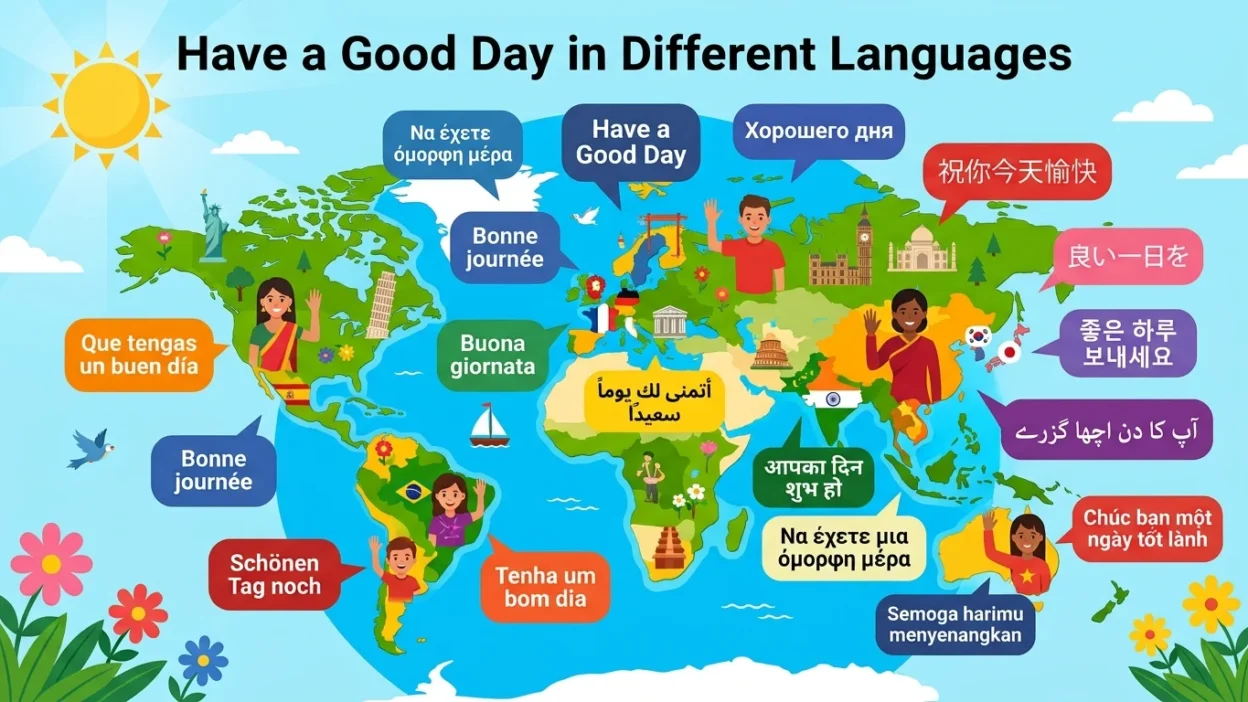
Have a Good Day in Different Languages (1–25)
| Language | Native Phrase | Easy English Pronunciation |
|---|---|---|
| English | Have a good day | Hav a Good Day |
| Spanish | Que tengas un buen día | Kay TEN-gas oon Bwen DEE-ah |
| French | Bonne journée | Bon Zhoor-NAY |
| German | Schönen Tag noch | SHUR-nen Tahk Nokh |
| Italian | Buona giornata | BWO-na Jor-NA-ta |
| Portuguese | Tenha um bom dia | TEN-ya oong Bong DEE-ah |
| Dutch | Fijne dag | FINE-uh Dakh |
| Swedish | Ha en bra dag | Ha en Bra Dag |
| Norwegian | Ha en fin dag | Ha en Fin Dag |
| Danish | Hav en god dag | Hav en Go Day |
| Finnish | Hyvää päivänjatkoa | HOO-vaa PIE-van YAT-ko-ah |
| Icelandic | Eigðu góðan dag | AY-guthu GO-than Dahg |
| Irish | Bíodh lá maith agat | Bee-ah Law Mah Ag-ut |
| Welsh | Mwynhewch eich diwrnod | Moin-hewch Aykh Dee-or-nid |
| Scottish Gaelic | Latha math dhut | La-ha Mah Ghoot |
| Polish | Miłego dnia | Mee-WEH-go DNYA |
| Czech | Hezký den | HES-kee Den |
| Slovak | Pekný deň | PEK-nee Den |
| Slovenian | Lep dan | Lep Dan |
| Croatian | Ugodan dan | OO-go-dan Dan |
| Serbian | Пријатан дан | Pree-ya-tan Dan |
| Bosnian | Ugodan dan | OO-go-dan Dan |
| Romanian | O zi frumoasă | O Zee Froo-MOA-sa |
| Hungarian | Szép napot | Sape NA-pot |
| Greek | Να έχετε μια όμορφη μέρα | Na EH-he-te Mia OR-mor-fi ME-ra |
| Language | Native Phrase | Easy English Pronunciation |
|---|---|---|
| Russian | Хорошего дня | Kha-RO-she-vo DNYA |
| Ukrainian | Гарного дня | HAR-no-ho DNYA |
| Belarusian | Добрага дня | DOB-ra-ha DNYA |
| Bulgarian | Хубав ден | HOO-bav Den |
| Macedonian | Убав ден | OO-bav Den |
| Albanian | Kalofsh një ditë të mbarë | Ka-LOFSH Nje Dee-te Te Mba-RE |
| Turkish | İyi günler | Ee-YEE Goon-LER |
| Arabic | أتمنى لك يوماً سعيداً | At-man-na Laka Yaw-man Sa-ee-dan |
| Hebrew | שיהיה לך יום טוב | She-yi-he Le-kha Yom Tov |
| Persian | روز خوبی داشته باشید | Rooz Khoobi Dashte Bashid |
| Kurdish | Rojeke baş be | Ro-je-ke Bash Beh |
| Hindi | आपका दिन शुभ हो | Aap-ka Din Shubh Ho |
| Urdu | آپ کا دن اچھا گزرے | Aap Ka Din Achha Guzray |
| Punjabi | ਤੁਹਾਡਾ ਦਿਨ ਚੰਗਾ ਲੰਘੇ | Tu-ha-da Din Chan-ga Lang-he |
| Bengali | আপনার দিনটি শুভ হোক | Ap-naar Din-ti Shubho Hok |
| Gujarati | તમારો દિવસ શુભ રહે | Ta-ma-ro Di-vas Shubh Ra-he |
| Marathi | तुमचा दिवस छान जावो | Tum-cha Di-vas Chhan Ja-vo |
| Nepali | तपाईंको दिन शुभ रहोस् | Ta-pa-ee Ko Din Shubh Ra-hos |
| Sinhala | ඔබට සුභ දවසක් | Oba-ta Suba Da-wa-sak |
| Tamil | உங்கள் நாள் இனிதாக அமையட்டும் | Ungal Naal Ini-tha-ga Amai-yat-tum |
| Telugu | మీ రోజు శుభంగా గడవాలి | Mee Ro-ju Shu-bham-ga Ga-da-vaa-li |
| Kannada | ನಿಮ್ಮ ದಿನ ಶುಭವಾಗಿರಲಿ | Nim-ma Di-na Shu-bha-va-gi-ra-li |
| Malayalam | നിങ്ങളുടെ ദിവസം നല്ലതാകട്ടെ | Ning-a-lu-de Di-va-sam Nal-la-tha-kat-te |
| Thai | ขอให้เป็นวันที่ดี | Kor Hai Pen Wan Tee Dee |
| Vietnamese | Chúc bạn một ngày tốt lành | Chook Ban Mot Ngai Tot Lanh |
| Language | Native Phrase | Easy English Pronunciation |
|---|---|---|
| Indonesian | Semoga harimu menyenangkan | Se-MO-ga Ha-ri-mu Men-ye-NANG-kan |
| Malay | Semoga hari anda indah | Se-MO-ga Ha-ri An-da In-dah |
| Filipino (Tagalog) | Magandang araw sa iyo | Ma-GAN-dang A-raw Sa Ee-yo |
| Chinese (Mandarin) | 祝你今天愉快 | Zhu Ni Jin Tian Yu Kuai |
| Japanese | 良い一日を | Yoi Ichi-nichi O |
| Korean | 좋은 하루 보내세요 | Jo-eun Ha-ru Bo-nae-se-yo |
| Mongolian | Өдрийг сайхан өнгөрүүлээрэй | Ud-riig Sai-khan Ung-gu-ruu-le-rei |
| Burmese | ကောင်းသောနေ့ဖြစ်ပါစေ | Kaung-thaw Nay Pyit Par Say |
| Khmer | សូមឲ្យអ្នកមានថ្ងៃល្អ | Som Oy Neak Mean Thngai Lor |
| Lao | ຂໍໃຫ້ມີມື້ດີ | Kor Hai Mee Mue Dee |
| Swahili | Uwe na siku njema | Oo-we Na See-koo Nje-ma |
| Zulu | Ube nosuku oluhle | Oo-bay No-soo-koo O-loo-hlay |
| Afrikaans | Geniet jou dag | Khe-NEET Yo Dowkh |
| Amharic | መልካም ቀን ይሁንልዎ | Mel-kam Ken Yi-hun-le-wo |
| Yoruba | E ku ọjọ | Eh Koo O-jo |
| Hausa | Allah ya sa ka yi rana lafiya | Al-lah Ya Sa Ka Yee Ra-na La-fi-ya |
| Maori | Kia pai tō rā | Kee-a Pie Tor Rah |
| Hawaiian | E loaʻa iā ʻoe kahi lā maikaʻi | Eh Lo-a Ah Ee O-eh Ka-hee Lah Mai-kai |
| Samoan | Ia manuia lou aso | Ee-a Ma-noo-ee-a Lo A-so |
| Esperanto | Bonan tagon | BO-nan TA-gon |
Why Learn “Have a Good Day” in Different Languages?
Learning have a good day in different languages is an easy way to make conversations friendlier and more meaningful. These expressions are commonly used when saying goodbye, ending emails, finishing phone calls, or wishing someone well before they leave.
Using a person’s native language shows kindness, respect, and appreciation for their culture.
How to Say Have a Good Day in Different Languages
If you want to learn how to say have a good day in different languages, start by practicing a few phrases every day. Listen to native speakers, repeat the pronunciation aloud, and use these expressions in daily conversations.
Have a Good Day Translations Around the World
These have a good day translations are widely understood and commonly used across Europe, Asia, Africa, North America, South America, and Oceania. While the wording may vary slightly between regions, the message of kindness remains the same.
Daily Greetings in Different Languages
Many language learners study good morning, good afternoon, good evening, good night, and have a good day in different languages together. Learning these everyday expressions helps you communicate naturally throughout the day.
Tips for Remembering These Phrases
- Learn two or three new greetings each day.
- Practice pronunciation with native audio.
- Use greetings in real conversations.
- Associate each phrase with its country.
- Review your favorite expressions regularly.
Conclusion
Learning have a good day in different languages is a simple yet meaningful way to improve your communication skills and connect with people from around the world. Whether you’re traveling, studying languages, or making new friends, these phrases help you leave every conversation on a positive note.
Frequently Asked Questions
1. How do you say “have a good day” in different languages?
Examples include Bonne journée (French), Que tengas un buen día (Spanish), Schönen Tag noch (German), and 良い一日を (Yoi Ichinichi o) in Japanese.
2. Why should I learn “have a good day” in different languages?
It helps you communicate politely, show cultural respect, and make friendly connections with people from different countries.
3. Is “have a good day” different from “goodbye”?
Yes. Have a good day is a farewell that wishes someone well, while goodbye simply ends a conversation.
4. Are these translations accurate?
Yes. These are commonly used expressions, although slight regional differences may exist.
5. Can I use these phrases while traveling?
Absolutely. Using local farewell expressions is a respectful and friendly way to interact with people.