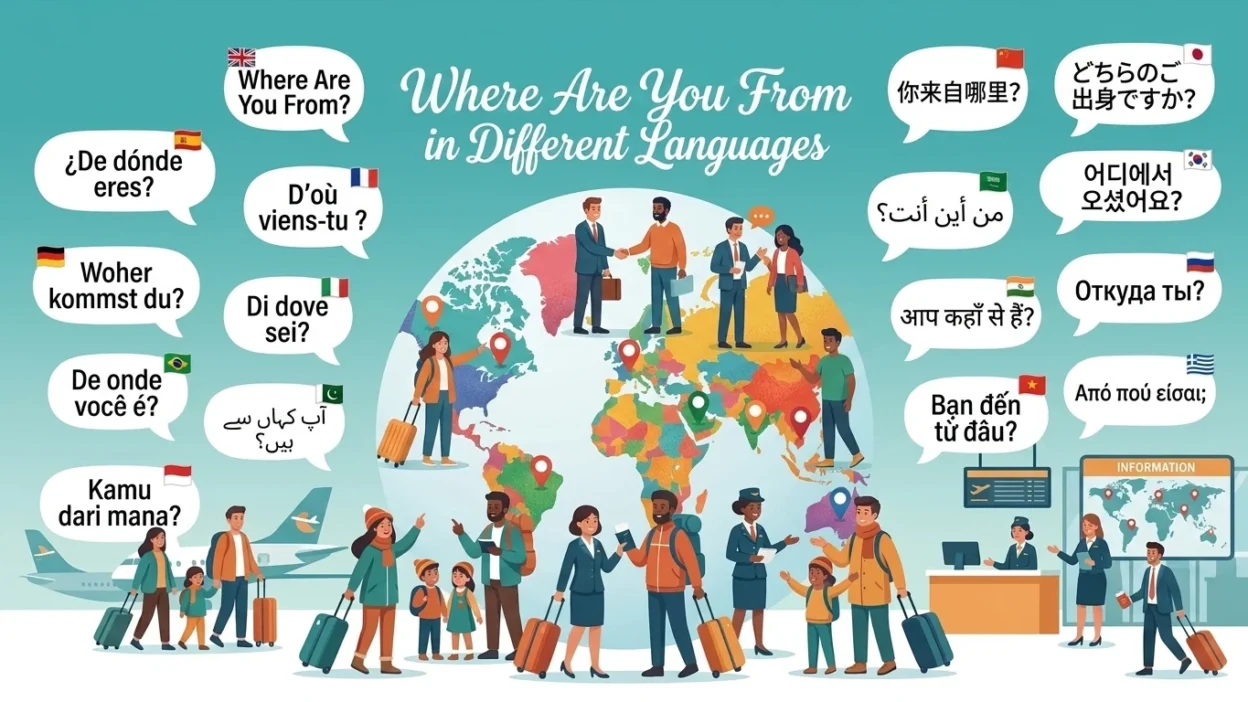
Knowing how to ask “Where are you from?” in different languages is a great way to start conversations and learn about people from different cultures. Whether you’re traveling, studying a new language, or making international friends, this phrase helps you connect naturally and politely.
This guide includes Where are you from translations with easy English pronunciations. If you’re searching for Where are you from in all languages or how to say Where are you from in different languages, this collection is the perfect place to begin.
Where Are You From in Different Languages (1–25)
| Language | Native Phrase | Easy English Pronunciation |
|---|---|---|
| English | Where are you from? | Wair Are You From |
| Spanish | ¿De dónde eres? | De DON-day EH-res |
| French | D’où viens-tu ? | Doo Vyen Too |
| German | Woher kommst du? | Vo-hair Komst Doo |
| Italian | Di dove sei? | Dee DO-veh Say |
| Portuguese | De onde você é? | De ON-je Vo-SE Eh |
| Dutch | Waar kom je vandaan? | Vaar Kom Yeh Van-DAAN |
| Swedish | Var kommer du ifrån? | Var KOM-mer Doo Ee-FRON |
| Norwegian | Hvor kommer du fra? | Vor KOM-mer Doo Fra |
| Danish | Hvor kommer du fra? | Vor KOM-mer Doo Fra |
| Finnish | Mistä olet kotoisin? | MIS-ta O-let Ko-toi-sin |
| Icelandic | Hvaðan ert þú? | KVA-than Ert Thoo |
| Irish | Cad as duit? | Kad Ass Ditch |
| Welsh | O ble rwyt ti? | Oh Ble Roo-it Tee |
| Scottish Gaelic | Cò às a tha thu? | Ko Ass A Ha Hoo |
| Polish | Skąd jesteś? | Skont YES-tesh |
| Czech | Odkud jsi? | ODT-kood See |
| Slovak | Odkiaľ si? | ODT-kee-al See |
| Slovenian | Od kod si? | Od Kod See |
| Croatian | Odakle si? | O-DAK-le See |
| Serbian | Одакле си? | O-DAK-le See |
| Bosnian | Odakle si? | O-DAK-le See |
| Romanian | De unde ești? | De OON-de Yesht |
| Hungarian | Honnan jöttél? | HON-nan Yot-tail |
| Greek | Από πού είσαι; | A-po Poo EE-se |
| Language | Native Phrase | Easy English Pronunciation |
|---|
| Russian | Откуда ты? | OTKOO-da Ty |
| Ukrainian | Звідки ти? | ZVEED-ky Ty |
| Belarusian | Адкуль ты? | Ad-KOOL Ty |
| Bulgarian | Откъде си? | Ot-KUH-de See |
| Macedonian | Од каде си? | Od KA-de See |
| Albanian | Nga je? | Nga Yeh |
| Turkish | Nerelisin? | Ne-re-LEE-sin |
| Arabic | من أين أنت؟ | Min Ayn Anta |
| Hebrew | מאיפה אתה? | May-Ey-fo A-ta |
| Persian | اهل کجا هستی؟ | Ahl-e Ko-ja Has-ti |
| Kurdish | Tu ji ku derê yî? | Too Jee Koo De-ray Yee |
| Hindi | आप कहाँ से हैं? | Aap Ka-haan Se Hain |
| Urdu | آپ کہاں سے ہیں؟ | Aap Ka-haan Se Hain |
| Punjabi | ਤੁਸੀਂ ਕਿੱਥੋਂ ਹੋ? | Tu-see Kit-thon Ho |
| Bengali | আপনি কোথা থেকে এসেছেন? | Aap-ni Ko-tha The-ke E-she-chen |
| Gujarati | તમે ક્યાંના છો? | Ta-me Kyaan-na Cho |
| Marathi | तुम्ही कुठून आहात? | Tum-hee Ku-thoon Aa-hat |
| Nepali | तपाईं कहाँबाट हुनुहुन्छ? | Ta-pa-ee Ka-haan-baat Hu-nu-hun-cha |
| Sinhala | ඔබ කොහෙන්ද? | O-ba Ko-hen-da |
| Tamil | நீங்கள் எங்கிருந்து வந்தீர்கள்? | Neeng-gal En-gi-run-thu Van-deer-gal |
| Telugu | మీరు ఎక్కడి వారు? | Mee-roo Ek-ka-di Va-roo |
| Kannada | ನೀವು ಎಲ್ಲಿಂದ ಬಂದಿದ್ದೀರಿ? | Nee-voo El-lin-da Ban-did-dee-ri |
| Malayalam | നിങ്ങൾ എവിടെ നിന്നാണ്? | Ning-ga-l Ev-i-de Nin-naan |
| Thai | คุณมาจากไหน | Khun Ma Jak Nai |
| Vietnamese | Bạn đến từ đâu? | Ban Den Tu Dow |
| Language | Native Phrase | Easy English Pronunciation |
|---|---|---|
| Indonesian | Kamu dari mana? | Ka-moo Da-ree Ma-na |
| Malay | Awak dari mana? | A-wak Da-ree Ma-na |
| Filipino (Tagalog) | Taga saan ka? | Ta-ga Sa-an Ka |
| Chinese (Mandarin) | 你来自哪里? | Nee Lai Dzuh Na Lee |
| Japanese | どちらのご出身ですか? | Do-chi-ra No Go-shus-shin Des Ka |
| Korean | 어디에서 오셨어요? | O-di-e-so O-syeot-seo-yo |
| Mongolian | Та хаанаас ирсэн бэ? | Ta Khaa-naas Ir-sen Be |
| Burmese | မင်းဘယ်ကလာတာလဲ? | Min Beh Ka Lar Ta Le |
| Khmer | អ្នកមកពីណា? | Neak Mok Pi Na |
| Lao | ເຈົ້າມາຈາກໃສ? | Jao Ma Jak Sai |
| Swahili | Unatoka wapi? | Oo-na-TO-ka Wa-pee |
| Zulu | Uvelaphi? | Oo-ve-LA-pee |
| Afrikaans | Waar kom jy vandaan? | Vaar Kom Yay Fan-daan |
| Amharic | ከየት ነህ? | Ke-yet Neh |
| Yoruba | Nibo ni o ti wa? | Nee-bo Nee O Tee Wa |
| Hausa | Daga ina kake? | Da-ga Ee-na Ka-ke |
| Maori | Nō hea koe? | No He-a Koy |
| Hawaiian | No hea mai ʻoe? | No He-a My O-eh |
| Samoan | O fea e te sau ai? | O Fe-a E Te Sau Eye |
| Esperanto | De kie vi venas? | De Kee-eh Vee Ve-nas |
Why Learn “Where Are You From?” in Different Languages?
Learning Where are you from in different languages is one of the easiest ways to begin friendly conversations with people from around the world. It’s a common question when meeting someone for the first time and helps you learn about different cultures and backgrounds.
How to Say “Where Are You From?” in Different Languages
If you’re searching for how to say Where are you from in different languages, practice both the pronunciation and the native writing. Speaking clearly and politely makes conversations more enjoyable and respectful.
Where Are You From Translations Around the World
These Where are you from translations are widely understood across Europe, Asia, Africa, the Americas, and Oceania. In some languages, there are separate formal and informal versions, but the phrases above are appropriate in most everyday situations.
Related Conversation Phrases
After learning Where are you from in different languages, you may also want to learn:
- Hello in Different Languages
- What Is Your Name? in Different Languages
- Nice to Meet You in Different Languages
- How Are You? in Different Languages
- Thank You in Different Languages
- Goodbye in Different Languages
Learning these expressions will help you have natural conversations with people from different countries.
Tips for Using This Phrase
- Use a friendly tone when asking the question.
- Learn both formal and informal versions if available.
- Practice the pronunciation regularly.
- Be respectful of cultural differences.
- Follow up by asking about the person’s country or city.
Conclusion
Learning Where are you from in different languages is a valuable communication skill for travelers, students, and language learners. These 70 translations can help you start conversations, make new friends, and better understand people from around the world.
Frequently Asked Questions
1. How do you say “Where are you from?” in different languages?
Examples include ¿De dónde eres? (Spanish), D’où viens-tu ? (French), Woher kommst du? (German), and 你来自哪里? (Nǐ láizì nǎlǐ?) in Chinese.
2. Is this question polite?
Yes. It is generally considered a polite way to get to know someone, especially when asked respectfully.
3. Are there formal and informal versions?
Yes. Many languages have both formal and informal forms depending on the relationship and setting.
4. Can I use these phrases while traveling?
Absolutely. They are excellent conversation starters when meeting locals or fellow travelers.
5. Are these translations accurate?
Yes. These are commonly used everyday expressions, although some regional variations may exist.