
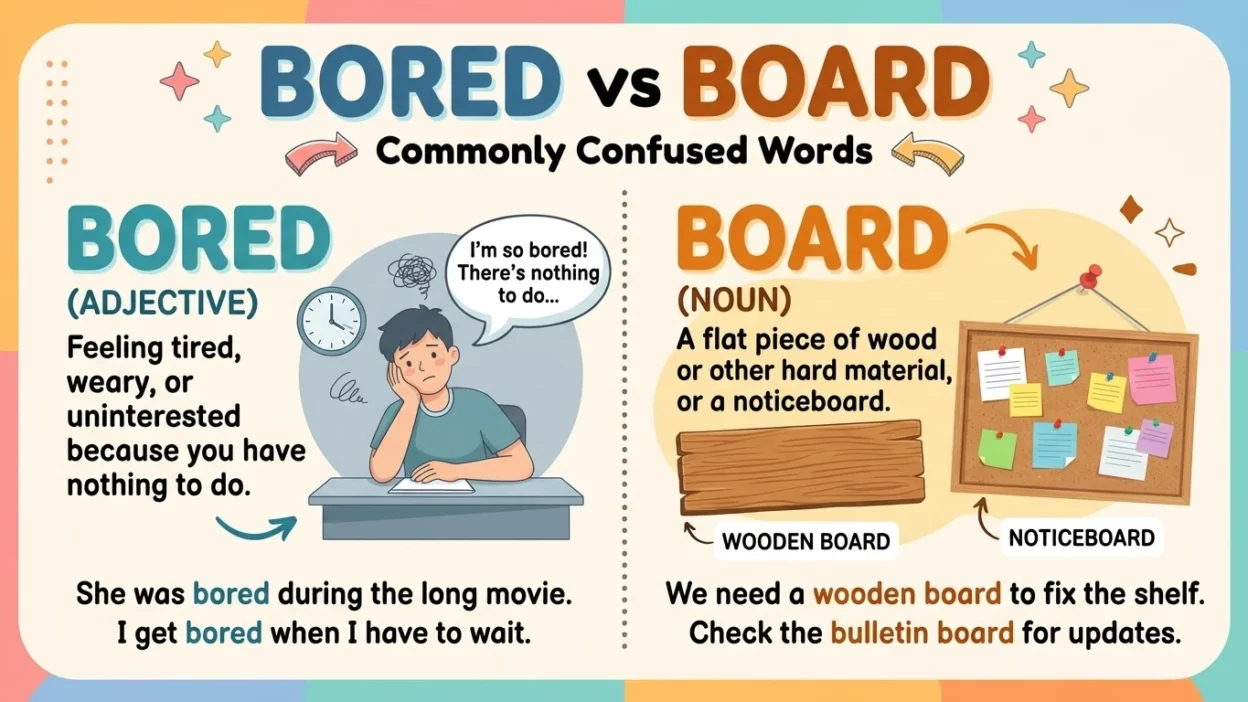
Have you ever wondered whether to write bored or board? These two words sound exactly the same, but their meanings, spellings, and grammatical uses are completely different. Bored describes a feeling of having little interest or excitement, while board usually refers to a flat, rigid piece of material, a group of people responsible for making decisions, or the act of getting onto a vehicle. Although they are pronounced identically, they cannot be used interchangeably.
People often confuse bored and board because they are homophones: words that have the same pronunciation but different meanings and spellings. Choosing the wrong one can change the meaning of your sentence. Whether you are writing a school assignment, sending a message, or improving your English vocabulary, understanding when to use each word will make your writing clearer. This guide explains their definitions, grammar, differences, examples, and common mistakes in simple American English.
Quick Answer: Bored vs. Board
Bored is an adjective that describes someone who feels uninterested, tired of an activity, or lacking excitement. Board is usually a noun meaning a flat piece of material or an organized group, but it can also be a verb meaning to get onto a vehicle. Remember: you feel bored, but you can write on a board or board a plane.
What Does Bored Mean?
Bored is an adjective that describes a feeling of dissatisfaction, disinterest, or lack of excitement. You use it when someone has nothing interesting to do or no longer finds an activity engaging.
For example:
- I am bored because there is nothing to watch.
- The students looked bored during the long lecture.
- She gets bored when she has to wait.
In these sentences, bored describes an emotional state rather than a physical object or action.
Part of Speech of Bored
Bored is primarily an adjective. It describes how a person feels about a situation, activity, or experience.
As an adjective:
- He feels bored at home.
- I was bored during the meeting.
After linking verbs:
- They seem bored.
- She became bored with the movie.
As a past participle:
Bored is also the past participle of the verb bore, which means to make someone feel uninterested.
- The speaker has bored the audience.
- The long presentation bored everyone.
Grammatical Forms of Bore
The word bored comes from the verb bore.
| Verb Form | Word | Example |
|---|---|---|
| Base form | Bore | Long lectures bore me. |
| Third-person singular | Bores | This movie bores him. |
| Present participle | Boring | The lesson is boring. |
| Simple past | Bored | The speech bored us. |
| Past participle | Bored | She has bored the audience. |
Bored vs. Boring: What’s the Difference?
Bored and boring are related, but they describe different things.
- Bored describes how someone feels.
- Boring describes something that causes that feeling.
Examples:
- I am bored with this game.
- This game is boring.
Another example:
- The children were bored.
- The activity was boring.
A simple way to remember this distinction is that people feel bored, while things can be boring.
When to Use Bored
Use bored when describing a person’s feeling of disinterest or lack of excitement.
Common situations include:
- At school: Students feel bored during repetitive lessons.
- At work: Employees may feel bored when tasks lack variety.
- At home: Someone might feel bored without activities.
- During entertainment: A viewer may feel bored watching an uninteresting movie.
- While waiting: People often feel bored during long delays.
Examples of Bored in Sentences
Here are five practical examples:
- I felt bored while waiting for the bus.
- The children were bored during the long journey.
- She gets bored when she has nothing creative to do.
- My brother was bored with the television program.
- The audience looked bored during the presentation.
What Does Board Mean?
Board has several meanings in English. It is commonly used as a noun to describe a flat, solid piece of material, such as wood, or a group of people who manage an organization.
It can also be used as a verb meaning to get onto a vehicle, such as a plane, train, or ship.
For example:
- Write your answer on the board.
- The school board approved the new policy.
- Passengers will board the plane shortly.
The meaning of board depends on the context in which it appears.
Part of Speech of Board
Board can function as both a noun and a verb.
As a noun:
- The wooden board is on the floor.
- The board held an important meeting.
As a verb:
- We will board the train at noon.
- Passengers boarded the plane.
Common Meanings of Board
The word board has several common uses.
1. A flat piece of material
A board can be a flat piece of wood, plastic, or another material used in construction or other activities.
Example: The carpenter cut a wooden board.
2. A group of decision-makers
A board can refer to a group of people responsible for managing or supervising an organization.
Example: The board approved the company’s budget.
3. A writing surface
A board can be a surface used for writing, displaying information, or teaching.
Example: The teacher wrote the lesson on the board.
4. Getting onto a vehicle
As a verb, board means entering a plane, train, ship, or bus.
Example: We boarded the bus after buying our tickets.
5. Meals and accommodation
Board can also refer to meals or accommodation provided as part of an arrangement.
Example: The hotel offers room and board.
Grammatical Forms of Board
When board is used as a verb, it follows regular verb patterns.
| Verb Form | Word | Example |
|---|---|---|
| Base form | Board | We board the train here. |
| Third-person singular | Boards | She boards the bus daily. |
| Present participle | Boarding | They are boarding the plane. |
| Simple past | Boarded | He boarded the ship. |
| Past participle | Boarded | We have boarded the train. |
When to Use Board
Use board when referring to a physical surface, an organization, a writing surface, or the action of getting onto a vehicle.
Common situations include:
- Construction: Wooden boards are used in building projects.
- Education: Teachers write information on a classroom board.
- Business: A board makes important organizational decisions.
- Travel: Passengers board planes, trains, and buses.
- Accommodation: Room and board refers to lodging and meals.
Examples of Board in Sentences
Here are five practical examples:
- The teacher wrote the homework on the board.
- The company board discussed the new business plan.
- We will board the airplane in twenty minutes.
- My father bought a wooden board for the repair.
- The school board announced its decision yesterday.
Bored vs. Board: Key Differences
Although bored and board sound alike, they have completely different meanings and grammatical functions.
| Feature | Bored | Board |
|---|---|---|
| Pronunciation | /bɔːrd/ | /bɔːrd/ |
| Part of speech | Mainly adjective; also a verb form | Noun and verb |
| Main meaning | Feeling uninterested | Flat material, group, or getting onto a vehicle |
| Related word | Boring | Boarded, boarding |
| Emotional meaning | Yes | No, not usually |
| Example | I am bored. | Write it on the board. |
Bored vs. Board in Simple Words
Consider these two sentences:
- I am bored during the lesson.
- The teacher writes on the board.
The first sentence describes a feeling. The second refers to a physical writing surface.
Even though the words sound identical, their meanings are easy to identify from the surrounding words.
Bored vs. Board: 10 More Practical Examples
The following examples show how to use both words in everyday American English.
More Examples of Bored
- My sister gets bored when she stays indoors all day.
- The movie was so slow that I became bored.
- He looked bored while listening to the long speech.
- Are you bored with your current job?
- We were bored because the game had been canceled.
More Examples of Board
- The students cleaned the classroom board after the lesson.
- The passengers began to board the flight.
- The directors held a board meeting on Monday.
- She placed the books on a wooden board.
- We need to board the train before it leaves.
Why Do People Confuse Bored and Board?
There are several reasons people mix up these two words.
1. They have the same pronunciation.
Bored and board are homophones. They sound exactly alike in standard American English, even though they have different spellings and meanings.
2. Their spellings are similar.
Both words contain the letters B, O, and R, making them easy to confuse when writing quickly.
3. They appear in everyday conversations.
People frequently use both words when discussing school, work, travel, and daily activities.
4. Spell-checking may not catch the mistake.
Both bored and board are correctly spelled words. A spell-checker may not recognize that you have chosen the wrong word for your sentence.
5. Their meanings depend on context.
You cannot identify the correct spelling by pronunciation alone. You must understand what the sentence is trying to communicate.
Common Mistakes and How to Correct Them
Using bored instead of board, or board instead of bored, can make your writing confusing.
Here are some common mistakes with their corrections.
| Incorrect Sentence | Correct Sentence | Explanation |
|---|---|---|
| I am board at home. | I am bored at home. | Bored describes a feeling. |
| Write your name on the bored. | Write your name on the board. | Board is a writing surface. |
| The students were board during class. | The students were bored during class. | Bored describes their feelings. |
| We will bored the plane soon. | We will board the plane soon. | Board means getting onto a plane. |
| The company bored approved the plan. | The company board approved the plan. | Board refers to a decision-making group. |
How to Avoid These Mistakes
Before writing either word, ask yourself what you mean.
- Are you describing a feeling of having nothing interesting to do? Use bored.
- Are you referring to a wooden surface, an organization, or getting onto a vehicle? Use board.
Reading the complete sentence before choosing a spelling can also help you catch errors.
An Easy Memory Trick to Remember Bored vs. Board
Here is a simple trick to remember the difference:
Bored = Feeling
Think of the sentence: “I am bored because I have nothing to do.”
Board = Object or Action
Think of a classroom board or boarding an airplane.
You can also remember these two phrases:
- Bored with nothing to do.
- Board a plane or write on a board.
If the sentence describes an emotion, choose bored. If it describes an object, organization, or travel action, choose board.
American vs. British English: Is There a Difference?
There is no spelling difference between bored and board in American and British English. Both words have the same spellings and basic meanings in the two varieties.
Their pronunciation is also generally the same within each variety, although regional accents may affect how the vowel sounds.
One related spelling difference worth knowing is boarding school, which has the same spelling in both American and British English. The word board does not change based on the variety of English.
Similar and Related Words
Learning related words can help you understand bored and board more clearly.
| Word | Meaning | Example |
|---|---|---|
| Boring | Causing a feeling of disinterest | The lecture was boring. |
| Boredom | The state of feeling bored | Boredom made him restless. |
| Uninterested | Not showing interest | She seemed uninterested. |
| Tired | Needing rest or feeling exhausted | I am tired after work. |
| Boarded | Got onto a vehicle | They boarded the train. |
| Boarding | The process of getting onto a vehicle | Boarding begins at 8 a.m. |
| Blackboard | A dark writing surface | The teacher used the blackboard. |
| Whiteboard | A smooth surface for writing with markers | The notes are on the whiteboard. |
| Boardroom | A room where a board meets | The directors met in the boardroom. |
| Blackboard | A traditional classroom writing surface | The lesson was written on the blackboard. |
Frequently Asked Questions
1. What is the main difference between bored and board?
Bored describes a feeling of having little interest or excitement. Board refers to a flat piece of material, a group of decision-makers, or the act of getting onto a vehicle. Although both words sound the same, their meanings and grammatical uses are different.
2. Are bored and board pronounced the same?
Yes. Bored and board are homophones in standard American English. They share the same pronunciation but have different spellings and meanings. You must use the context of a sentence to determine which word is correct.
3. Is bored an adjective or a verb?
Bored is primarily an adjective when describing someone’s feelings. It is also the past tense and past participle of the verb bore, which means to make someone lose interest. For example, “I am bored” uses an adjective, while “The lecture bored me” uses a verb form.
4. Is board a noun or a verb?
Board can be both a noun and a verb. As a noun, it can mean a flat piece of material or a group responsible for making decisions. As a verb, it means getting onto a vehicle, such as a plane, bus, or train.
5. Is it bored or board at school?
It depends on the meaning. If you feel uninterested during class, use bored. If you are talking about the surface where a teacher writes, use board. For example, “I am bored in class” and “The answer is on the board” are both correct.
6. What is the difference between bored and boring?
Bored describes the feeling experienced by a person, while boring describes something that causes that feeling. For example, “I am bored” describes your emotion, while “The movie is boring” describes the movie.
7. Can board be used as a verb?
Yes. Board means to get onto a plane, bus, train, or ship. For example, “Passengers will board the plane shortly.” Its past tense is boarded, and its present participle is boarding.
Remember This: Bored vs. Board
- Bored describes a feeling of disinterest or lack of excitement.
- Board can mean a flat surface or a decision-making group.
- Board can also mean getting onto a vehicle.
- Both words are homophones and sound the same.
- Their spelling does not change between American and British English.
The easiest rule is: You feel bored, but you write on a board or board a plane.
Conclusion
The difference between bored vs. board is easy to understand once you focus on their meanings. Bored is an adjective that describes a person’s feeling of disinterest, while board is a noun or verb referring to a physical surface, an organization, or the action of getting onto a vehicle. Although these words sound identical, they cannot be substituted for each other. Understanding their definitions and grammatical functions will help you avoid common spelling mistakes.
Whenever you are unsure which word to use, think about the context of your sentence. If you are talking about an emotion, choose bored. If you are referring to a surface, a group of people, or entering a vehicle, choose board. With a little practice, you will be able to use both words confidently in everyday conversations and writing.

Daniel Whitmore is a language writer and editor from the United Kingdom who is passionate about making language learning accessible to everyone. He specializes in English grammar, vocabulary, spelling differences, pronunciation, and multilingual communication. His articles break down complex language concepts into clear, practical lessons that readers can apply in everyday conversations and writing. Daniel enjoys exploring the history, culture, and evolution of languages while creating engaging content for students, educators, travelers, and language enthusiasts. His goal is to provide accurate, reader-friendly resources that help people build confidence in learning English and other world languages through simple explanations and real-life examples.