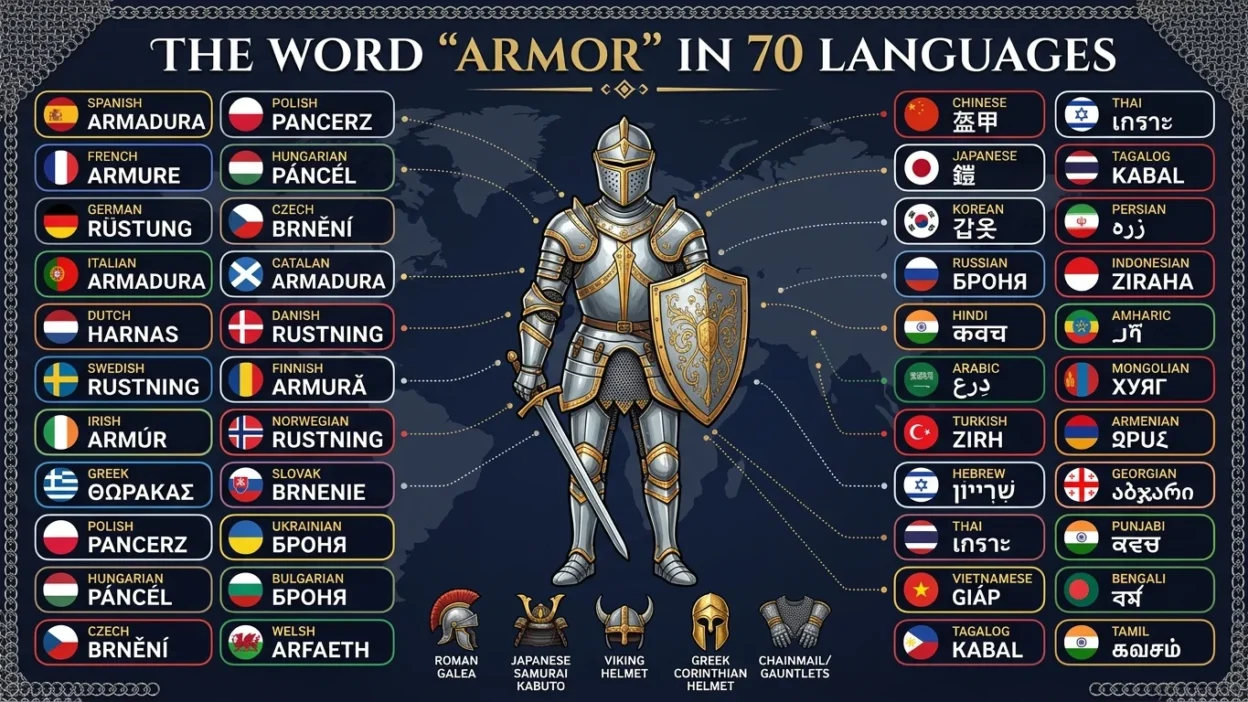
The word “armor” refers to protective clothing, equipment, or covering designed to protect the body from weapons, injuries, or other dangers. Throughout history, armor has played an important role in battles, military traditions, and the development of protective technology.
From the metal suits worn by medieval knights to modern military body armor, this word represents protection, strength, and defense.
But how do people say armor in different languages? Every language has its own word for describing protective equipment. Some translations refer specifically to body armor, while others can also describe shields, protective coverings, or defensive equipment.
In this guide, you will discover how to say “armor” in 70 languages, including native translations and easy English pronunciations.
How to Say Armor in 70 Languages
Explore the table below to discover the word “armor” in 70 languages around the world.
| Language | Armor in Native Language | Easy Pronunciation |
|---|---|---|
| English | Armor | AR-mer |
| Spanish | Armadura | Ar-ma-DOO-rah |
| French | Armure | Ar-MOOR |
| German | Rüstung | RUUS-toong |
| Italian | Armatura | Ar-ma-TOO-rah |
| Portuguese | Armadura | Ar-ma-DOO-rah |
| Dutch | Harnas | HAR-nahs |
| Swedish | Rustning | ROOST-ning |
| Norwegian | Rustning | ROOST-ning |
| Danish | Rustning | ROOST-ning |
| Finnish | Panssari | PAN-sah-ree |
| Icelandic | Brynja | BRIN-yah |
| Irish | Armúr | Ar-MOOR |
| Welsh | Arfwisg | Ar-VOOSG |
| Scottish Gaelic | Armachd | AR-machk |
| Polish | Zbroja | ZBROH-yah |
| Czech | Brnění | BUR-nyeh-nee |
| Slovak | Brnenie | BUR-neh-nyeh |
| Slovenian | Oklep | OH-klep |
| Croatian | Oklop | OH-klop |
| Serbian | Оклоп | OH-klop |
| Bosnian | Oklop | OH-klop |
| Romanian | Armură | Ar-MOO-ruh |
| Hungarian | Páncél | PAAN-tsayl |
| Greek | Πανοπλία | Pah-noh-PLEE-ah |
| Russian | Броня | Bra-NYAH |
| Ukrainian | Броня | Bro-NYAH |
| Belarusian | Браня | BRAH-nyah |
| Bulgarian | Броня | BROH-nyah |
| Macedonian | Оклоп | OH-klop |
| Albanian | Armaturë | Ar-ma-TOO-ruh |
| Turkish | Zırh | ZURH |
| Arabic | درع | Dir’ |
| Hebrew | שריון | Shir-YON |
| Persian | زره | Zeh-REH |
| Kurdish | Zirx | ZIRKH |
| Hindi | कवच | Ka-VACH |
| Urdu | زرہ | ZIR-rah |
| Punjabi | ਕਵਚ | Ka-VACH |
| Bengali | বর্ম | BORM |
| Gujarati | બખ્તર | BAKH-tar |
| Marathi | चिलखत | CHIL-khat |
| Nepali | कवच | Ka-VACH |
| Sinhala | සන්නාහය | San-naa-ha-ya |
| Tamil | கவசம் | Ka-va-sam |
| Telugu | కవచం | Ka-va-cham |
| Kannada | ಕವಚ | Ka-va-cha |
| Malayalam | കവചം | Ka-va-cham |
| Thai | เกราะ | GRAW |
| Vietnamese | Áo giáp | OW ZAHHP |
| Indonesian | Baju zirah | BAH-joo ZEE-rah |
| Malay | Perisai | Peh-ree-SAI |
| Filipino (Tagalog) | Baluti | Bah-LOO-tee |
| Chinese (Mandarin) | 盔甲 | Kuī jiǎ (Kway jyah) |
| Japanese | 鎧 | Yoroi (Yoh-roh-ee) |
| Korean | 갑옷 | Ga-bot |
| Mongolian | Хуяг дуулга | Khoo-yag dool-gah |
| Burmese | သံချပ်ကာ | Than-chet-kah |
| Khmer | គ្រឿងសឹក | Kreung-seuk |
| Lao | ເກາະ | Gaw |
| Swahili | Vazi la kinga | VAH-zee lah KING-gah |
| Zulu | Izikhali zokuzivikela | Ee-zee-KHAH-lee zoh-koo-zee-vee-KEH-lah |
| Afrikaans | Wapenrusting | VAA-pen-RUS-ting |
| Amharic | ጋሻ መከላከያ | Gasha mekelakeya |
| Yoruba | Ìhámọ́ra | Ee-HAH-maw-rah |
| Hausa | Sulke | SOOL-keh |
| Māori | Kākahu ārai | KAA-kaa-hoo AA-rai |
| Hawaiian | Pale kaua | PAH-leh KOW-ah |
| Samoan | Ofutau puipui | Oh-foo-tow poo-ee-poo-ee |
| Esperanto | Kiraso | Kee-RAH-soh |
Note: Some languages distinguish between body armor, protective clothing, shields, and general defensive equipment. The translations above represent common equivalents, and pronunciation guides are approximate.
What Does Armor Mean?
Armor is a protective covering or equipment worn or used to defend against physical harm. Traditionally, it protected soldiers and warriors from swords, arrows, spears, and other weapons.
Today, armor can refer to several types of protective equipment, including bullet-resistant vests, helmets, shields, and specialized protective suits.
The word can have different meanings depending on the context:
- Body protection: Equipment worn to protect the body from injuries.
- Military defense: Protective equipment used by soldiers during combat.
- Historical armor: Metal or leather protection worn by warriors and knights.
- Protective covering: A strong outer layer that protects an object or structure.
- Figurative protection: Emotional strength or a mental defense against criticism or difficulties.
How to Say Armor in Popular Languages
Here are some popular translations of armor with examples to help you understand how the word is used.
Armor in Spanish
In Spanish, armor is armadura. It commonly refers to protective equipment worn by warriors, soldiers, or historical characters.
Example: El caballero llevaba una armadura pesada.
Meaning: The knight was wearing heavy armor.
Armor in French
The French word for armor is armure. It is frequently used when discussing knights, medieval history, and protective equipment.
Example: Le chevalier portait une armure.
Meaning: The knight was wearing armor.
Armor in German
In German, armor is called Rüstung. The word can refer to protective equipment, particularly in military or historical contexts.
Example: Der Ritter trug eine schwere Rüstung.
Meaning: The knight wore heavy armor.
Armor in Italian
The Italian word for armor is armatura. It is commonly associated with historical warriors and protective clothing.
Example: Il cavaliere indossava un’armatura.
Meaning: The knight was wearing armor.
Armor in Japanese
In Japanese, traditional armor is called 鎧 (yoroi). It is especially associated with samurai and historical Japanese warriors.
Example: 侍は鎧を着ていました。
Meaning: The samurai was wearing armor.
Armor in Korean
The Korean word for armor is 갑옷 (gabot). It describes protective clothing worn by warriors or soldiers.
Example: 군인은 갑옷을 입었습니다.
Meaning: The soldier wore armor.
Armor in Arabic
In Arabic, armor is درع (dirʿ). Depending on the context, this word can refer to armor or a protective shield.
Example: ارتدى الجندي الدرع.
Meaning: The soldier wore armor.
Armor in Hindi and Urdu
In Hindi, armor is कवच (kavach), while in Urdu, a common equivalent is زرہ (zره). Both words refer to protective covering or armor.
Example in Hindi: योद्धा ने कवच पहना।
Meaning: The warrior wore armor.
Different Types of Armor
Armor has changed significantly throughout history. Different materials and designs have been developed to protect people from different kinds of threats.
Here are some common types:
- Plate armor: Metal plates designed to protect a warrior’s body.
- Chainmail: Protective clothing made from connected metal rings.
- Leather armor: Protective equipment made from treated animal hide.
- Bulletproof armor: Specialized protective equipment designed to resist bullets.
- Body armor: Protective clothing worn by military personnel and security professionals.
- Medieval armor: Historical protective equipment used by knights and soldiers.
- Ceramic armor: Protective material used in some modern ballistic protection systems.
Synonyms and Related Words for Armor
Several English words are related to armor, although they do not all have exactly the same meaning.
| Word | Meaning |
|---|---|
| Protection | Something that keeps a person or object safe |
| Shield | A protective object used to block attacks |
| Defense | The act of protecting against danger |
| Plate armor | Protective equipment made from solid plates |
| Chainmail | Armor made from linked metal rings |
| Helmet | Protective headgear |
| Breastplate | Armor covering the chest |
| Body armor | Protective clothing worn on the body |
| Guard | Something that protects against harm |
| Barrier | Something that blocks or reduces danger |
Why Was Armor Important in History?
Armor played a major role in the development of warfare and military technology. Ancient civilizations used different materials to protect warriors, while medieval societies developed more advanced metal armor.
Here are a few reasons armor was important:
- Protection in battle: It helped reduce injuries from weapons.
- Military identity: Different armor styles represented armies, cultures, and ranks.
- Technological progress: Armor development encouraged improvements in metalworking and engineering.
- Historical significance: Armor provides valuable information about ancient and medieval societies.
- Cultural symbolism: It often represented courage, authority, and strength.
Frequently Asked Questions
How do you say armor in 10 different languages?
Here are 10 popular translations:
- Spanish: Armadura
- French: Armure
- German: Rüstung
- Italian: Armatura
- Portuguese: Armadura
- Japanese: Yoroi
- Korean: Gabot
- Chinese: Kuī jiǎ
- Arabic: Dirʿ
- Hindi: Kavach
What is the Japanese word for armor?
The Japanese word for traditional armor is 鎧 (yoroi). It is especially associated with the protective equipment worn by samurai.
What is the French word for armor?
The French word for armor is armure. It is commonly used when describing historical protective clothing and equipment.
What is the Spanish word for armor?
In Spanish, armor is called armadura. It can describe protective equipment worn by knights, warriors, and soldiers.
What is another word for armor?
Some related words include protection, shield, defense, body armor, chainmail, and protective covering. The best alternative depends on the type of armor being described.
What is the difference between armor and a shield?
Armor is generally worn on the body to provide protection, while a shield is usually held or positioned separately to block attacks.
Is armor still used today?
Yes. Modern armor includes bullet-resistant vests, helmets, protective plates, and specialized equipment used by military personnel and security professionals.
Conclusion
The word armor represents protection, defense, and strength across different languages and cultures. From armadura in Spanish to Rüstung in German and yoroi in Japanese, every language has its own way of describing this important protective equipment.
Learning how to say armor in 70 languages is a useful way to expand your vocabulary while exploring military history, cultural traditions, and the development of protective technology.
Whether you are studying languages, reading about medieval knights, or exploring historical weapons and equipment, these translations offer a helpful starting point.
Keep discovering new words and exploring how different cultures express the idea of protection! 🛡️