
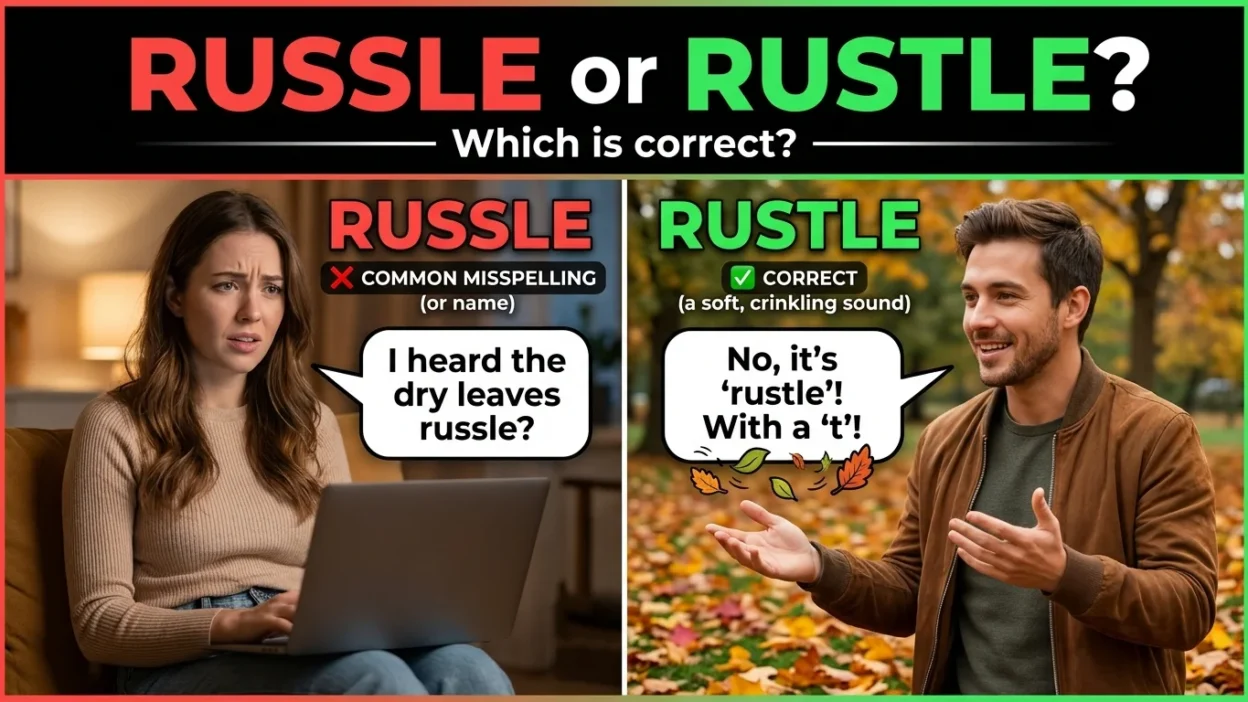
Have you ever wondered whether the correct spelling is russle or rustle? Although these words look and sound similar, only rustle is the standard English spelling. It describes a soft, gentle, crackling, or swishing sound made when leaves, paper, clothing, or other lightweight materials move. It can also mean moving something quietly, gathering something quickly, or obtaining something through theft in certain contexts.
The confusion often happens because the letter combination in rustle is not clearly heard in everyday American pronunciation. People may also confuse it with Russell, a common first name and surname that sounds almost identical. In this guide, you will learn the correct spelling, rustle meaning, pronunciation, parts of speech, grammatical forms, synonyms, and practical examples. You will also discover expressions such as rustle up, common spelling mistakes, and the difference between rustle and Russell.
Quick Answer: Russle or Rustle?
Rustle is the correct standard English spelling. Russle is generally a misspelling, not an accepted alternative. Rustle can function as both a noun and a verb, describing a soft sound made by moving leaves, paper, or fabric. It can also mean gathering something quickly, as in “rustle up dinner.” Remember: R-U-S-T-L-E is the correct spelling.
Russle or Rustle: Which Spelling Is Correct?
The correct spelling is rustle, with the letter T between S and L.
The word rustle is used in standard American and British English. It describes a gentle sound, a movement that creates that sound, or certain actions involving gathering or obtaining something.
On the other hand, russle is generally an incorrect spelling of rustle. You may encounter it in online searches, informal messages, or typing mistakes, but it is not the standard spelling you should use in professional writing, school assignments, or everyday communication.
Here is a quick comparison:
| Word | Correct? | Meaning | Example |
| Rustle | Yes | A soft sound or quiet movement | The leaves rustle in the breeze. |
| Russle | No | Common misspelling | Russle is not the standard spelling. |
| Russell | Yes | A person’s first name or surname | Russell called me yesterday. |
A useful rule is simple:
- Use rustle when describing a sound, movement, or quick gathering.
- Use Russell when referring to someone with that name.
- Avoid russle when writing standard English.
Why Do People Confuse Russle and Rustle?
People often confuse russle and rustle because their pronunciation is almost identical in everyday American English. When someone hears the word without seeing it written, it can be difficult to identify the correct spelling.
Several factors contribute to this common spelling confusion.
1. Similar Pronunciation
The word rustle is commonly pronounced RUH-suhl. In normal speech, the T is not clearly heard, which makes the spelling less obvious.
As a result, someone who has only heard the word may naturally write russle instead of rustle.
2. Influence of the Name Russell
Russell is a familiar English first name and surname. Because it sounds almost identical to rustle, people sometimes associate the sound with the spelling of the name.
For example:
- Russell is my new classmate.
- The leaves rustle in the wind.
Both words sound similar, but their meanings and spellings are different.
3. Fast Typing Mistakes
People often make spelling mistakes when typing quickly on phones, laptops, or computers.
Common incorrect variations include:
- Russle
- Russled
- Russling
- Rustel
- Rustal
The correct forms are rustle, rustled, and rustling.
4. Unfamiliar English Spelling Patterns
English spelling does not always match pronunciation. Some letters are silent or less noticeable when words are spoken naturally.
This can make unfamiliar vocabulary difficult for beginners and ESL learners.
The best solution is to understand the word’s meaning and memorize its standard spelling.
What Does Rustle Mean?
Rustle is an English word that describes a soft, gentle, crackling, or swishing sound produced when lightweight materials move against each other.
It commonly refers to sounds made by:
- Dry leaves moving in the wind.
- Paper or newspaper being handled.
- Clothing or fabric brushing together.
- Grass moving as an animal passes through it.
- Plastic bags being moved or opened.
For example:
“The autumn leaves rustled gently as the wind passed through the trees.”
In this sentence, rustled describes the soft sound made by the moving leaves.
However, rustle has more than one meaning. Depending on the context, it can also mean preparing something quickly, gathering supplies, or stealing livestock.
Rustle as a Verb
As a verb, rustle means to make a soft crackling or swishing sound, or to move something in a way that creates such a sound.
It can describe both natural movement and human activity.
Examples of rustle as a verb:
- The dry leaves rustled whenever the wind blew.
- She began to rustle through her handbag for her keys.
- The curtains rustled as the breeze entered the room.
- He tried not to rustle the papers during the meeting.
- I heard something rustle in the bushes.
In these sentences, the word describes movement or an action associated with a soft sound.
Rustle as a Noun
As a noun, rustle refers to the soft sound itself rather than the action producing it.
It is commonly used when describing something heard in a quiet environment.
Examples of rustle as a noun:
- I heard a strange rustle behind the door.
- The rustle of leaves made the garden peaceful.
- A gentle rustle came from the nearby bushes.
- The sudden rustle of paper interrupted the conversation.
- We heard a faint rustle in the grass.
Notice the difference:
- Verb: The leaves rustled in the wind.
- Noun: I heard a rustle in the leaves.
The verb describes an action, while the noun identifies the sound.
Rustle Meaning Beyond Sound: Other Definitions and Uses
Although most people know rustle as a word for soft sounds, it has additional meanings in everyday and historical English.
Understanding these meanings will help you recognize the word in different situations.
1. Rustle Up: To Prepare or Gather Something Quickly
The phrasal verb rustle up means to prepare, find, or gather something quickly, often with whatever is available.
It is commonly used in informal American English and everyday conversation.
For example:
- I’ll rustle up something for dinner.
- She rustled up a few ideas for the presentation.
- We need to rustle up some supplies before leaving.
- He managed to rustle up enough chairs for everyone.
- Can you rustle up a quick breakfast?
Here are some common expressions using rustle up:
| Expression | Meaning | Example |
| Rustle up dinner | Prepare a meal quickly | I’ll rustle up dinner tonight. |
| Rustle up ideas | Find or create ideas quickly | The team rustled up some solutions. |
| Rustle up supplies | Gather necessary items | They rustled up supplies for the trip. |
| Rustle up money | Find or obtain money quickly | She rustled up enough money for the ticket. |
| Rustle up help | Find assistance quickly | We rustled up some help for the event. |
Remember: The expression rustle up usually suggests quick preparation or gathering, not necessarily making a sound.
2. Rustle: To Steal or Obtain Livestock Illegally
Another established meaning of rustle is to steal livestock, especially cattle or horses.
This meaning is strongly associated with the American Old West, where livestock theft was a serious issue.
A person who steals cattle or other livestock is called a rustler.
Examples:
- The sheriff searched for cattle rustlers.
- The rancher accused the thieves of rustling his cattle.
- The outlaws tried to rustle horses from a nearby ranch.
- The rancher reported the stolen livestock to the authorities.
This meaning is less common in everyday conversation today, but it still appears in Western movies, historical stories, ranching discussions, and books about the American frontier.
3. Rustle: To Move or Search Quietly
The verb can also describe someone moving around or searching through something, often while creating a soft noise.
Examples:
- She was rustling through her bag for her phone.
- Someone was rustling around in the kitchen.
- The campers began rustling around before sunrise.
- He heard an animal rustling through the grass.
The exact meaning depends on the context.
Russle vs. Rustle vs. Russell: What’s the Difference?
One additional word worth understanding is Russell.
Although rustle and Russell sound almost identical in many American accents, they have completely different meanings.
| Feature | Rustle | Russle | Russell |
| Standard spelling | Yes | No | Yes |
| Word type | Common noun and verb | Nonstandard spelling | Proper noun |
| Meaning | Soft sound, movement, gathering, or livestock theft | Usually a spelling mistake | A person’s name or surname |
| Pronunciation | RUH-suhl | Intended to sound like rustle | RUH-suhl |
| Example | The leaves rustle. | Incorrect spelling | Russell is my friend. |
Rustle vs. Russell: Examples
Example 1: Talking About Nature
Incorrect: The russle of the leaves woke me up.
Correct: The rustle of the leaves woke me up.
Example 2: Talking About a Person
Incorrect: I met Rustle yesterday.
Correct: I met Russell yesterday.
Example 3: Describing a Sound
Incorrect: I heard a Russell behind the curtain.
Correct: I heard a rustle behind the curtain.
Example 4: Talking About a Meal
Correct: Russell will rustle up dinner tonight.
Here, Russell is the person’s name, and rustle up means to prepare something quickly.
A simple rule makes the difference easy to remember: Russell is a name, while rustle is a word describing sounds, movement, and certain actions.
Russle or Rustle Pronunciation Guide
The correct pronunciation of rustle is generally written as:
RUH-suhl
Its IPA pronunciation is commonly represented as /ˈrʌs.əl/.
The word has two syllables:
- Rus: Sounds like the beginning of the word “rust.”
- Tle: Sounds like “uhl” in natural pronunciation.
The T is not clearly pronounced as a separate sound in the usual pronunciation. This is one reason people sometimes spell the word incorrectly.
Rustle vs. Russell Pronunciation
| Word | Pronunciation | Meaning |
| Rustle | RUH-suhl | A soft sound or action |
| Russell | RUH-suhl | A person’s name |
| Hustle | HUS-uhl | To move quickly or work hard |
| Bustle | BUS-uhl | Busy activity or movement |
In many American accents, rustle and Russell are homophones: they sound the same but have different spellings and meanings.
Grammatical Forms of Rustle
The word rustle follows regular English verb patterns. Learning its grammatical forms will help you use it correctly in conversations and writing.
| Grammatical Form | Correct Word | Example |
| Base form | Rustle | Leaves rustle outside. |
| Third-person singular | Rustles | The paper rustles loudly. |
| Past tense | Rustled | The leaves rustled yesterday. |
| Present participle | Rustling | Someone is rustling the papers. |
| Past participle | Rustled | The curtains have rustled all morning. |
When to Use Each Form
- Rustle: Use for the base form or after helping verbs such as will and can.
- Rustles: Use with a singular third-person subject in the simple present tense.
- Rustled: Use for past actions or with helping verbs such as has and have.
- Rustling: Use for ongoing actions or as a descriptive word.
Examples:
- The leaves rustle every morning.
- The newspaper rustles when I turn the pages.
- The branches rustled during last night’s storm.
- The wind is rustling the trees.
- She has rustled up a delicious meal.
When Should You Use Rustle?
Use rustle when your sentence describes a soft sound, gentle movement, quick gathering, or the specific action of stealing livestock.
Here are the most common situations.
1. When Describing Moving Leaves
Use rustle when leaves move gently because of wind, animals, or human activity.
Example: The leaves rustled softly above our heads.
2. When Describing Paper Sounds
Use it when someone handles paper, newspapers, documents, or pages.
Example: He rustled the pages while searching for the correct information.
3. When Describing Clothing and Fabric
The word can describe the soft sound produced by moving clothes.
Example: Her silk dress rustled as she walked across the room.
4. When Describing Sounds in Nature
Use rustle for quiet sounds coming from bushes, grass, branches, and trees.
Example: Something rustled in the tall grass.
5. When Describing Someone Searching
Use it when someone moves or searches through a bag, drawer, or collection of objects.
Example: She rustled through her backpack to find her notebook.
6. When Preparing Something Quickly
Use the expression rustle up when someone quickly prepares or gathers something.
Example: I’ll rustle up a quick meal before the guests arrive.
7. When Talking About Livestock Theft
Use rustle when referring to the illegal stealing of cattle or other livestock.
Example: The rancher reported that someone had rustled several horses.
15 Practical Rustle Examples in Everyday English
The following rustle sentence examples demonstrate how the word works in different contexts.
Nature and Outdoor Examples
- The wind made the palm leaves rustle softly.
- I heard a strange rustle outside my bedroom window.
- The little mouse rustled through the dry grass.
- The trees rustle gently during the afternoon breeze.
- The birds disappeared when the bushes began to rustle.
Clothing, Paper, and Objects Examples
- She tried not to rustle the wrapping paper.
- The newspaper rustled as Dad turned another page.
- Her long skirt made a gentle rustle as she walked.
- The plastic bag rustled loudly on the kitchen counter.
- I heard the rustle of clothing behind me.
Human Movement and Everyday Expressions
- He was rustling through his backpack for his keys.
- Someone was rustling around in the kitchen.
- The children tried not to rustle their snack bags during the movie.
- We need to rustle up some food before the guests arrive.
- The rancher discovered that thieves had rustled his cattle.
These examples cover the most useful meanings of rustle, including sound, movement, quick preparation, and livestock theft.
Common Mistakes People Make With Russle or Rustle
Even confident English speakers sometimes make spelling or usage mistakes with rustle.
Here are common errors and their corrections.
| Incorrect Usage | Correct Usage | Explanation |
| The leaves russle outside. | The leaves rustle outside. | Rustle is the correct spelling. |
| I heard a russle nearby. | I heard a rustle nearby. | Use rustle for a soft sound. |
| The paper is russling. | The paper is rustling. | Rustling is the correct -ing form. |
| She russled the newspaper. | She rustled the newspaper. | Rustled is the correct past tense. |
| The curtains russled in the breeze. | The curtains rustled in the breeze. | The letter T must be included. |
| I heard a Russell behind the door. | I heard a rustle behind the door. | Rustle means a sound; Russell is a name. |
| The chef will russle up dinner. | The chef will rustle up dinner. | Rustle up means prepare quickly. |
Mistake 1: Leaving Out the Letter T
The most common spelling error is writing russle instead of rustle.
Correction: Always include the letter T after S.
Mistake 2: Using the Wrong Past Tense
Some learners write russled because they mistakenly believe russle is the base word.
Correction: Use rustled.
Mistake 3: Confusing Rustle With Rust
These words have different meanings.
- Rust: The reddish-brown coating that forms on iron or steel through corrosion.
- Rustle: A soft sound, quiet movement, or certain quick actions.
Example:
- The old metal gate is covered in rust.
- The dry leaves rustle in the wind.
Mistake 4: Confusing Rustle With Russell
Russell is a proper noun, while rustle is a common English word.
Correction: Use Russell for a person’s name and rustle for a sound or action.
Mistake 5: Using Rustle for Every Noise
A rustle is generally a soft, light sound. It should not normally describe a loud crash, explosion, or heavy bang.
Correction: Choose words such as crash, bang, rattle, or thud when they describe the sound more accurately.
Rustle Synonyms and Related Words
Several English words have meanings related to rustle. However, they are not always interchangeable.
Choosing the right synonym can make your writing more natural and descriptive.
| Related Word | Meaning | Example |
| Whisper | Speak or make a very soft sound | She whispered a secret. |
| Swish | Move with a soft sweeping sound | Her dress swished across the floor. |
| Crackle | Make a series of small, sharp sounds | The fire began to crackle. |
| Rattle | Make repeated short, sharp sounds | The window rattled in the wind. |
| Flutter | Move lightly and quickly | The paper fluttered in the breeze. |
| Shuffle | Move or mix things with a scraping sound | He shuffled the papers. |
| Creak | Make a long, high-pitched sound | The old door creaked. |
Rustle vs. Rattle
Rustle describes a soft, light sound, while rattle usually describes a series of sharper, more noticeable sounds.
- The leaves rustled in the wind.
- The loose window rattled during the storm.
Rustle vs. Crackle
Rustle generally describes the sound of lightweight materials moving. Crackle often describes repeated sharp, popping sounds.
- The paper rustled in her hands.
- The burning wood crackled in the fireplace.
Rustle vs. Shuffle
Rustle focuses on a soft sound, while shuffle usually describes sliding or dragging movements.
- The leaves rustled under the tree.
- He shuffled his feet across the floor.
Rustle vs. Hustle vs. Bustle
These three words sound similar, but they have different meanings.
| Word | Meaning | Example |
| Rustle | Make a soft sound or gather something quickly | The leaves rustled outside. |
| Hustle | Move quickly or work energetically | She hustled to finish the project. |
| Bustle | Be full of busy activity | The city bustled with tourists. |
An easy way to remember:
- Rustle = Soft sound or movement.
- Hustle = Fast effort or activity.
- Bustle = Busy surroundings.
American vs. British English: Is There a Difference?
There is no standard spelling difference between American and British English for rustle.
Both varieties use the same spelling, pronunciation pattern, grammatical forms, and basic meanings.
The word can also appear in expressions such as rustle up in both varieties of English.
Regional accents may affect how the word sounds, but they do not change its standard spelling.
Russle is not an accepted American or British alternative.
How to Remember the Correct Spelling of Rustle
If you regularly confuse russle and rustle, a simple memory trick can help you remember the correct spelling.
Memory Trick 1: Trees Have T
Think of this sentence:
Trees rustle in the wind.
Both trees and rustle contain the letter T.
Whenever you imagine leaves moving in the wind, remember that rustle also needs a T.
Memory Trick 2: Russell Is a Person
Remember the difference between the common name and the English word:
- Russell: A person’s first name or surname.
- Rustle: A soft sound or movement.
Examples:
- Russell went to the grocery store.
- The leaves rustled outside.
Memory Trick 3: RUST + LE = RUSTLE
Break the correct spelling into two parts:
RUST + LE = RUSTLE
This simple technique helps you remember that the letter T belongs in the word.
Memory Trick 4: Create a Mental Picture
Imagine walking through a quiet forest.
The trees move gently, and dry leaves make a soft sound.
That sound is called a rustle.
Connecting the word with a familiar image makes it easier to remember its spelling and meaning.
Fun Facts About the Word Rustle
The word rustle has several interesting features that make it useful in English.
1. Rustle Can Describe Different Materials
Although people often associate rustling with leaves, the word also describes sounds made by paper, plastic, clothing, grass, and other lightweight materials.
2. Rustle Has More Than One Meaning
It is not limited to describing sounds. The word also appears in the expression rustle up, meaning to prepare or gather something quickly.
It also has a historical connection with livestock theft.
3. Rustler Is a Related Word
A rustler is someone who steals livestock, especially cattle.
The word is commonly associated with American Western history and ranching.
4. Rustle and Russell Can Sound the Same
In many American accents, rustle and Russell are pronounced almost identically.
This makes them a useful example of why understanding context matters when learning English spelling.
Rustle Practice Quiz: Can You Choose the Correct Word?
Test your understanding of rustle, russle, and Russell with these short questions.
Question 1
The autumn leaves began to ______ in the wind.
A. Russle
B. Rustle
C. Russell
Answer: B. Rustle
Question 2
I spoke with ______ after the meeting.
A. Rustle
B. Russell
C. Russle
Answer: B. Russell
Question 3
The chef will ______ up a quick meal tonight.
A. Rustle
B. Russell
C. Russle
Answer: A. Rustle
Question 4
I heard a strange ______ coming from the attic.
A. Russell
B. Rustle
C. Russle
Answer: B. Rustle
Question 5
The newspaper ______ when Dad turned the page.
A. Russled
B. Rustled
C. Russell
Answer: B. Rustled
Practice helps you understand the difference between similar-sounding words and choose the correct spelling based on meaning.
Frequently Asked Questions About Russle or Rustle
1. Is Russle or Rustle Correct?
Rustle is the correct standard English spelling. Russle is generally a misspelling and should not be used in formal or polished writing. Use rustle when describing soft sounds, gentle movement, or quick gathering.
2. What Does Rustle Mean in Simple English?
Rustle means making a soft, gentle sound when something moves. For example, leaves rustle when the wind blows through a tree. It can also describe the sound of paper, clothing, plastic, or grass moving.
3. Is Russle a Real English Word?
Russle is not a recognized standard spelling in modern American or British English. It is generally used as a misspelling of rustle. If you are describing a soft sound or quiet movement, always use rustle.
4. How Do You Pronounce Rustle?
Rustle is commonly pronounced RUH-suhl, with two syllables. Its IPA pronunciation is /ˈrʌs.əl/. The T is not clearly heard as a separate sound in ordinary pronunciation, which can make the spelling confusing.
5. Can Rustle Be Used as Both a Noun and a Verb?
Yes. As a noun, rustle means a soft sound, as in “I heard a rustle in the bushes.” As a verb, it describes making that sound, as in “The leaves rustle in the wind.”
6. What Is the Past Tense of Rustle?
The past tense of rustle is rustled. Its present participle is rustling, and its third-person singular form is rustles. For example, “The curtains rustled when the wind entered the room.”
7. What Does Rustle Up Mean?
Rustle up means to prepare, find, or gather something quickly. It is an informal English expression commonly used in everyday conversation. For example, “I’ll rustle up something for dinner” means that someone will prepare a quick meal.
8. What Is the Difference Between Rustle and Russell?
Rustle is a common English word describing a soft sound, movement, or action. Russell is a proper noun commonly used as a first name or surname. They sound almost identical in many American accents but have different spellings and meanings.
9. Is Rustle the Same in American and British English?
Yes. Both American and British English use the spelling rustle. There is no standard regional spelling difference, although pronunciation may vary slightly depending on the speaker’s accent.
10. What Is a Person Who Steals Cattle Called?
A person who steals cattle or other livestock is called a rustler. The related verb rustle can mean to steal livestock. This meaning is particularly associated with American Western history and ranching.
Remember This: Russle or Rustle
Here are the most important points to remember:
- Rustle is the correct standard English spelling.
- Russle is generally a spelling mistake.
- Rustle works as both a noun and a verb.
- A rustle is a soft, crackling, or swishing sound.
- Rustling is the present participle.
- Rustled is the past tense and past participle.
- Rustle up means to prepare or gather something quickly.
- A rustler is someone who steals livestock.
- Russell is a person’s name, not an alternative spelling of rustle.
- American and British English both use rustle.
The easiest memory trick is: RUST + LE = RUSTLE.
Conclusion
When choosing between russle or rustle, always use rustle in standard English. It is the correct spelling for describing soft sounds made by moving leaves, paper, clothing, or other materials. It can also describe quiet movement, gathering something quickly through the expression rustle up, and stealing livestock in specific contexts. Although russle may appear in informal writing, it is not the accepted standard spelling. Remember that Russell is a separate word used as a person’s name.
Understanding the meaning of rustle, correct spelling, pronunciation, grammatical forms, synonyms, and sentence examples will help you use the word confidently. Whether you are writing a school assignment, improving your vocabulary, learning American English, or communicating professionally, choosing the right word makes your writing clearer. Keep the simple memory trick in mind: Trees rustle, and trees have a T!

Ethan John is a content writer from the United Kingdom who focuses on language education and effective communication. He writes informative articles about grammar, pronunciation, translation, idioms, and language comparisons to help readers develop confidence in their reading and writing abilities. Ethan believes that learning a language should be practical, enjoyable, and relevant to everyday life. His content is designed for learners of all levels, offering clear guidance and useful insights into both English and other widely spoken languages around the world.