The word “calm” describes a peaceful, quiet, and relaxed state without stress, excitement, or disturbance. It can describe a person, feeling, place, situation, voice, or atmosphere.
If you’re learning languages or building your vocabulary, discovering how to say calm in different languages is a beautiful way to explore words connected with peace, relaxation, and tranquility
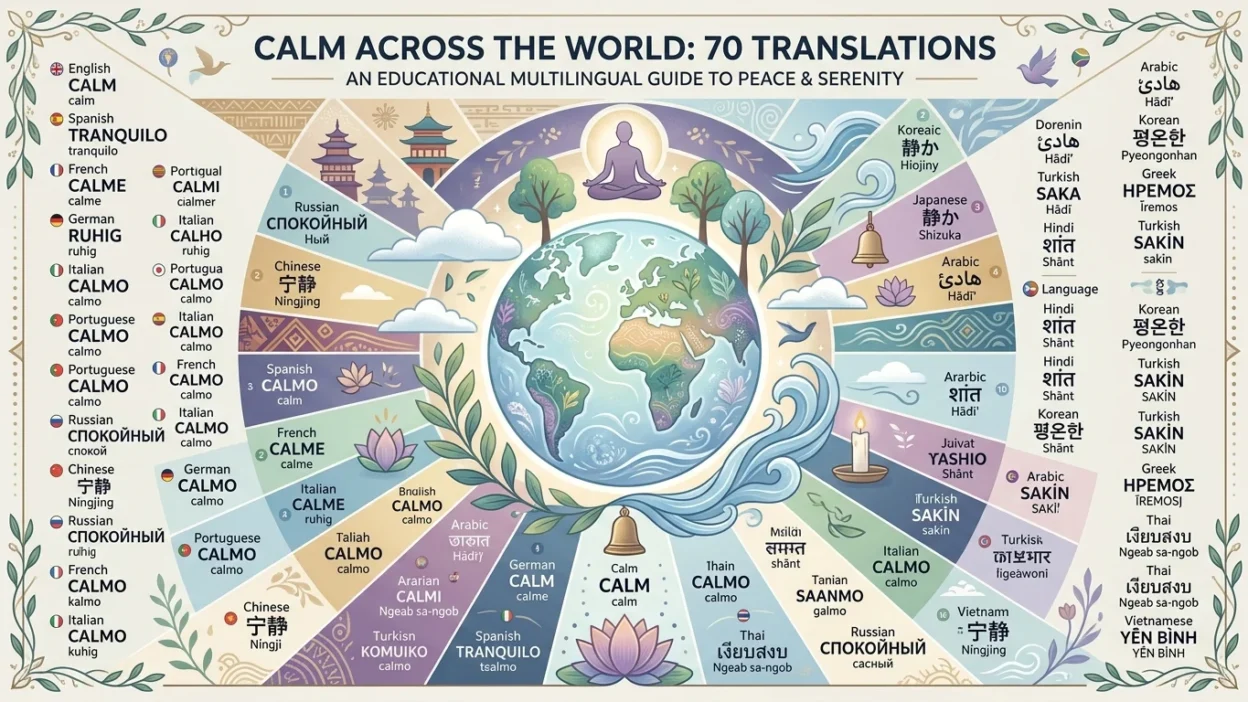
| Language | Native Word | Easy English Pronunciation |
|---|---|---|
| English | Calm | KAHM |
| Spanish | Tranquilo / Tranquila | Trahn-KEE-loh / Trahn-KEE-la |
| French | Calme | KAHLM |
| German | Ruhig | ROO-ikh |
| Italian | Calmo / Calma | KAL-moh / KAL-ma |
| Portuguese | Calmo / Calma | KAL-moh / KAL-ma |
| Dutch | Kalm | KAHLM |
| Swedish | Lugn | LOONGN |
| Norwegian | Rolig | ROO-lee |
| Danish | Rolig | ROH-lee |
| Finnish | Rauhallinen | ROW-hah-lee-nen |
| Icelandic | Rólegur | ROH-leh-gur |
| Irish | Socair | SOH-ker |
| Welsh | Tawel | TOW-el |
| Scottish Gaelic | Sàmhach | SAH-vach |
| Polish | Spokojny / Spokojna | Spo-KOY-ny / Spo-KOY-na |
| Czech | Klidný / Klidná | KLEED-nee / KLEED-na |
| Slovak | Pokojný / Pokojná | PO-koy-nee / PO-koy-na |
| Slovenian | Miren / Mirna | MEE-ren / MEER-na |
| Croatian | Miran / Mirna | MEE-ran / MEER-na |
| Serbian | Миран / Мирна | MEE-ran / MEER-na |
| Bosnian | Miran / Mirna | MEE-ran / MEER-na |
| Romanian | Calm / Calmă | KAHLM / KAL-muh |
| Hungarian | Nyugodt | NYOO-got |
| Greek | Ήρεμος / Ήρεμη | EE-reh-mos / EE-reh-mee |
| Language | Native Word | Easy English Pronunciation |
|---|---|---|
| Russian | Спокойный / Спокойная | Spa-KOY-ny / Spa-KOY-na-ya |
| Ukrainian | Спокійний / Спокійна | Spo-KEE-ny / Spo-KEE-na |
| Belarusian | Спакойны / Спакойная | Spa-KOY-ny / Spa-KOY-na-ya |
| Bulgarian | Спокоен / Спокойна | Spo-KO-yen / Spo-KOY-na |
| Macedonian | Мирен / Мирна | MEE-ren / MEER-na |
| Albanian | I qetë | Ee CHEH-tuh |
| Turkish | Sakin | SAH-kin |
| Arabic | هادئ / هادئة | HAA-dee / HAA-de-ah |
| Hebrew | רגוע / רגועה | Rah-GOO-ah / Rah-goo-AH |
| Persian | آرام | Aa-RAAM |
| Kurdish | Aram | Ah-RAHM |
| Hindi | शांत | SHAANT |
| Urdu | پُرسکون | Pur-SKOON |
| Punjabi | ਸ਼ਾਂਤ | SHAANT |
| Bengali | শান্ত | SHAANTO |
| Gujarati | શાંત | SHAANT |
| Marathi | शांत | SHAANT |
| Nepali | शान्त | SHAANT |
| Sinhala | සන්සුන් | San-SOON |
| Tamil | அமைதியான | Ah-MAI-dee-YAA-na |
| Telugu | ప్రశాంతమైన | Pra-SHAAN-ta-mai-na |
| Kannada | ಶಾಂತ | SHAAN-ta |
| Malayalam | ശാന്തമായ | SHAAN-ta-MAA-ya |
| Thai | สงบ | Sa-NGOP |
| Vietnamese | Bình tĩnh | BINH TINH |
| Language | Native Word | Easy English Pronunciation |
|---|---|---|
| Indonesian | Tenang | TEH-nang |
| Malay | Tenang | TEH-nang |
| Filipino (Tagalog) | Kalmado | Kal-MA-doh |
| Chinese (Mandarin) | 平静 | PING-jeeng |
| Japanese | 穏やか | O-day-AH-ka |
| Korean | 차분한 | CHA-boon-han |
| Mongolian | Тайван | TAI-wan |
| Burmese | ငြိမ်သက်သော | Nyeem-THET-thaw |
| Khmer | ស្ងប់ស្ងាត់ | Sngop Sngat |
| Lao | ສະຫງົບ | Sa-NGOP |
| Swahili | Tulivu | Too-LEE-voo |
| Zulu | Zolile | ZOH-lee-leh |
| Afrikaans | Kalm | KAHLM |
| Amharic | ረጋ ያለ | Reh-GA YA-leh |
| Yoruba | Tútù | TOO-too |
| Hausa | Natsuwa | Nat-SOO-wa |
| Māori | Marino | Mah-REE-no |
| Hawaiian | Maluhia | Mah-loo-HEE-ah |
| Samoan | To’afilemu | Toh-ah-fee-LEH-moo |
| Esperanto | Trankvila | Trank-VEE-la |
What Does “Calm” Mean? 🕊️
Calm means being peaceful, relaxed, and free from strong excitement, worry, or disturbance. It can describe both people and situations.
For example:
- Stay calm.
- She has a calm voice.
- The sea is calm today.
- He remained calm during the difficult situation.
- I enjoy the calm atmosphere of the countryside.
The exact translation can change depending on whether calm is being used as an adjective, verb, or noun.
How Do You Say Calm in Spanish?
In Spanish, calm can be translated as tranquilo for masculine forms and tranquila for feminine forms.
Pronunciation: Trahn-KEE-loh / Trahn-KEE-la
Example:
Mantén la calma.
Meaning: Stay calm.
How Do You Say Calm in French?
In French, calm is calme.
Pronunciation: KAHLM
Example:
Reste calme.
Meaning: Stay calm.
How Do You Say Calm in German?
In German, calm is commonly ruhig.
Pronunciation: ROO-ikh
Example:
Bleib ruhig.
Meaning: Stay calm.
How Do You Say Calm in Italian?
In Italian, you can use calmo or calma, depending on grammatical gender.
Pronunciation: KAL-moh / KAL-ma
Example:
Rimani calmo.
Meaning: Stay calm.
How Do You Say Calm in Arabic?
In Arabic, a common translation is هادئ for masculine and هادئة for feminine.
Pronunciation: HAA-dee / HAA-de-ah
The expression can vary according to grammatical gender and context.
How Do You Say Calm in Hindi?
In Hindi, calm can be expressed as शांत.
Pronunciation: SHAANT
Example:
शांत रहो।
Meaning: Stay calm.
How Do You Say Calm in Urdu?
In Urdu, calm can be translated as پُرسکون.
Pronunciation: Pur-SKOON
It conveys the idea of being peaceful, composed, or tranquil.
How Do You Say Calm in Chinese?
In Mandarin Chinese, calm can be expressed as 平静.
Pinyin: píngjìng
Easy pronunciation: PING-jeeng
It is commonly associated with a peaceful or emotionally steady state.
How Do You Say Calm in Japanese?
In Japanese, 穏やか is one way to express calm, gentle, or peaceful.
Pronunciation: O-day-AH-ka
The appropriate Japanese expression depends on whether you are describing a person, atmosphere, sea, voice, or situation.
How Do You Say Calm in Korean?
In Korean, 차분한 means calm, composed, or collected.
Pronunciation: CHA-boon-han
It can be used to describe someone’s calm manner or personality.
Calm vs. Peaceful
Calm and peaceful are closely related, but they are not always interchangeable.
| Calm | Peaceful |
|---|---|
| Not nervous or excited | Free from disturbance or conflict |
| Often describes a person’s behavior | Often describes a place, situation, or atmosphere |
| Can describe emotional control | Often suggests tranquility |
| Example: “Stay calm.” | Example: “A peaceful garden.” |
Calm vs. Quiet
These words are also related but have different meanings.
Calm usually refers to a peaceful or emotionally controlled state.
Quiet usually refers to a lack of noise.
For example:
- She remained calm during the emergency.
- The room was quiet.
A room can be quiet without being calm, and a person can be calm even when surrounded by noise.
Related Words for Calm
If you’re learning vocabulary around calm, these words are useful:
- Peaceful
- Relaxed
- Quiet
- Serene
- Tranquil
- Still
- Gentle
- Composed
- Patient
- Restful
- Soothing
- Untroubled
- Peace
- Serenity
- Relaxation
Why Learn “Calm” in Different Languages?
🌍 Travel: Knowing words related to emotions and situations can make communication easier.
🗣️ Language learning: “Calm” is a practical adjective used in everyday conversations.
📚 Vocabulary building: It introduces useful words connected with emotions, behavior, and surroundings.
❤️ Communication: Knowing how to say “stay calm” can be especially useful when communicating with people from different language backgrounds.
🧘 Wellness vocabulary: Words such as calm, peaceful, relaxed, and serene are useful when discussing mindfulness and relaxation.
How to Remember “Calm” in Different Languages
Several European languages use words that are related to ideas of peace, quietness, or tranquility.
For example:
French: Calme
German: Ruhig
Dutch: Kalm
Italian: Calmo
Portuguese: Calmo
Afrikaans: Kalm
Other languages use very different words:
Chinese: 平静
Japanese: 穏やか
Arabic: هادئ
Hindi: शांत
Urdu: پُرسکون
Swahili: Tulivu
Learning these groups can make multilingual vocabulary easier to remember.
Calm in 70 Languages — Quick Reference 🌎
English: Calm
Spanish: Tranquilo / Tranquila
French: Calme
German: Ruhig
Italian: Calmo / Calma
Portuguese: Calmo / Calma
Dutch: Kalm
Swedish: Lugn
Norwegian: Rolig
Danish: Rolig
Finnish: Rauhallinen
Icelandic: Rólegur
Irish: Socair
Welsh: Tawel
Scottish Gaelic: Sàmhach
Polish: Spokojny / Spokojna
Czech: Klidný / Klidná
Slovak: Pokojný / Pokojná
Slovenian: Miren / Mirna
Croatian: Miran / Mirna
Serbian: Миран / Мирна
Bosnian: Miran / Mirna
Romanian: Calm / Calmă
Hungarian: Nyugodt
Greek: Ήρεμος / Ήρεμη
Russian: Спокойный / Спокойная
Ukrainian: Спокійний / Спокійна
Belarusian: Спакойны / Спакойная
Bulgarian: Спокоен / Спокойна
Macedonian: Мирен / Мирна
Albanian: I qetë
Turkish: Sakin
Arabic: هادئ / هادئة
Hebrew: רגוע / רגועה
Persian: آرام
Kurdish: Aram
Hindi: शांत
Urdu: پُرسکون
Punjabi: ਸ਼ਾਂਤ
Bengali: শান্ত
Gujarati: શાંત
Marathi: शांत
Nepali: शान्त
Sinhala: සන්සුන්
Tamil: அமைதியான
Telugu: ప్రశాంతమైన
Kannada: ಶಾಂತ
Malayalam: ശാന്തമായ
Thai: สงบ
Vietnamese: Bình tĩnh
Indonesian: Tenang
Malay: Tenang
Filipino: Kalmado
Chinese: 平静
Japanese: 穏やか
Korean: 차분한
Mongolian: Тайван
Burmese: ငြိမ်သက်သော
Khmer: ស្ងប់ស្ងាត់
Lao: ສະຫງົບ
Swahili: Tulivu
Zulu: Zolile
Afrikaans: Kalm
Amharic: ረጋ ያለ
Yoruba: Tútù
Hausa: Natsuwa
Māori: Marino
Hawaiian: Maluhia
Samoan: To’afilemu
Esperanto: Trankvila
Frequently Asked Questions
What is calm in different languages?
The word calm has many different translations. Examples include tranquilo in Spanish, calme in French, ruhig in German, 平静 in Chinese, and शांत in Hindi.
What is calm in Spanish?
“Calm” is commonly tranquilo or tranquila in Spanish, depending on the grammatical gender.
What is calm in French?
“Calm” is calme in French.
What is calm in Hindi?
“Calm” is शांत (shaant) in Hindi.
What is calm in Urdu?
“Calm” can be translated as پُرسکون (pursukoon) in Urdu.
What is calm in Chinese?
“Calm” can be expressed as 平静 (píngjìng) in Mandarin Chinese.
What is calm in Japanese?
One common Japanese word is 穏やか (odayaka), which can mean calm, gentle, or peaceful depending on context.
What is calm in Korean?
차분한 (chabunhan) means calm, composed, or collected in Korean.
Is calm the same as peaceful?
They are closely related but not identical. Calm often describes a person’s emotional state or a situation without excitement, while peaceful often emphasizes freedom from disturbance or conflict.
Conclusion 🕊️🌍
From calme in French and ruhig in German to 平静 in Chinese, शांत in Hindi, and tulivu in Swahili, languages around the world have many beautiful ways to express the idea of being calm.
Learning calm in different languages can expand your vocabulary while introducing useful words connected with peace, relaxation, emotions, and everyday communication. Whether you’re learning a new language or simply exploring words from around the world, calm is a simple and meaningful word to add to your multilingual vocabulary.