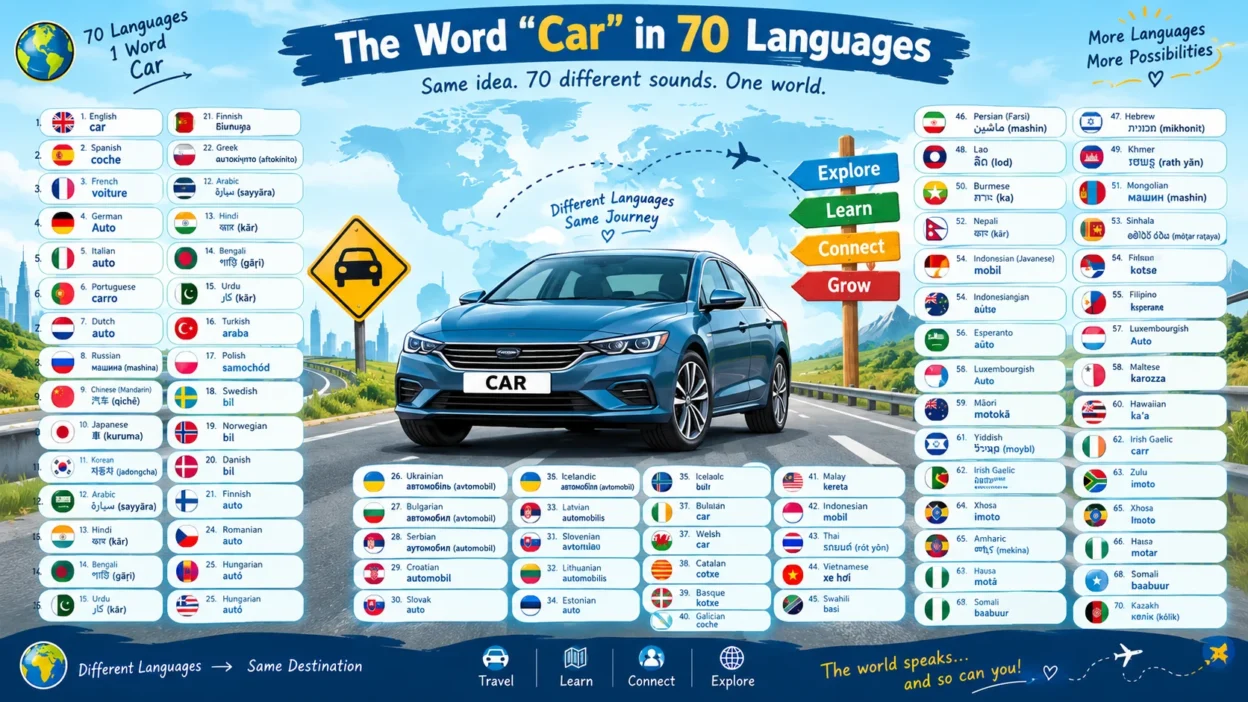
Learning how to say “car” in different languages is useful for travelers, language learners, students, and anyone interested in global vocabulary. The word can vary widely across languages, while some languages use forms related to English or other international terms
| Language | Native Word | Easy English Pronunciation |
|---|---|---|
| English | Car | KAHR |
| Spanish | Coche | KOH-cheh |
| French | Voiture | Vwah-TOOR |
| German | Auto | OW-toh |
| Italian | Auto | OW-toh |
| Portuguese | Carro | KAH-roh |
| Dutch | Auto | OW-toh |
| Swedish | Bil | BEEL |
| Norwegian | Bil | BEEL |
| Danish | Bil | BEEL |
| Finnish | Auto | OW-toh |
| Icelandic | Bíll | BEEL |
| Irish | Carr | KAHR |
| Welsh | Car | KAHR |
| Scottish Gaelic | Càr | KAHR |
| Polish | Samochód | Sa-MOH-khoot |
| Czech | Auto | OW-toh |
| Slovak | Auto | OW-toh |
| Slovenian | Avto | OW-toh |
| Croatian | Automobil | Ow-toh-MOH-beel |
| Serbian | Аутомобил | Ow-toh-MOH-beel |
| Bosnian | Automobil | Ow-toh-MOH-beel |
| Romanian | Mașină | Mah-SHEE-nuh |
| Hungarian | Autó | OW-toh |
| Greek | Αυτοκίνητο | Af-toh-KEE-nee-toh |
| Language | Native Word | Easy English Pronunciation |
|---|---|---|
| Russian | Машина | Ma-SHEE-na |
| Ukrainian | Машина | Ma-SHY-na |
| Belarusian | Машына | Ma-SHI-na |
| Bulgarian | Кола | Koh-LAH |
| Macedonian | Автомобил | Ow-toh-MOH-beel |
| Albanian | Makinë | Ma-KEE-nuh |
| Turkish | Araba | Ah-RAH-bah |
| Arabic | سيارة | Say-YAH-rah |
| Hebrew | מכונית | Meh-kho-NEET |
| Persian | ماشین | Maa-SHEEN |
| Kurdish | Erebe | Eh-REH-beh |
| Hindi | कार | KAAR |
| Urdu | گاڑی | GAA-ree |
| Punjabi | ਕਾਰ | KAAR |
| Bengali | গাড়ি | GAA-ree |
| Gujarati | કાર | KAAR |
| Marathi | गाडी | GAA-dee |
| Nepali | गाडी | GAA-dee |
| Sinhala | කාර් | KAAR |
| Tamil | கார் | KAAR |
| Telugu | కారు | KAA-roo |
| Kannada | ಕಾರು | KAA-roo |
| Malayalam | കാർ | KAAR |
| Thai | รถยนต์ | Rot-YON |
| Vietnamese | Ô tô | OH-toh |
| Indonesian | Mobil | MOH-beel |
| Language | Native Word | Easy English Pronunciation |
|---|---|---|
| Malay | Kereta | Kuh-REH-tah |
| Filipino (Tagalog) | Kotse | KOT-seh |
| Chinese (Mandarin) | 汽车 | CHEE-cheh |
| Japanese | 車 | KUR-uh-mah |
| Korean | 자동차 | Jahng-cha |
| Mongolian | Машин | MA-shin |
| Burmese | ကား | KAA |
| Khmer | ឡាន | LAAN |
| Lao | ລົດ | LOT |
| Swahili | Gari | GAH-ree |
| Zulu | Imoto | Ee-MOH-toh |
| Afrikaans | Motor | MOH-tor |
| Amharic | መኪና | Meh-KEE-na |
| Yoruba | Ọkọ̀ ayọ́kẹ́lẹ́ | Oh-kaw Ah-yaw-keh-leh |
| Hausa | Mota | MOH-tah |
| Māori | Motokā | Moh-toh-KAA |
| Hawaiian | Kaʻa | KAH-ah |
| Samoan | Ta’avale | Tah-ah-VAH-leh |
| Esperanto | Aŭto | OW-toh |
What Does “Car” Mean?
A car is a road vehicle, usually with four wheels, designed to carry people. Cars are commonly used for personal transportation, commuting, travel, and everyday activities.
The word itself changes considerably from one language to another. For example:
- Spanish: Coche
- French: Voiture
- German: Auto
- Italian: Auto
- Hindi: कार
- Urdu: گاڑی
- Chinese: 汽车
- Japanese: 車
- Korean: 자동차
Interestingly, several languages use words related to auto, motor, or other international vocabulary.
How Do You Say Car in Spanish?
In Spanish, car is commonly translated as coche in Spain. In many Latin American countries, carro or auto may also be used depending on the region.
Example:
Mi coche es nuevo. — My car is new.
How Do You Say Car in French?
The French word for car is voiture.
Example:
Ma voiture est rouge. — My car is red.
How Do You Say Car in German?
In German, Auto is the everyday word for car.
Example:
Mein Auto ist neu. — My car is new.
How Do You Say Car in Hindi?
In Hindi, car is commonly written as कार (kaar).
Example:
मेरी कार नई है। — My car is new.
How Do You Say Car in Urdu?
In Urdu, گاڑی (gaaṛī) is commonly used for a vehicle or car.
Example:
میری گاڑی نئی ہے۔ — My car is new.
How Do You Say Car in Chinese?
In Mandarin Chinese, car is 汽车 (qìchē).
- 汽 = qi
- 车 = chē
Example:
我的汽车很新。 — My car is very new.
How Do You Say Car in Japanese?
Japanese commonly uses 車 (くるま, kuruma) for car or vehicle.
Another common term is 自動車 (じどうしゃ, jidōsha), meaning automobile.
How Do You Say Car in Korean?
In Korean, car is 자동차 (jadongcha).
The shorter word 차 (cha) is also widely used in everyday speech to mean a car or vehicle.
Car vs. Automobile
Car and automobile generally refer to the same type of vehicle, but they have different levels of formality.
- Car — common everyday word
- Automobile — more formal or technical
- Auto — shortened form used in several languages
For everyday conversation, car is usually the most natural English choice.
Related Car Vocabulary
Once you know the word car, learning related vocabulary can make conversations easier:
- Car
- Automobile
- Vehicle
- Driver
- Passenger
- Road
- Highway
- Garage
- Engine
- Wheel
- Tire
- Steering wheel
- Seat
- Door
- Windshield
- Fuel
- Electric car
- Sports car
- Taxi
- Bus
Why Learn “Car” in Different Languages?
Learning a simple word such as car can be a useful starting point for studying a new language.
It can help you:
- Build everyday vocabulary
- Communicate while traveling
- Understand road signs and transportation terms
- Practice pronunciation
- Learn related vehicle vocabulary
- Recognize words when reading or listening
A familiar everyday noun is often easier to remember because you can connect it with something you see regularly.
How to Remember “Car” in Different Languages
Try grouping the translations by similarity.
For example, several European languages use forms related to auto:
German — Auto
Italian — Auto
Dutch — Auto
Czech — Auto
Hungarian — Autó
Esperanto — Aŭto
Other languages have completely different everyday words:
French — Voiture
Spanish — Coche
Romanian — Mașină
Turkish — Araba
Swahili — Gari
Grouping similar words together can make a large vocabulary list much easier to memorize.
Quick Reference: Car in 10 Languages
| Language | Word |
|---|---|
| English | Car |
| Spanish | Coche |
| French | Voiture |
| German | Auto |
| Italian | Auto |
| Portuguese | Carro |
| Arabic | سيارة |
| Hindi | कार |
| Chinese | 汽车 |
| Japanese | 車 |
Frequently Asked Questions
What is the word for car in Spanish?
The common Spanish word is coche, although carro and auto are also used in different Spanish-speaking regions.
What is car in French?
Car is voiture in French.
What is car in German?
Car is Auto in German.
What is car in Hindi?
Car is कार (kaar) in Hindi.
What is car in Urdu?
Car is commonly گاڑی (gaaṛī) in Urdu.
What is car in Japanese?
Car is 車 (kuruma) in Japanese.
What is car in Chinese?
Car is 汽车 (qìchē) in Mandarin Chinese.
What is car in Korean?
Car is 자동차 (jadongcha) in Korean, while 차 (cha) is also commonly used.
Conclusion
The word “car” has many different forms around the world. Some languages use words such as Auto, while others have completely different terms such as voiture, coche, araba, and gari.
Learning car in different languages is a simple way to expand your vocabulary and discover how languages describe familiar objects. Whether you are traveling, studying languages, or creating multilingual content, these 70 translations provide a useful starting point.

Daniel Whitmore is a language writer and editor from the United Kingdom who is passionate about making language learning accessible to everyone. He specializes in English grammar, vocabulary, spelling differences, pronunciation, and multilingual communication. His articles break down complex language concepts into clear, practical lessons that readers can apply in everyday conversations and writing. Daniel enjoys exploring the history, culture, and evolution of languages while creating engaging content for students, educators, travelers, and language enthusiasts. His goal is to provide accurate, reader-friendly resources that help people build confidence in learning English and other world languages through simple explanations and real-life examples.