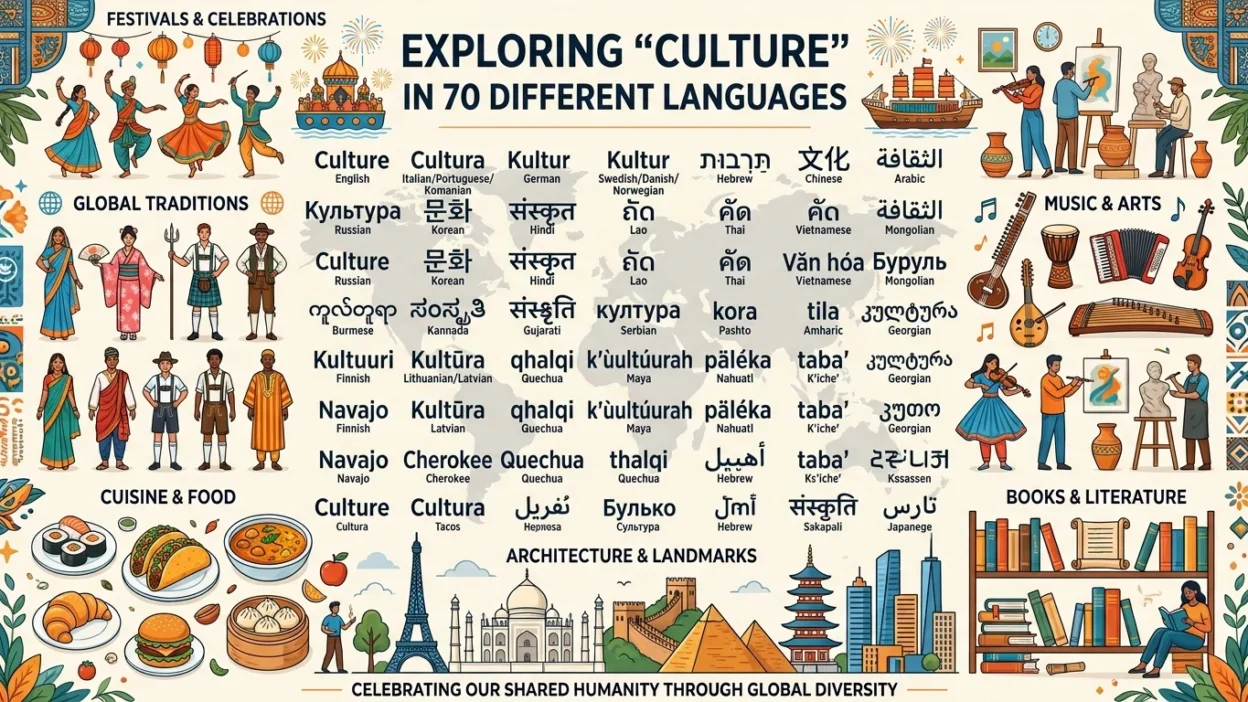
Culture is the collection of traditions, customs, beliefs, values, arts, food, language, and ways of life shared by a group of people. Every country and community has its own unique culture, making this word especially interesting to learn in different languages.
If you are learning languages or researching how people around the world express ideas about culture, this guide gives you the word for culture in 70 languages, with native spellings and easy English pronunciations.
| Language | Native Word | Easy English Pronunciation |
|---|---|---|
| English | Culture | KUL-cher |
| Spanish | Cultura | Kool-TOO-ra |
| French | Culture | Kool-TUR |
| German | Kultur | Kool-TOOR |
| Italian | Cultura | Kool-TOO-ra |
| Portuguese | Cultura | Kool-TOO-ra |
| Dutch | Cultuur | Kool-TOOR |
| Swedish | Kultur | Kool-TOOR |
| Norwegian | Kultur | Kool-TOOR |
| Danish | Kultur | Kool-TOOR |
| Finnish | Kulttuuri | Kool-too-ree |
| Icelandic | Menning | MEN-ning |
| Irish | Cultúr | KUL-toor |
| Welsh | Diwylliant | Dee-WILL-yant |
| Scottish Gaelic | Cultar | KOOL-tar |
| Polish | Kultura | Kool-TOO-ra |
| Czech | Kultura | Kool-TOO-ra |
| Slovak | Kultúra | Kool-TOO-ra |
| Slovenian | Kultura | Kool-TOO-ra |
| Croatian | Kultura | Kool-TOO-ra |
| Serbian | Култура | Kool-TOO-ra |
| Bosnian | Kultura | Kool-TOO-ra |
| Romanian | Cultură | Kool-TOO-ruh |
| Hungarian | Kultúra | Kool-TOO-rah |
| Greek | Πολιτισμός | Poh-lee-tee-zMOS |
Culture in Russian, Turkish, Arabic, and South Asian Languages
| Language | Native Word | Easy English Pronunciation |
|---|---|---|
| Russian | Культура | Kool-TOO-ra |
| Ukrainian | Культура | Kool-TOO-ra |
| Belarusian | Культура | Kool-TOO-ra |
| Bulgarian | Култура | Kool-TOO-ra |
| Macedonian | Култура | Kool-TOO-ra |
| Albanian | Kulturë | Kool-TOOR-uh |
| Turkish | Kültür | KUL-toor |
| Arabic | ثقافة | Tha-QAA-fa |
| Hebrew | תרבות | Tar-BOOT |
| Persian | فرهنگ | Far-HANG |
| Kurdish | Çand | CHAND |
| Hindi | संस्कृति | San-SKRI-tee |
| Urdu | ثقافت | Sa-QAA-fat |
| Punjabi | ਸੱਭਿਆਚਾਰ | Sab-yaa-CHAAR |
| Bengali | সংস্কৃতি | Shong-SKRI-tee |
| Gujarati | સંસ્કૃતિ | Sans-KRI-tee |
| Marathi | संस्कृती | Sans-KRI-tee |
| Nepali | संस्कृति | Sans-KRI-tee |
| Sinhala | සංස්කෘතිය | Sans-KROO-tee-ya |
| Tamil | கலாச்சாரம் | Ka-laa-CHAAram |
| Telugu | సంస్కృతి | Sans-KRU-tee |
| Kannada | ಸಂಸ್ಕೃತಿ | Sans-KRU-ti |
| Malayalam | സംസ്കാരം | Sans-KAA-ram |
| Thai | วัฒนธรรม | Wat-tha-na-tham |
| Vietnamese | Văn hóa | Van HWA |
Culture in Asian Languages
| Language | Native Word | Easy English Pronunciation |
|---|---|---|
| Indonesian | Budaya | Boo-DAH-ya |
| Malay | Budaya | Boo-DAH-ya |
| Filipino (Tagalog) | Kultura | Kool-TOO-ra |
| Chinese (Mandarin) | 文化 | WEN-hwa |
| Japanese | 文化 | BUN-ka |
| Korean | 문화 | MOON-hwa |
| Mongolian | Соёл | SO-yol |
| Burmese | ယဉ်ကျေးမှု | Yin-kye-mhoo |
| Khmer | វប្បធម៌ | Vop-pa-thor |
| Lao | ວັດທະນະທໍາ | Wat-tha-na-tham |
Culture in African Languages
| Language | Native Word | Easy English Pronunciation |
|---|---|---|
| Swahili | Utamaduni | Oo-ta-ma-DOO-nee |
| Zulu | Isiko | Ee-SEE-koh |
| Afrikaans | Kultuur | Kool-TOOR |
| Amharic | ባህል | Bah-hil |
| Yoruba | Àṣà | Ah-SHA |
| Hausa | Al’ada | Al-AA-da |
Culture in Pacific and Other Languages
| Language | Native Word | Easy English Pronunciation |
|---|---|---|
| Māori | Ahurea | Ah-HOO-reh-ah |
| Hawaiian | Moʻomeheu | Moh-oh-meh-HEH-oo |
| Samoan | Aganuʻu | Ah-gah-noo-OO |
| Esperanto | Kulturo | Kool-TOO-ro |
What Does Culture Mean? 🌎
Culture refers to the shared patterns of life within a society or community. It can include traditions, celebrations, language, music, clothing, cuisine, art, social customs, and beliefs.
Culture is not limited to one area of life. It can influence how people communicate, celebrate, eat, work, create art, and interact with others.
For example, food traditions are an important part of culture in many communities. Festivals, music, traditional clothing, storytelling, and family customs can also reflect cultural identity.
How Do You Say Culture in Spanish?
In Spanish, culture is “cultura.”
Pronunciation: Kool-TOO-ra
Example:
La cultura española es muy diversa.
Meaning: Spanish culture is very diverse.
How Do You Say Culture in French?
In French, culture is “culture.”
Pronunciation: Kool-TUR
Example:
La culture française est connue dans le monde entier.
Meaning: French culture is known around the world.
How Do You Say Culture in German?
In German, culture is “Kultur.”
Pronunciation: Kool-TOOR
Example:
Die Kultur ist ein wichtiger Teil der Gesellschaft.
Meaning: Culture is an important part of society.
How Do You Say Culture in Italian?
In Italian, culture is “cultura.”
Pronunciation: Kool-TOO-ra
The Italian word is closely related to the equivalent word in Spanish and Portuguese.
How Do You Say Culture in Arabic?
In Arabic, culture is commonly written as ثقافة.
Pronunciation: Tha-QAA-fa
Arabic has several related terms used when discussing cultural heritage, traditions, and society.
How Do You Say Culture in Hindi?
In Hindi, culture is संस्कृति.
Pronunciation: San-SKRI-tee
The word is commonly used when discussing Indian culture, traditions, heritage, and social customs.
How Do You Say Culture in Urdu?
In Urdu, culture is ثقافت.
Pronunciation: Sa-QAA-fat
It can be used when talking about the traditions, customs, arts, and lifestyle of a community.
How Do You Say Culture in Chinese?
In Mandarin Chinese, culture is 文化.
Pinyin: wénhuà
Easy pronunciation: WEN-hwa
The term is widely used for discussions of culture, education, arts, and society.
How Do You Say Culture in Japanese?
In Japanese, culture is 文化.
Pronunciation: BUN-ka
It is written using two kanji characters and is commonly used in everyday and academic contexts.
How Do You Say Culture in Korean?
In Korean, culture is 문화.
Pronunciation: MOON-hwa
It can refer to culture in a broad social sense, including popular culture, traditional culture, and international culture.
Culture and Tradition: What’s the Difference?
Culture and tradition are closely connected, but they are not exactly the same.
| Culture | Tradition |
|---|---|
| Broad way of life of a community | A practice or custom passed through generations |
| Includes language, art, food, beliefs, and customs | Usually focuses on inherited customs and practices |
| Can change over time | Can also change over time |
| Covers many aspects of society | Usually represents a particular practice or custom |
For example, music, language, food, clothing, and traditions can all be parts of a community’s broader culture.
Culture vs. Cultural Heritage
Culture describes the broader way of life and shared practices of a community.
Cultural heritage generally refers to traditions, places, objects, knowledge, practices, and expressions that communities inherit and pass on.
Both concepts are important when discussing the history and identity of societies around the world.
Examples of Culture
Culture can be expressed in many different ways:
- 🍲 Food and cuisine
- 🎵 Music
- 💃 Dance
- 🎨 Art
- 🗣️ Language
- 👗 Traditional clothing
- 🎉 Festivals
- 📖 Stories and literature
- 🏛️ Architecture
- 👨👩👧 Family customs
- 🙏 Social practices
- 🎭 Performing arts
Why Learn “Culture” in Different Languages?
Learning the word culture in different languages can be useful for language learners, travelers, students, writers, and researchers.
🌍 For travel: Cultural vocabulary can help you discuss local traditions and customs.
📚 For students: The word appears frequently in history, sociology, anthropology, literature, and language studies.
🗣️ For language learning: Learning everyday abstract nouns expands your vocabulary beyond basic objects.
💼 For international communication: Cultural topics often come up when people from different countries work together.
❤️ For understanding communities: Language provides another way to explore how different societies describe culture and identity.
Related Words for Culture
If you’re learning vocabulary around culture, these related words can also be useful:
- Tradition
- Custom
- Heritage
- Society
- Community
- Language
- History
- Art
- Music
- Cuisine
- Festival
- Identity
- Values
- Beliefs
- Lifestyle
How to Remember “Culture” in Different Languages
One useful trick is to group languages with similar words.
For example:
Spanish: Cultura
Italian: Cultura
Portuguese: Cultura
Polish: Kultura
Czech: Kultura
Croatian: Kultura
Serbian: Култура
Russian: Культура
These forms are relatively easy to recognize because they share a similar root.
Other languages use completely different words:
Chinese: 文化
Japanese: 文化
Arabic: ثقافة
Persian: فرهنگ
Hindi: संस्कृति
Indonesian: Budaya
Swahili: Utamaduni
This makes multilingual vocabulary especially interesting because languages can express the same concept through very different words.
Culture in 70 Languages — Quick Reference
Here is a quick list for easy reference:
English: Culture
Spanish: Cultura
French: Culture
German: Kultur
Italian: Cultura
Portuguese: Cultura
Dutch: Cultuur
Swedish: Kultur
Norwegian: Kultur
Danish: Kultur
Finnish: Kulttuuri
Icelandic: Menning
Irish: Cultúr
Welsh: Diwylliant
Scottish Gaelic: Cultar
Polish: Kultura
Czech: Kultura
Slovak: Kultúra
Slovenian: Kultura
Croatian: Kultura
Serbian: Култура
Bosnian: Kultura
Romanian: Cultură
Hungarian: Kultúra
Greek: Πολιτισμός
Russian: Культура
Ukrainian: Культура
Belarusian: Культура
Bulgarian: Култура
Macedonian: Култура
Albanian: Kulturë
Turkish: Kültür
Arabic: ثقافة
Hebrew: תרבות
Persian: فرهنگ
Kurdish: Çand
Hindi: संस्कृति
Urdu: ثقافت
Punjabi: ਸੱਭਿਆਚਾਰ
Bengali: সংস্কৃতি
Gujarati: સંસ્કૃતિ
Marathi: संस्कृती
Nepali: संस्कृति
Sinhala: සංස්කෘතිය
Tamil: கலாச்சாரம்
Telugu: సంస్కృతి
Kannada: ಸಂಸ್ಕೃತಿ
Malayalam: സംസ്കാരം
Thai: วัฒนธรรม
Vietnamese: Văn hóa
Indonesian: Budaya
Malay: Budaya
Filipino: Kultura
Chinese: 文化
Japanese: 文化
Korean: 문화
Mongolian: Соёл
Burmese: ယဉ်ကျေးမှု
Khmer: វប្បធម៌
Lao: ວັດທະນະທໍາ
Swahili: Utamaduni
Zulu: Isiko
Afrikaans: Kultuur
Amharic: ባህል
Yoruba: Àṣà
Hausa: Al’ada
Māori: Ahurea
Hawaiian: Moʻomeheu
Samoan: Aganuʻu
Esperanto: Kulturo
Frequently Asked Questions
What is culture in different languages?
The word culture has different forms around the world. Examples include cultura in Spanish, Kultur in German, 文化 in Chinese and Japanese, and Budaya in Indonesian and Malay.
What is culture called in Spanish?
Culture is cultura in Spanish, pronounced approximately Kool-TOO-ra.
What is culture called in French?
Culture is culture in French, pronounced approximately Kool-TUR.
What is culture called in Hindi?
Culture is संस्कृति (sanskriti) in Hindi, pronounced approximately San-SKRI-tee.
What is culture called in Urdu?
Culture is ثقافت (saqafat) in Urdu, pronounced approximately Sa-QAA-fat.
What is culture called in Chinese?
Culture is 文化 (wénhuà) in Mandarin Chinese, pronounced approximately WEN-hwa.
What is culture called in Japanese?
Culture is 文化 (bunka) in Japanese, pronounced approximately BUN-ka.
What is the difference between culture and tradition?
Culture is a broad concept covering the shared ways of life of a community, while a tradition is generally a particular custom, practice, or belief passed from one generation to another.
Conclusion 🌍❤️
The word culture may look and sound similar across many European languages, while languages from Asia, Africa, and the Pacific often use completely different terms. Learning these differences gives language learners a fascinating look at how people around the world communicate ideas about tradition, heritage, identity, and society.
Whether you are studying a new language, preparing for international travel, researching cultures around the world, or simply expanding your vocabulary, learning “culture” in different languages is a simple way to connect language with the rich diversity of human life.