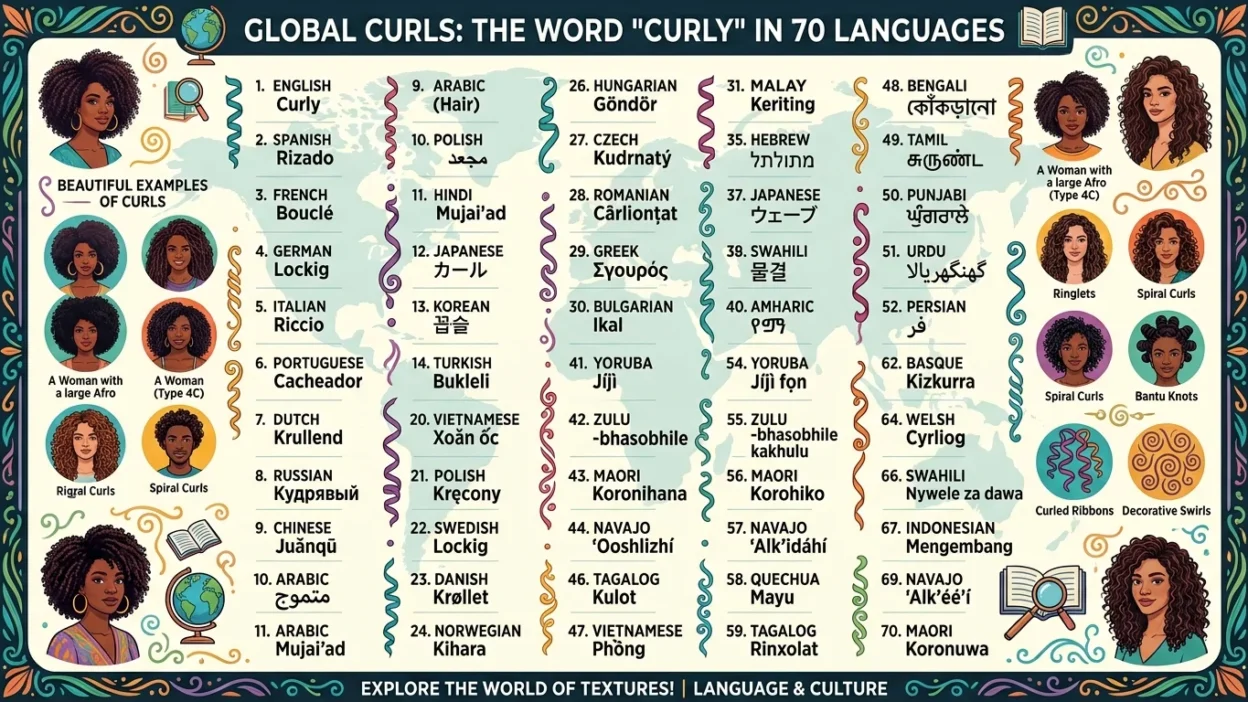
“Curly” is an adjective used to describe something that forms curls, loops, or rounded bends. It is especially common when talking about curly hair, but it can also describe curly shapes, lines, ribbons, and other objects.
Below, you’ll find “curly” in 70 languages, with the native word and an easy English pronunciation.
| Language | Native Word | Easy English Pronunciation |
|---|---|---|
| English | Curly | KUR-lee |
| Spanish | Rizado | Ree-SAH-doh |
| French | Bouclé / Bouclés | Boo-KLAY / Boo-KLAY |
| German | Lockig | LOK-ig |
| Italian | Riccio | REECH-choh |
| Portuguese | Cacheado | Ka-sheh-AH-doh |
| Dutch | Krullend | KRUH-lent |
| Swedish | Lockig | LOK-ig |
| Norwegian | Krøllete | KRUR-leh-teh |
| Danish | Krøllet | KRUR-let |
| Finnish | Kihara | KEE-ha-ra |
| Icelandic | Krullaður | KROOL-lah-thur |
| Irish | Catach | KAH-takh |
| Welsh | Cyrliog | KUR-lyog |
| Scottish Gaelic | Lùbach | LOO-bakh |
| Polish | Kręcony | KREN-tso-nih |
| Czech | Kudrnatý | KOO-dra-na-tee |
| Slovak | Kučeravý | KOO-cheh-ra-vee |
| Slovenian | Kodrast | KOH-drast |
| Croatian | Kovrčav | KOH-vr-chav |
| Serbian | Коврџав | KOVR-dzhav |
| Bosnian | Kovrdžav | KOVR-dzhav |
| Romanian | Creț | KRETZ |
| Hungarian | Göndör | GURN-dur |
| Greek | Σγουρός | Sgoo-ROS |
Curly in Russian, Turkish, Arabic, and South Asian Languages
| Language | Native Word | Easy English Pronunciation |
|---|---|---|
| Russian | Кудрявый | Kood-RYAH-vy |
| Ukrainian | Кучерявий | Koo-cheh-RYAH-vy |
| Belarusian | Кучаравы | Koo-cha-RA-vy |
| Bulgarian | Къдрав | KAH-drav |
| Macedonian | Кадрав | KA-drav |
| Albanian | Kaçurrel | Ka-CHOO-rel |
| Turkish | Kıvırcık | Kuh-vur-JUK |
| Arabic | مجعد | Moo-JA-ad |
| Hebrew | מתולתל | Mee-too-TAL |
| Persian | فرفری | Far-fa-REE |
| Kurdish | Pîç | PEECH |
| Hindi | घुंघराला | Ghoong-gha-RAA-la |
| Urdu | گھنگریالا | Ghang-ri-YAA-la |
| Punjabi | ਘੁੰਗਰਾਲੇ | Ghoong-raa-LAY |
| Bengali | কোঁকড়ানো | Kon-kra-NO |
| Gujarati | વાંકડિયા | Vaan-ka-DI-ya |
| Marathi | कुरळे | KOO-ra-leh |
| Nepali | घुम्रिएको | Ghoom-ri-E-ko |
| Sinhala | කැරලි | KAH-ra-lee |
| Tamil | சுருள் | Soo-RUL |
| Telugu | వంకర | VUN-ka-ra |
| Kannada | ಗುಂಗುರು | Goon-goo-roo |
| Malayalam | ചുരുണ്ട | Choo-RUN-da |
| Thai | หยิก | YIK |
| Vietnamese | Xoăn | SWAN |
Curly in Asian Languages
| Language | Native Word | Easy English Pronunciation |
|---|---|---|
| Indonesian | Keriting | Keh-REE-ting |
| Malay | Kerinting | Keh-RIN-ting |
| Filipino (Tagalog) | Kulot | KOO-lot |
| Chinese (Mandarin) | 卷曲 | Juǎn-qū |
| Japanese | 巻き毛の | Ma-ki-ge-no |
| Korean | 곱슬곱슬한 | Gop-seul-gop-seul-han |
| Mongolian | Буржгар | Boor-JGAR |
| Burmese | ကောက်ကွေးသော | Kauk-Kway-thaw |
| Khmer | រួញ | Ruonh |
| Lao | ຢິກ | Yik |
Curly in African Languages
| Language | Native Word | Easy English Pronunciation |
|---|---|---|
| Swahili | Yenye kujipinda | Yen-yeh koo-jee-PIN-da |
| Zulu | Kugobile | Koo-GOH-bee-leh |
| Afrikaans | Krullerig | KRUHL-uh-rikh |
| Amharic | ጠማማ | Teh-MA-ma |
| Yoruba | Kíkọ́ | Kee-KOH |
| Hausa | Mai lanƙwasa | My LAN-kwah-sa |
Curly in Pacific and Other Languages
| Language | Native Word | Easy English Pronunciation |
|---|---|---|
| Māori | Kōpikopiko | Kaw-pee-kaw-pee-kaw |
| Hawaiian | Kīwaha | Kee-VA-ha |
| Samoan | Piʻo | Pee-OH |
| Esperanto | Bukla | BOO-kla |
What Does “Curly” Mean? 🌀
Curly describes something that bends, twists, or forms curls instead of remaining straight.
The most common use is curly hair. For example:
She has curly hair.
The word can also describe:
- Curly hair
- Curly ribbons
- Curly lines
- Curly handwriting
- Curly shapes
- Curly leaves
- Curly fibers
The exact translation can change depending on what is being described.
How Do You Say Curly in Spanish?
In Spanish, curly is commonly translated as rizado.
Rizado is especially common when describing hair.
Example:
Ella tiene el cabello rizado.
Meaning: She has curly hair.
How Do You Say Curly in French?
In French, curly can be expressed as bouclé for masculine singular and bouclée for feminine singular. For curly hair, cheveux bouclés is commonly used.
Example:
Elle a les cheveux bouclés.
Meaning: She has curly hair.
How Do You Say Curly in German?
In German, curly is lockig.
Example:
Sie hat lockige Haare.
Meaning: She has curly hair.
How Do You Say Curly in Italian?
In Italian, curly is riccio or riccia, depending on grammatical gender.
For example:
Capelli ricci means curly hair.
How Do You Say Curly in Portuguese?
In Portuguese, curly is commonly cacheado or cacheada, depending on gender.
Cabelo cacheado means curly hair.
How Do You Say Curly in Arabic?
In Arabic, curly can be expressed as مجعد.
For feminine forms, the ending changes according to Arabic grammar.
The word is commonly used when describing curly hair.
How Do You Say Curly in Hindi?
In Hindi, curly can be expressed as घुंघराला.
It is often used to describe curly or ringlet-like hair.
Example:
उसके बाल घुंघराले हैं।
Meaning: Her hair is curly.
How Do You Say Curly in Urdu?
In Urdu, curly is commonly expressed as گھنگریالا.
It can be used when talking about naturally curly or ringlet-shaped hair.
How Do You Say Curly in Chinese?
In Mandarin Chinese, curly can be expressed as 卷曲 (juǎnqū).
For curly hair, 卷发 (juǎnfà) is also commonly used.
卷发 literally refers to curled or curly hair.
How Do You Say Curly in Japanese?
In Japanese, curly hair is commonly expressed as 巻き毛 (makige).
巻き毛 refers to hair that curls or is naturally curled.
How Do You Say Curly in Korean?
In Korean, curly can be expressed with 곱슬곱슬한.
For example, 곱슬머리 means curly hair.
Curly vs. Wavy
Curly and wavy are related but different descriptions.
| Curly | Wavy |
|---|---|
| Forms noticeable curls or coils | Forms gentle waves |
| Often bends into loops | Usually creates an S-like pattern |
| Curls can be tight or loose | Waves are generally less defined |
| Example: curly hair | Example: wavy hair |
Someone can also have hair that falls somewhere between wavy and curly.
Curly Hair Vocabulary
If you’re learning vocabulary related to curly hair, these words can help:
- Curl
- Curly
- Curls
- Ringlet
- Coil
- Wavy
- Straight
- Hair
- Texture
- Volume
- Frizz
- Natural curls
- Curly hair
- Hair pattern
- Hair texture
Curly in Different Languages for Hair
When talking specifically about hair, several languages use a different grammatical form or a more specific expression.
For example:
- Spanish: cabello rizado
- French: cheveux bouclés
- German: lockige Haare
- Italian: capelli ricci
- Portuguese: cabelo cacheado
- Chinese: 卷发
- Japanese: 巻き毛
- Korean: 곱슬머리
- Indonesian: rambut keriting
- Filipino: kulot na buhok
This is useful because translating the single adjective “curly” does not always produce the most natural phrase for “curly hair.”
Why Learn “Curly” in Different Languages?
Learning the word curly in different languages is useful for language learners, travelers, writers, beauty professionals, and anyone interested in describing appearance.
💇 Beauty vocabulary: Hair descriptions are common in salons and beauty conversations.
🌍 Travel: Knowing appearance-related vocabulary can make everyday communication easier.
📚 Language learning: Adjectives are essential for describing people and objects.
🗣️ Conversation: Words such as curly, straight, tall, short, and wavy frequently appear in descriptions.
✍️ Writing: Descriptive vocabulary helps create more vivid characters and scenes.
Related Words for Curly
Here are some useful related words:
- Straight
- Wavy
- Curled
- Coiled
- Ringlet
- Frizzy
- Thick
- Thin
- Long
- Short
- Natural
- Hair
- Curl
- Texture
- Volume
How to Remember “Curly” in Different Languages
Some languages have words that are completely different from English, while others have related forms.
For example:
English: Curly
Spanish: Rizado
French: Bouclé
German: Lockig
Italian: Riccio
Portuguese: Cacheado
Turkish: Kıvırcık
Indonesian: Keriting
Filipino: Kulot
A useful strategy is to learn the word together with “curly hair” rather than memorizing the adjective alone. This helps you remember how native speakers naturally use it.
Curly in 70 Languages — Quick Reference
English: Curly
Spanish: Rizado
French: Bouclé
German: Lockig
Italian: Riccio
Portuguese: Cacheado
Dutch: Krullend
Swedish: Lockig
Norwegian: Krøllete
Danish: Krøllet
Finnish: Kihara
Icelandic: Krullaður
Irish: Catach
Welsh: Cyrliog
Scottish Gaelic: Lùbach
Polish: Kręcony
Czech: Kudrnatý
Slovak: Kučeravý
Slovenian: Kodrast
Croatian: Kovrčav
Serbian: Коврџав
Bosnian: Kovrdžav
Romanian: Creț
Hungarian: Göndör
Greek: Σγουρός
Russian: Кудрявый
Ukrainian: Кучерявий
Belarusian: Кучаравы
Bulgarian: Къдрав
Macedonian: Кадрав
Albanian: Kaçurrel
Turkish: Kıvırcık
Arabic: مجعد
Hebrew: מתולתל
Persian: فرفری
Kurdish: Pîç
Hindi: घुंघराला
Urdu: گھنگریالا
Punjabi: ਘੁੰਗਰਾਲੇ
Bengali: কোঁকড়ানো
Gujarati: વાંકડિયા
Marathi: कुरळे
Nepali: घुम्रिएको
Sinhala: කැරලි
Tamil: சுருள்
Telugu: వంకర
Kannada: ಗುಂಗುರು
Malayalam: ചുരുണ്ട
Thai: หยิก
Vietnamese: Xoăn
Indonesian: Keriting
Malay: Kerinting
Filipino: Kulot
Chinese: 卷曲
Japanese: 巻き毛の
Korean: 곱슬곱슬한
Mongolian: Буржгар
Burmese: ကောက်ကွေးသော
Khmer: រួញ
Lao: ຢິກ
Swahili: Yenye kujipinda
Zulu: Kugobile
Afrikaans: Krullerig
Amharic: ጠማማ
Yoruba: Kíkọ́
Hausa: Mai lanƙwasa
Māori: Kōpikopiko
Hawaiian: Kīwaha
Samoan: Piʻo
Esperanto: Bukla
Frequently Asked Questions
What is curly in different languages?
The word curly changes significantly between languages. Examples include rizado in Spanish, bouclé in French, lockig in German, riccio in Italian, and cacheado in Portuguese.
What is curly in Spanish?
Curly is rizado in Spanish, especially when describing hair.
What is curly in French?
Curly is commonly bouclé in French. Cheveux bouclés means curly hair.
What is curly in German?
Curly is lockig in German. Lockige Haare means curly hair.
What is curly in Hindi?
Curly can be expressed as घुंघराला in Hindi, particularly when describing curly hair.
What is curly in Urdu?
Curly can be expressed as گھنگریالا in Urdu, especially when referring to curly hair.
What is curly in Chinese?
Curly can be expressed as 卷曲 (juǎnqū) in Mandarin. 卷发 (juǎnfà) is commonly used for curly or curled hair.
What is curly in Japanese?
For curly hair, Japanese commonly uses 巻き毛 (makige).
Is curly the same as wavy?
No. Curly generally describes hair or another shape that forms curls, while wavy describes softer, wave-like bends.
Conclusion 🌀🌍
The word “curly” has many interesting translations around the world. From rizado in Spanish and riccio in Italian to 卷曲 in Chinese and 곱슬곱슬한 in Korean, each language has its own way of describing curls and rounded shapes.
If you’re learning a new language, remembering “curly hair” along with the basic adjective can make the vocabulary easier to use naturally. Whether you’re describing someone’s hair, a ribbon, a line, or another curled shape, this multilingual guide gives you a useful starting point.

Daniel Whitmore is a language writer and editor from the United Kingdom who is passionate about making language learning accessible to everyone. He specializes in English grammar, vocabulary, spelling differences, pronunciation, and multilingual communication. His articles break down complex language concepts into clear, practical lessons that readers can apply in everyday conversations and writing. Daniel enjoys exploring the history, culture, and evolution of languages while creating engaging content for students, educators, travelers, and language enthusiasts. His goal is to provide accurate, reader-friendly resources that help people build confidence in learning English and other world languages through simple explanations and real-life examples.