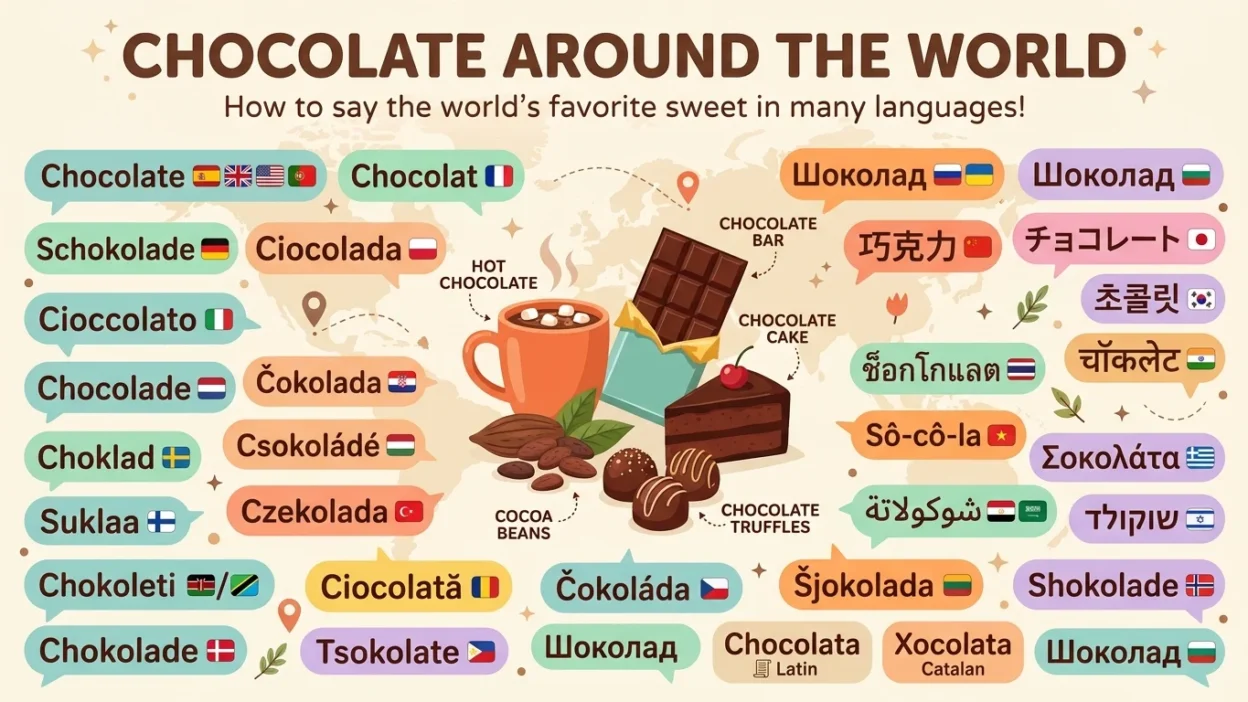
Chocolate is a favorite sweet treat enjoyed by people around the world. From creamy milk chocolate to rich dark chocolate and delicious chocolate desserts, it is loved in many cultures. Although the word sounds similar in some languages, other languages use unique spellings, pronunciations, and writing systems.
In this guide, you’ll discover how to say chocolate in 70 different languages, with native spellings and easy pronunciation guides to help you learn each word.
Chocolate in 70 Different Languages
| No. | Language | Native Word | Easy Pronunciation |
|---|---|---|---|
| 1 | English | Chocolate | CHOK-lit |
| 2 | Spanish | Chocolate | cho-ko-LAH-teh |
| 3 | French | Chocolat | sho-ko-LAH |
| 4 | German | Schokolade | shoh-ko-LAH-duh |
| 5 | Italian | Cioccolato | chok-ko-LAH-toh |
| 6 | Portuguese | Chocolate | sho-ko-LAH-chee |
| 7 | Dutch | Chocolade | shoh-ko-LAH-duh |
| 8 | Swedish | Choklad | SHOH-klad |
| 9 | Norwegian | Sjokolade | shoo-ko-LAH-duh |
| 10 | Danish | Chokolade | koh-ko-LAH-thuh |
| 11 | Finnish | Suklaa | SOOK-lah |
| 12 | Icelandic | Súkkulaði | SOOK-oo-lah-thi |
| 13 | Irish | Seacláid | shak-LAWDJ |
| 14 | Welsh | Siocled | SHOK-led |
| 15 | Scottish Gaelic | Seòclaid | SHOH-kletch |
| 16 | Polish | Czekolada | cheh-ko-LAH-dah |
| 17 | Czech | Čokoláda | cho-ko-LAH-dah |
| 18 | Slovak | Čokoláda | cho-ko-LAH-dah |
| 19 | Slovenian | Čokolada | cho-ko-LAH-dah |
| 20 | Croatian | Čokolada | cho-ko-LAH-dah |
| 21 | Serbian | Чоколада | cho-ko-LAH-dah |
| 22 | Bosnian | Čokolada | cho-ko-LAH-dah |
| 23 | Romanian | Ciocolată | cho-ko-LAH-tuh |
| 24 | Hungarian | Csokoládé | cho-ko-LAH-day |
| 25 | Greek | Σοκολάτα | so-ko-LAH-tah |
| 26 | Russian | Шоколад | sha-ka-LAHT |
| 27 | Ukrainian | Шоколад | sho-ko-LAHD |
| 28 | Belarusian | Шакалад | sha-ka-LAHD |
| 29 | Bulgarian | Шоколад | sho-ko-LAHD |
| 30 | Macedonian | Чоколадо | cho-ko-LAH-doh |
| 31 | Albanian | Çokollatë | cho-ko-LAH-tuh |
| 32 | Turkish | Çikolata | chee-ko-LAH-tah |
| 33 | Arabic | شوكولاتة | shaw-ko-LAH-tah |
| 34 | Hebrew | שוקולד | shoh-ko-LAHD |
| 35 | Persian | شکلات | sheh-ko-LAHT |
| 36 | Kurdish | Çîkolata | chee-ko-LAH-tah |
| 37 | Hindi | चॉकलेट | CHAWK-let |
| 38 | Urdu | چاکلیٹ | CHAWK-lit |
| 39 | Punjabi | ਚਾਕਲੇਟ | CHAWK-lit |
| 40 | Bengali | চকোলেট | CHO-ko-let |
| 41 | Gujarati | ચોકલેટ | CHAWK-let |
| 42 | Marathi | चॉकलेट | CHAWK-let |
| 43 | Nepali | चकलेट | CHOK-let |
| 44 | Sinhala | චොකලට් | CHO-ka-lat |
| 45 | Tamil | சாக்லேட் | CHAWK-let |
| 46 | Telugu | చాక్లెట్ | CHAWK-let |
| 47 | Kannada | ಚಾಕೊಲೇಟ್ | CHAWK-oh-layt |
| 48 | Malayalam | ചോക്ലേറ്റ് | CHAWK-layt |
| 49 | Thai | ช็อกโกแลต | chok-ko-laet |
| 50 | Vietnamese | Sô-cô-la | soh-koh-LAH |
| 51 | Indonesian | Cokelat | CHO-keh-laht |
| 52 | Malay | Coklat | CHOK-laht |
| 53 | Filipino (Tagalog) | Tsokolate | tso-ko-LAH-teh |
| 54 | Chinese (Mandarin) | 巧克力 | chyow-kuh-LEE |
| 55 | Japanese | チョコレート | cho-ko-ray-toh |
| 56 | Korean | 초콜릿 | cho-kol-lit |
| 57 | Mongolian | Шоколад | sho-ko-LAHD |
| 58 | Burmese | ချောကလက် | chaw-ka-let |
| 59 | Khmer | សូកូឡា | soh-koh-LAH |
| 60 | Lao | ຊັອກໂກແລັດ | chok-ko-laet |
| 61 | Swahili | Chokoleti | cho-ko-LEH-tee |
| 62 | Zulu | Ushokoledi | oo-sho-ko-LEH-dee |
| 63 | Afrikaans | Sjokolade | shoh-ko-LAH-duh |
| 64 | Amharic | ቸኮሌት | cheh-ko-LET |
| 65 | Yoruba | Chocolate | CHAWK-lit |
| 66 | Hausa | Cakulan | cha-koo-lan |
| 67 | Māori | Tiakarete | tee-ah-kah-REH-teh |
| 68 | Hawaiian | Kokoleka | koh-koh-LEH-kah |
| 69 | Samoan | Sukalati | soo-kah-LAH-tee |
| 70 | Esperanto | Ĉokolado | cho-ko-LAH-doh |
Pronunciations are approximate. Regional accents and alternative spellings may occur.
What Does Chocolate Mean?
Chocolate is a food made from cacao beans that are fermented, dried, roasted, and processed. Depending on the recipe, chocolate may contain cocoa solids, cocoa butter, sugar, milk ingredients, and flavorings.
The English word chocolate came through Spanish chocolate. Its history is connected to Indigenous languages and cacao traditions in Mesoamerica, where cacao was used long before chocolate became a globally popular treat.
How to Say Chocolate in Popular Languages
Here are several common translations with example sentences.
Spanish
Chocolate
Me gusta el chocolate. — I like chocolate.
French
Chocolat
J’aime le chocolat. — I love chocolate.
German
Schokolade
Ich mag Schokolade. — I like chocolate.
Italian
Cioccolato
Mi piace il cioccolato. — I like chocolate.
Japanese
チョコレート (chokorēto)
チョコレートが好きです。 — I like chocolate.
Chinese (Mandarin)
巧克力 (qiǎokèlì)
我喜欢巧克力。 — I like chocolate.
Urdu
چاکلیٹ (chocolate)
مجھے چاکلیٹ پسند ہے۔ — I like chocolate.
Hindi
चॉकलेट (chocolate)
मुझे चॉकलेट पसंद है। — I like chocolate.
Different Types of Chocolate
| Type | Description |
|---|---|
| Dark chocolate | Rich chocolate with a higher proportion of cocoa solids |
| Milk chocolate | Creamy chocolate made with milk ingredients |
| White chocolate | Made with cocoa butter, sugar, and milk ingredients, without cocoa solids |
| Hot chocolate | A warm drink made with chocolate or cocoa |
| Chocolate truffles | Small, rich confections often filled with ganache |
| Chocolate couverture | Chocolate with a formulation suited to coating and confectionery |
| Ruby chocolate | Pink-colored chocolate made using specially processed cacao ingredients |
Useful Chocolate-Related Words
| English | Spanish | French | German | Italian |
|---|---|---|---|---|
| Chocolate cake | Pastel de chocolate | Gâteau au chocolat | Schokoladenkuchen | Torta al cioccolato |
| Hot chocolate | Chocolate caliente | Chocolat chaud | Heiße Schokolade | Cioccolata calda |
| Cocoa | Cacao | Cacao | Kakao | Cacao |
| Sweet | Dulce | Sucré | Süß | Dolce |
| Candy | Dulce | Bonbon | Süßigkeit | Caramella |
Why Learn Chocolate in Different Languages?
Learning food vocabulary can make language practice more enjoyable and practical.
- Travel: Recognize chocolate products on menus and in shops.
- Culture: Explore desserts and drinks from different countries.
- Pronunciation: Practice unfamiliar sounds and writing systems.
- Conversation: Talk about favorite sweets with people around the world.
- Vocabulary building: Learn related words such as cocoa, cake, candy, and dessert.
Tips to Remember Chocolate Translations
- Group similar words. Spanish chocolate and Portuguese chocolate look familiar to English speakers.
- Say the words aloud. Repeating a word can help you remember its pronunciation.
- Use pictures. Associate each translation with a chocolate bar or dessert.
- Practice a sentence. Learn “I like chocolate” in addition to the individual word.
- Review regularly. Start with five to ten languages and add more as you improve.
Frequently Asked Questions
How do you say chocolate in 70 languages?
Chocolate is chocolate in Spanish, chocolat in French, Schokolade in German, cioccolato in Italian, 巧克力 in Mandarin Chinese, and チョコレート in Japanese. The full table above includes 70 languages.
Which languages use a word similar to chocolate?
Spanish, Portuguese, Filipino, and several other languages have words that resemble chocolate. Other languages use different spellings or writing systems.
How do you say chocolate in French?
Chocolate in French is chocolat, pronounced approximately “sho-ko-lah.” The final t is generally silent.
How do you say chocolate in Japanese?
Chocolate in Japanese is チョコレート, romanized as chokorēto.
How do you say chocolate in Chinese?
In Mandarin Chinese, chocolate is 巧克力, written in pinyin as qiǎokèlì.
Is chocolate spelled the same in every language?
No. Some languages use similar spellings, while others have their own pronunciations, spellings, and writing systems.
What is the difference between cacao and chocolate?
Cacao refers to the plant, its beans, and ingredients made from them. Chocolate is the finished food produced from cacao ingredients, often with sugar and other additions.
Conclusion
Chocolate is a beloved treat with names that vary across languages and cultures. From chocolate in Spanish to chocolat in French and 巧克力 in Mandarin Chinese, learning these words offers a fun way to explore international vocabulary.
Use this list of chocolate in 70 different languages to practice pronunciation, prepare for travel, discover food traditions, or improve your language-learning skills.