Coffee is one of the most popular drinks in the world. From a strong espresso in Italy to Turkish coffee and a creamy café latte, people enjoy coffee in many different ways. Learning how to say coffee in different languages is a fun way to expand your vocabulary, explore other cultures, and prepare for your next trip abroad.
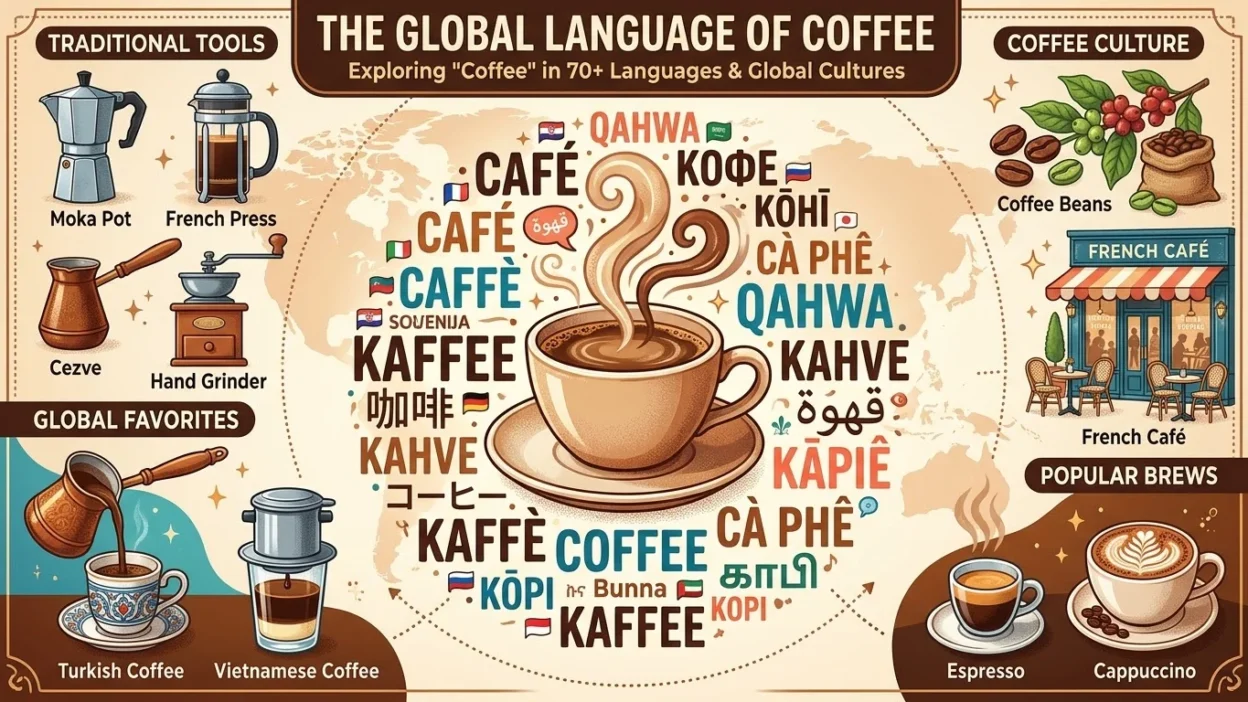
The word for coffee varies from one language to another. In Spanish and French, it is café; in German, it is Kaffee; in Italian, it is caffè; and in Japanese, it is コーヒー (kōhī). Many languages have words that sound similar because coffee vocabulary has spread across countries through trade and cultural exchange.
In this guide, you will discover how to say coffee in 70 languages, learn native spellings, practice easy English pronunciations, and explore useful phrases for ordering coffee around the world.
Coffee in 70 Different Languages
The following table includes the word for coffee in 70 languages, along with native writing and approximate English pronunciation. Some languages use a borrowed word, while others use a traditional term.
| Language | Native Word | Easy English Pronunciation |
|---|---|---|
| 1. English | Coffee | KAW-fee |
| 2. Spanish | Café | Kah-FEH |
| 3. French | Café | Kah-FAY |
| 4. German | Kaffee | KAH-fay |
| 5. Italian | Caffè | Kahf-FEH |
| 6. Portuguese | Café | Kah-FEH |
| 7. Dutch | Koffie | KAW-fee |
| 8. Swedish | Kaffe | KAF-feh |
| 9. Norwegian | Kaffe | KAF-feh |
| 10. Danish | Kaffe | KAF-feh |
| 11. Finnish | Kahvi | KAH-vee |
| 12. Icelandic | Kaffi | KAF-fee |
| 13. Irish | Caife | KAF-eh |
| 14. Welsh | Coffi | KOF-ee |
| 15. Scottish Gaelic | Cofaidh | KOH-fee |
| 16. Polish | Kawa | KAH-vah |
| 17. Czech | Káva | KAA-vah |
| 18. Slovak | Káva | KAA-vah |
| 19. Slovenian | Kava | KAH-vah |
| 20. Croatian | Kava | KAH-vah |
| 21. Serbian | Кафа | KAH-fah |
| 22. Bosnian | Kafa | KAH-fah |
| 23. Romanian | Cafea | Kah-FEH-ah |
| 24. Hungarian | Kávé | KAA-vay |
| 25. Greek | Καφές | Kah-FES |
| 26. Russian | Кофе | KOH-feh |
| 27. Ukrainian | Кава | KAH-vah |
| 28. Belarusian | Кава | KAH-vah |
| 29. Bulgarian | Кафе | Kah-FEH |
| 30. Macedonian | Кафе | Kah-FEH |
| 31. Albanian | Kafe | Kah-FEH |
| 32. Turkish | Kahve | KAH-veh |
| 33. Arabic | قهوة | QAH-wah |
| 34. Hebrew | קפה | Kah-FEH |
| 35. Persian | قهوه | Ghah-veh |
| 36. Kurdish | Qehwe | Keh-WEH |
| 37. Hindi | कॉफ़ी | KAW-fee |
| 38. Urdu | کافی | KAA-fee |
| 39. Punjabi | ਕੌਫੀ | KAW-fee |
| 40. Bengali | কফি | KOH-fee |
| 41. Gujarati | કોફી | KOH-fee |
| 42. Marathi | कॉफी | KAW-fee |
| 43. Nepali | कफी | KAH-fee |
| 44. Sinhala | කෝපි | KOH-pee |
| 45. Tamil | காபி | KAA-bee |
| 46. Telugu | కాఫీ | KAA-fee |
| 47. Kannada | ಕಾಫಿ | KAA-fee |
| 48. Malayalam | കാപ്പി | KAA-pee |
| 49. Thai | กาแฟ | GAA-fae |
| 50. Vietnamese | Cà phê | Kah-FEH |
| 51. Indonesian | Kopi | KOH-pee |
| 52. Malay | Kopi | KOH-pee |
| 53. Filipino (Tagalog) | Kape | KAH-peh |
| 54. Chinese (Mandarin) | 咖啡 | KAH-fay |
| 55. Japanese | コーヒー | KOH-hee |
| 56. Korean | 커피 | KUH-pee |
| 57. Mongolian | Кофе | KOH-feh |
| 58. Burmese | ကော်ဖီ | KAW-fee |
| 59. Khmer | កាហ្វេ | KAA-feh |
| 60. Lao | ກາເຟ | KAA-feh |
| 61. Swahili | Kahawa | Kah-HAH-wah |
| 62. Zulu | Ikhofi | Ee-KHOH-fee |
| 63. Afrikaans | Koffie | KAW-fee |
| 64. Amharic | ቡና | BOO-nah |
| 65. Yoruba | Kọfi | KAW-fee |
| 66. Hausa | Kofi | KOH-fee |
| 67. Māori | Kawhe | KAH-feh |
| 68. Hawaiian | Kope | KOH-peh |
| 69. Samoan | Kofe | KOH-feh |
| 70. Esperanto | Kafo | KAH-foh |
Note: Pronunciations are approximate and can vary by accent. In Amharic, ቡና (buna) is the traditional word for coffee and is especially associated with Ethiopia’s coffee culture.
What Does Coffee Mean?
Coffee is a drink usually made by brewing roasted coffee beans with hot water. The beans come from the fruit of coffee plants, commonly known as coffee cherries.
Coffee is enjoyed in many forms, including espresso, cappuccino, latte, Americano, and iced coffee. Some people prefer it black, while others add milk, cream, sugar, or flavored syrups.
The word coffee can refer to the beverage itself, the roasted beans, or the drink prepared from ground coffee. Its exact meaning depends on the context.
How to Say Coffee in Popular Languages
Here are some common translations of coffee, with example sentences to help you use each word in everyday conversations.
Coffee in Spanish
In Spanish, coffee is café, pronounced approximately kah-FEH.
Example: Quiero un café, por favor.
Meaning: I would like a coffee, please.
Coffee in French
In French, coffee is café, pronounced approximately kah-FAY.
Example: Je voudrais un café, s’il vous plaît.
Meaning: I would like a coffee, please.
Coffee in German
In German, coffee is Kaffee, pronounced approximately KAH-fay.
Example: Ich möchte einen Kaffee, bitte.
Meaning: I would like a coffee, please.
Coffee in Italian
In Italian, coffee is caffè, pronounced approximately kahf-FEH.
Example: Vorrei un caffè, per favore.
Meaning: I would like a coffee, please.
Coffee in Portuguese
In Portuguese, coffee is café, pronounced approximately kah-FEH.
Example: Quero um café, por favor.
Meaning: I would like a coffee, please.
Coffee in Arabic
In Arabic, coffee is قهوة (qahwa).
Example: أريد قهوة، من فضلك.
Meaning: I would like coffee, please.
Coffee in Hindi
In Hindi, coffee is कॉफ़ी (coffee).
Example: मुझे एक कॉफ़ी चाहिए।
Meaning: I would like a coffee.
Coffee in Urdu
In Urdu, coffee is کافی (kaafi).
Example: مجھے ایک کافی چاہیے۔
Meaning: I would like a coffee.
Coffee in Chinese
In Mandarin Chinese, coffee is 咖啡 (kāfēi).
Example: 我想喝咖啡。
Meaning: I would like to drink coffee.
Coffee in Japanese
In Japanese, coffee is コーヒー (kōhī).
Example: コーヒーをお願いします。
Meaning: Coffee, please.
Coffee in Korean
In Korean, coffee is 커피 (keopi).
Example: 커피 한 잔 주세요.
Meaning: One cup of coffee, please.
Coffee in Turkish
In Turkish, coffee is kahve, pronounced approximately KAH-veh.
Example: Bir kahve lütfen.
Meaning: One coffee, please.
How to Order Coffee in Different Languages
Learning the word for coffee is helpful, but knowing a few ordering phrases can make traveling and visiting cafés much easier.
| Language | Phrase | English Meaning |
|---|---|---|
| Spanish | Un café, por favor. | A coffee, please. |
| French | Un café, s’il vous plaît. | A coffee, please. |
| German | Einen Kaffee, bitte. | A coffee, please. |
| Italian | Un caffè, per favore. | A coffee, please. |
| Portuguese | Um café, por favor. | A coffee, please. |
| Turkish | Bir kahve lütfen. | One coffee, please. |
| Hindi | एक कॉफ़ी, कृपया। | One coffee, please. |
| Urdu | ایک کافی، براہِ کرم۔ | One coffee, please. |
| Mandarin Chinese | 请给我一杯咖啡。 | Please give me a cup of coffee. |
| Japanese | コーヒーをお願いします。 | Coffee, please. |
| Korean | 커피 한 잔 주세요. | One cup of coffee, please. |
The wording can change depending on the region and how formal or casual you want to sound.
Popular Types of Coffee Around the World
Different countries have their own coffee traditions, preparation methods, and serving styles.
| Coffee Type | Description |
|---|---|
| Espresso | A concentrated coffee brewed under pressure |
| Cappuccino | Espresso with steamed milk and a layer of milk foam |
| Latte | Espresso mixed with steamed milk |
| Americano | Espresso diluted with hot water |
| Turkish coffee | Finely ground coffee simmered in water and traditionally served unfiltered |
| Vietnamese coffee | Often prepared with a drip filter and served with sweetened condensed milk |
| Café au lait | Coffee served with hot milk |
| Cold brew | Coffee steeped in cool or room-temperature water over an extended period |
| Flat white | Espresso with steamed milk and a fine layer of microfoam |
| Ethiopian coffee | Coffee enjoyed in a rich cultural tradition that may include roasting, brewing, and serving ceremonies |
Recipes and serving styles vary by café and region, so the same name may describe slightly different drinks in different places.
Coffee vs. Café: What Is the Difference?
The words coffee and café are related, but they can mean different things depending on the language.
- Coffee: In English, this usually means the drink made from coffee beans.
- Café: In French and Spanish, this means coffee. In English, café usually refers to a small restaurant or coffee shop.
- Caffè: In Italian, this means coffee and can also refer to a coffee bar or establishment in some contexts.
- Kaffee: The German word for the drink.
For example, an English speaker might say, “Let’s meet at a café,” while a Spanish speaker might order un café to request a coffee.
Why Learn Coffee in Different Languages?
Learning coffee vocabulary can be useful for everyday communication and cultural exploration.
- Travel confidently: Recognize coffee on menus in other countries.
- Order your favorite drink: Ask for coffee politely when visiting a café abroad.
- Explore coffee cultures: Discover different brewing methods and traditions.
- Build vocabulary: Learn useful words related to drinks, food, and restaurants.
- Practice conversations: Use short phrases with baristas, shopkeepers, and local speakers.
Easy Tips to Remember Coffee Translations
1. Group similar words together. Spanish café, French café, and Portuguese café are easy to compare.
2. Connect words with places. Remember caffè with Italy, kahve with Turkey, and cà phê with Vietnam.
3. Practice ordering phrases. Saying “One coffee, please” helps you remember the vocabulary in a useful context.
4. Listen to native pronunciation. Audio examples can help you learn sounds that are difficult to represent in English letters.
5. Review a few languages each day. Start with five words, revisit them later, and gradually add more.
Frequently Asked Questions
How do you say coffee in different languages?
Examples include café in Spanish and French, Kaffee in German, caffè in Italian, kopi in Indonesian and Malay, and kāfēi in Mandarin Chinese.
What is the Spanish word for coffee?
The Spanish word is café, pronounced approximately kah-FEH.
What is coffee called in French?
Coffee is called café in French.
How do you say coffee in Japanese?
The Japanese word is コーヒー (kōhī).
How do you say coffee in Hindi and Urdu?
Coffee is कॉफ़ी in Hindi and کافی in Urdu.
Which language uses the word kopi for coffee?
Indonesian and Malay both use kopi. Similar forms also appear in several other languages.
What is the traditional Ethiopian word for coffee?
In Amharic, coffee is called ቡና (buna). Ethiopia is also known for its distinctive coffee-growing heritage and traditional coffee ceremonies.
Why do coffee words sound similar in many languages?
Many coffee-related words spread through trade and cultural contact. As coffee became popular around the world, languages adopted or adapted words that sometimes retained similar sounds.
Conclusion
Learning how to say coffee in 70 different languages is a simple way to expand your vocabulary and explore cultures around the world. From café in Spanish and French to caffè in Italian, kahve in Turkish, and 咖啡 (kāfēi) in Chinese, each word gives you another way to connect with people over a familiar drink.
Start with a few translations, practice ordering a cup of coffee, and discover how different countries prepare and enjoy it. These small steps can make language learning more practical, memorable, and enjoyable.

Ethan John is a content writer from the United Kingdom who focuses on language education and effective communication. He writes informative articles about grammar, pronunciation, translation, idioms, and language comparisons to help readers develop confidence in their reading and writing abilities. Ethan believes that learning a language should be practical, enjoyable, and relevant to everyday life. His content is designed for learners of all levels, offering clear guidance and useful insights into both English and other widely spoken languages around the world.