Curiosity is a wonderful part of being human. It encourages us to ask questions, discover new ideas, explore unfamiliar places, and learn about the world around us. Whether someone is curious about science, nature, culture, or other people, curiosity helps make everyday life more interesting.
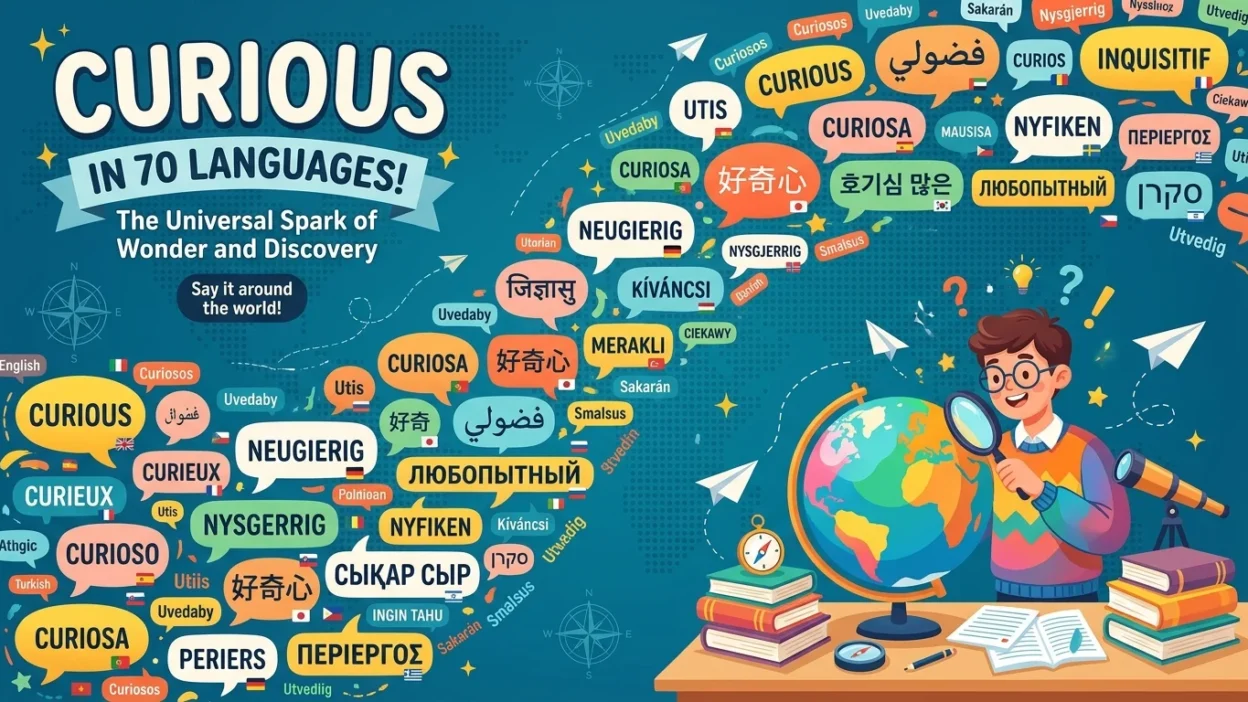
The word “curious” in different languages can have different spellings, sounds, and shades of meaning. Some translations describe a person who wants to learn something, while others may suggest being inquisitive or eager to know more. In this guide, you’ll discover how to say “curious” in 70 languages, with native words and easy pronunciation guides.
Curious in 70 Different Languages
| No. | Language | Curious in Native Language | Easy Pronunciation |
|---|---|---|---|
| 1 | English | Curious | KYOOR-ee-us |
| 2 | Spanish | Curioso / Curiosa | koo-ree-OH-soh / koo-ree-OH-sah |
| 3 | French | Curieux / Curieuse | kyoo-ree-UH / kyoo-ree-UHZ |
| 4 | German | Neugierig | noy-GEE-rikh |
| 5 | Italian | Curioso / Curiosa | koo-ree-OH-zoh / koo-ree-OH-zah |
| 6 | Portuguese | Curioso / Curiosa | koo-ree-OH-zoo / koo-ree-OH-zah |
| 7 | Dutch | Nieuwsgierig | nyoos-KHEE-rikh |
| 8 | Swedish | Nyfiken | NOO-fee-ken |
| 9 | Norwegian | Nysgjerrig | NOOSH-yeh-rig |
| 10 | Danish | Nysgerrig | NOO-skeh-ree |
| 11 | Finnish | Utelias | OO-teh-lee-ahs |
| 12 | Icelandic | Forvitinn | FOR-vee-tin |
| 13 | Irish | Fiosrach | FISS-rakh |
| 14 | Welsh | Chwilfrydig | khwil-VRUD-ig |
| 15 | Scottish Gaelic | Fiosrach | FEE-us-rakh |
| 16 | Polish | Ciekawy / Ciekawa | chyeh-KAH-vih / chyeh-KAH-vah |
| 17 | Czech | Zvědavý / Zvědavá | ZVYEH-dah-vee / ZVYEH-dah-vah |
| 18 | Slovak | Zvedavý / Zvedavá | ZVEH-dah-vee / ZVEH-dah-vah |
| 19 | Slovenian | Radoveden / Radovedna | rah-doh-VEH-den / rah-doh-VEH-dnah |
| 20 | Croatian | Znatiželjan / Znatiželjna | znah-tee-ZHEL-yahn / znah-tee-ZHEL-yah |
| 21 | Serbian | Радознао / Радознала | rahd-oh-ZNAH-oh / rahd-oh-ZNAH-lah |
| 22 | Bosnian | Znatiželjan / Znatiželjna | znah-tee-ZHEL-yahn / znah-tee-ZHEL-yah |
| 23 | Romanian | Curios / Curioasă | koo-ree-OS / koo-ree-oh-AH-suh |
| 24 | Hungarian | Kíváncsi | KEE-vahnch-shee |
| 25 | Greek | Περίεργος / Περίεργη | peh-REE-er-ghos / peh-REE-er-ghee |
| 26 | Russian | Любопытный / Любопытная | lyoo-bah-PYIT-nih / lyoo-bah-PYIT-nah |
| 27 | Ukrainian | Допитливий / Допитлива | doh-PIT-lyh-vyi / doh-PIT-lyh-vah |
| 28 | Belarusian | Цікаўны / Цікаўная | tsee-KAHW-nih / tsee-KAHW-nah |
| 29 | Bulgarian | Любопитен / Любопитна | lyoo-boh-PEE-ten / lyoo-boh-PEET-nah |
| 30 | Macedonian | Љубопитен / Љубопитна | lyoo-boh-PEE-ten / lyoo-boh-PEET-nah |
| 31 | Albanian | Kurioz / Kurioze | koo-ree-OZ / koo-ree-OH-zeh |
| 32 | Turkish | Meraklı | meh-rahk-LUH |
| 33 | Arabic | فضولي / فضولية | fa-DOO-lee / fa-DOO-lee-yah |
| 34 | Hebrew | סקרן / סקרנית | skah-RAN / skah-rah-NEET |
| 35 | Persian | کنجکاو | kon-j-kahv |
| 36 | Kurdish | Meraqdar | meh-rahk-DAR |
| 37 | Hindi | जिज्ञासु | jij-NYAH-soo |
| 38 | Urdu | متجسس | muta-JASS-is |
| 39 | Punjabi | ਜਗਿਆਸੂ | jag-yaa-SOO |
| 40 | Bengali | কৌতূহলী | kow-too-TOO-lee |
| 41 | Gujarati | જિજ્ઞાસુ | jij-NYAA-soo |
| 42 | Marathi | जिज्ञासू | jij-NYAA-soo |
| 43 | Nepali | जिज्ञासु | jij-NYAA-soo |
| 44 | Sinhala | කුතුහලයෙන් යුතු | koo-too-ha-layen yoo-too |
| 45 | Tamil | ஆர்வமுள்ள | aar-vam-oo-lla |
| 46 | Telugu | ఆసక్తి గల | aas-ak-ti ga-la |
| 47 | Kannada | ಕುತೂಹಲವುಳ್ಳ | koo-too-ha-la-vool-la |
| 48 | Malayalam | കൗതുകമുള്ള | kow-thoo-ka-mool-la |
| 49 | Thai | อยากรู้อยากเห็น | yahk-roo-yahk-hen |
| 50 | Vietnamese | Tò mò | taw maw |
| 51 | Indonesian | Penasaran | puh-nah-SAH-ran |
| 52 | Malay | Ingin tahu | IN-gin TAH-hoo |
| 53 | Filipino (Tagalog) | Mausisa | mah-oo-SEE-sah |
| 54 | Chinese (Mandarin) | 好奇 | hào qí |
| 55 | Japanese | 好奇心旺盛な | koh-kee-shin-oh-sei-nah |
| 56 | Korean | 호기심이 많은 | ho-gi-shi-mi mah-neun |
| 57 | Mongolian | Сониуч | soh-nee-ooch |
| 58 | Burmese | စူးစမ်းလိုစိတ်ရှိသော | soo-zan-lo-zate-shi-thaw |
| 59 | Khmer | ចង់ដឹងចង់ឮ | chong-dung-chong-lue |
| 60 | Lao | ຢາກຮູ້ຢາກເຫັນ | yahk-hoo-yahk-hen |
| 61 | Swahili | Mwenye udadisi | mweh-nyeh oo-dah-dee-see |
| 62 | Zulu | Ngelukuluku | ngeh-loo-koo-LOO-koo |
| 63 | Afrikaans | Nuuskierig | NEES-khee-rikh |
| 64 | Amharic | ጉጉት ያለው | goo-goot yah-lew |
| 65 | Yoruba | Nífẹ̀ẹ́ láti mọ̀ | nee-feh eh lah-tee maw |
| 66 | Hausa | Mai son sani | my son sah-nee |
| 67 | Māori | Pākiki | paa-KEE-kee |
| 68 | Hawaiian | Makemake e ʻike | mah-keh-mah-keh eh ee-keh |
| 69 | Samoan | Fia iloa | fee-ah ee-loh-ah |
| 70 | Esperanto | Scivolema | stsee-voh-LEH-mah |
Note: Many languages change adjectives according to gender, number, or sentence structure. Where two forms are shown, they generally represent masculine and feminine forms. Some languages express “curious” more naturally as “eager to know” or “interested in learning.” Pronunciations are approximate.
What Does Curious Mean?
The word curious describes someone who wants to know, understand, or discover something. A curious person often asks questions, explores new subjects, and looks for explanations.
For example:
- “The curious child asked how the stars shine.”
- “I am curious about different cultures.”
- “She was curious to discover what was inside the box.”
The word can also describe something unusual or unexpected, as in “That is a curious situation.” Its meaning depends on the context.
How to Say Curious in Popular Languages
Curious in Spanish
In Spanish, curious is curioso for masculine nouns and curiosa for feminine nouns.
Example: Soy curioso.
Meaning: “I am curious.” (Masculine speaker or adjective agreement.)
Curious in French
In French, the word is curieux in the masculine form and curieuse in the feminine form.
Example: Je suis curieux.
Meaning: “I am curious.” (Masculine adjective form.)
Curious in German
In German, curious is neugierig.
Example: Ich bin neugierig.
Meaning: “I am curious.”
Curious in Italian
In Italian, curious is curioso or curiosa, depending on grammatical gender.
Example: Sono curioso.
Meaning: “I am curious.” (Masculine adjective form.)
Curious in Hindi
In Hindi, curious can be expressed as जिज्ञासु (jigyāsu).
Example: मैं जानने के लिए उत्सुक हूँ।
Meaning: “I am eager to know.”
Curious in Urdu
In Urdu, متجسس is one way to express curious or inquisitive.
Example: میں جاننے کے لیے متجسس ہوں۔
Meaning: “I am curious to know.”
Curious in Japanese
In Japanese, 好奇心旺盛な describes someone who is very curious or full of curiosity.
Example: 私は好奇心旺盛です。
Meaning: “I am very curious.”
Curious in Chinese
In Mandarin Chinese, 好奇 (hào qí) means curious.
Example: 我很好奇。
Meaning: “I am very curious.”
Synonyms of Curious
Several English words have meanings similar to curious, although each has its own nuance.
| Word | Meaning |
|---|---|
| Inquisitive | Eager to ask questions and learn |
| Interested | Wanting to know more about a subject |
| Intrigued | Fascinated or attracted by something unusual |
| Eager | Excited and ready to learn or experience something |
| Questioning | Inclined to ask questions or examine ideas |
| Investigative | Focused on finding facts or explanations |
| Wondering | Thinking about something you do not yet know |
| Nosy | Too interested in other people’s private matters; often negative |
Tip: “Curious” and “inquisitive” are usually positive when they describe a desire to learn. “Nosy” is more likely to suggest unwanted interest in someone else’s private life.
Example Sentences Using Curious
Here are a few examples to help you understand how to use the word naturally.
- I am curious about space. — I want to learn more about the universe.
- The curious student asked another question. — The student wanted to understand more.
- She was curious to see the new museum. — She wanted to explore it.
- We are curious about your idea. — We would like to know more about it.
- That is a curious choice. — That choice is unusual or surprising.
- Children are often curious about animals. — Children frequently want to learn about animals.
Why Learn Curious in Different Languages?
Learning this word can help you express interest, ask questions, and connect with people from other cultures.
- Improve communication: Tell someone when you want to learn more.
- Build vocabulary: Learn useful words related to discovery, questions, and knowledge.
- Explore culture: Understand how different languages express curiosity.
- Practice grammar: Notice how some languages change adjectives based on gender or sentence structure.
- Encourage learning: Curiosity helps you discover new ideas and ask thoughtful questions.
Frequently Asked Questions
How do you say curious in 70 languages?
The translations vary by language. Examples include curioso in Spanish, curieux in French, neugierig in German, 好奇 in Mandarin Chinese, and جिज्ञासु in Hindi. See the full table for 70 languages.
What is another word for curious?
Common synonyms include inquisitive, interested, intrigued, eager to know, and questioning. The best choice depends on the sentence.
Is curious a positive word?
Usually, yes. Curious often describes someone who enjoys learning and asking questions. However, it can suggest nosiness if someone shows too much interest in private matters.
What is the difference between curious and inquisitive?
Both describe a desire to learn. Curious is a broad, everyday word, while inquisitive often emphasizes asking questions and seeking information.
How do you say curious in Spanish?
The Spanish forms are curioso and curiosa. The correct form depends on the noun or person being described.
How do you say curious in French?
In French, use curieux for the masculine form and curieuse for the feminine form.
Why is curiosity important?
Curiosity encourages people to ask questions, explore new ideas, solve problems, and develop a deeper understanding of the world.
Conclusion
The word curious expresses a desire to learn, discover, and understand. From Spanish curioso and French curieux to German neugierig and Mandarin 好奇, different languages offer their own ways to describe an inquisitive mind.
Use this list of curious translations to expand your vocabulary, practice a new language, and discover how people around the world express the joy of learning.

Ethan John is a content writer from the United Kingdom who focuses on language education and effective communication. He writes informative articles about grammar, pronunciation, translation, idioms, and language comparisons to help readers develop confidence in their reading and writing abilities. Ethan believes that learning a language should be practical, enjoyable, and relevant to everyday life. His content is designed for learners of all levels, offering clear guidance and useful insights into both English and other widely spoken languages around the world.