The word clean means free from dirt, stains, germs, or impurities. It can describe a person, object, place, or environment that is neat, hygienic, and tidy. Learning clean in different languages is useful for travelers, language learners, students, and everyday conversations.
This guide includes clean translations with easy English pronunciations. If you’re searching for clean in all languages or how to say clean in different languages, this collection is the perfect place to begin.
Clean in Different Languages (1–25)
| Language | Native Word | Easy English Pronunciation |
|---|---|---|
| English | Clean | Kleen |
| Spanish | Limpio | LEEM-pyo |
| French | Propre | PRO-pruh |
| German | Sauber | ZOW-ber |
| Italian | Pulito | Poo-LEE-to |
| Portuguese | Limpo | LEEM-poo |
| Dutch | Schoon | Skhohn |
| Swedish | Ren | Ren |
| Norwegian | Ren | Ren |
| Danish | Ren | Ren |
| Finnish | Puhdas | POO-das |
| Icelandic | Hreinn | Hrayn |
| Irish | Glan | Glan |
| Welsh | Glân | Glaan |
| Scottish Gaelic | Glan | Glan |
| Polish | Czysty | CHIS-tee |
| Czech | Čistý | CHIS-tee |
| Slovak | Čistý | CHIS-tee |
| Slovenian | Čist | Cheest |
| Croatian | Čist | Cheest |
| Serbian | Чист | Cheest |
| Bosnian | Čist | Cheest |
| Romanian | Curat | Koo-RAT |
| Hungarian | Tiszta | TEES-taw |
| Greek | Καθαρός | Ka-tha-ROS |
Clean in Different Languages (26–50)
| Language | Native Word | Easy English Pronunciation |
|---|---|---|
| Russian | Чистый | CHEES-tiy |
| Ukrainian | Чистий | CHYS-tyy |
| Belarusian | Чысты | CHIS-ty |
| Bulgarian | Чист | Chist |
| Macedonian | Чист | Chist |
| Albanian | I pastër | Ee PAS-ter |
| Turkish | Temiz | Teh-MEEZ |
| Arabic | نظيف | Na-ZEEF |
| Hebrew | נקי | Na-KEE |
| Persian | تمیز | Ta-MEEZ |
| Kurdish | Paqij | Pa-KEEJ |
| Hindi | साफ़ | Saaf |
| Urdu | صاف | Saaf |
| Punjabi | ਸਾਫ਼ | Saaf |
| Bengali | পরিষ্কার | Po-ri-SHKAR |
| Gujarati | સ્વચ્છ | Swachh |
| Marathi | स्वच्छ | Swachh |
| Nepali | सफा | Sa-fa |
| Sinhala | පිරිසිදු | Pi-ri-si-du |
| Tamil | சுத்தமான | Sut-tha-maa-na |
| Telugu | శుభ్రమైన | Shu-bhra-maina |
| Kannada | ಸ್ವಚ್ಛ | Swa-cha |
| Malayalam | വൃത്തിയുള്ള | Vrit-thi-yul-la |
| Thai | สะอาด | Sa-at |
| Vietnamese | Sạch | Sak |
Clean in Different Languages (51–70)
| Language | Native Word | Easy English Pronunciation |
|---|---|---|
| Indonesian | Bersih | Ber-seeh |
| Malay | Bersih | Ber-seeh |
| Filipino (Tagalog) | Malinis | Ma-li-NEES |
| Chinese (Mandarin) | 干净 | Gān Jìng |
| Japanese | きれい | Ki-rei |
| Korean | 깨끗한 | Kkae-kkeut-han |
| Mongolian | Цэвэр | Tse-ver |
| Burmese | သန့်ရှင်း | Thant-Shin |
| Khmer | ស្អាត | S’at |
| Lao | ສະອາດ | Sa-at |
| Swahili | Safi | SA-fi |
| Zulu | Hlanzekile | Hlan-ze-KEH-lee |
| Afrikaans | Skoon | Skoon |
| Amharic | ንጹህ | Nit-su-h |
| Yoruba | Mímọ́ | Mee-moh |
| Hausa | Tsabta | TSAB-ta |
| Maori | Mā | Maa |
| Hawaiian | Maʻemaʻe | Mah-eh-mah-eh |
| Samoan | Mama | MA-ma |
| Esperanto | Pura | POO-ra |
Why Learn “Clean” in Different Languages?
Learning clean in different languages helps you communicate about hygiene, health, household chores, travel, hotels, restaurants, and everyday situations. It is one of the most practical adjectives for language learners.
How to Say “Clean” in Different Languages
If you’re searching for how to say clean in different languages, learning the native spelling and pronunciation will help you understand signs, product labels, conversations, and travel-related information around the world.
Clean Translations Around the World
These clean translations are commonly used across Europe, Asia, Africa, the Americas, and Oceania. While some languages have multiple words depending on whether something is physically clean or morally pure, the translations above represent the most common everyday meaning.
Related Cleaning Vocabulary
After learning clean in different languages, you may also want to learn:
- Cleanse in Different Languages
- Wash in Different Languages
- Soap in Different Languages
- Water in Different Languages
- Tidy in Different Languages
- Hygiene in Different Languages
Tips for Learning Everyday Adjectives
- Practice using the word in simple sentences.
- Pair adjectives with common nouns.
- Listen to native speakers for pronunciation.
- Learn opposite words such as dirty and messy.
- Review vocabulary regularly for better retention.
Conclusion
Learning clean in different languages is an excellent way to improve your practical vocabulary for travel, daily life, and communication. These 70 translations provide a valuable reference for students, travelers, and language enthusiasts.
Frequently Asked Questions
1. How do you say “clean” in different languages?
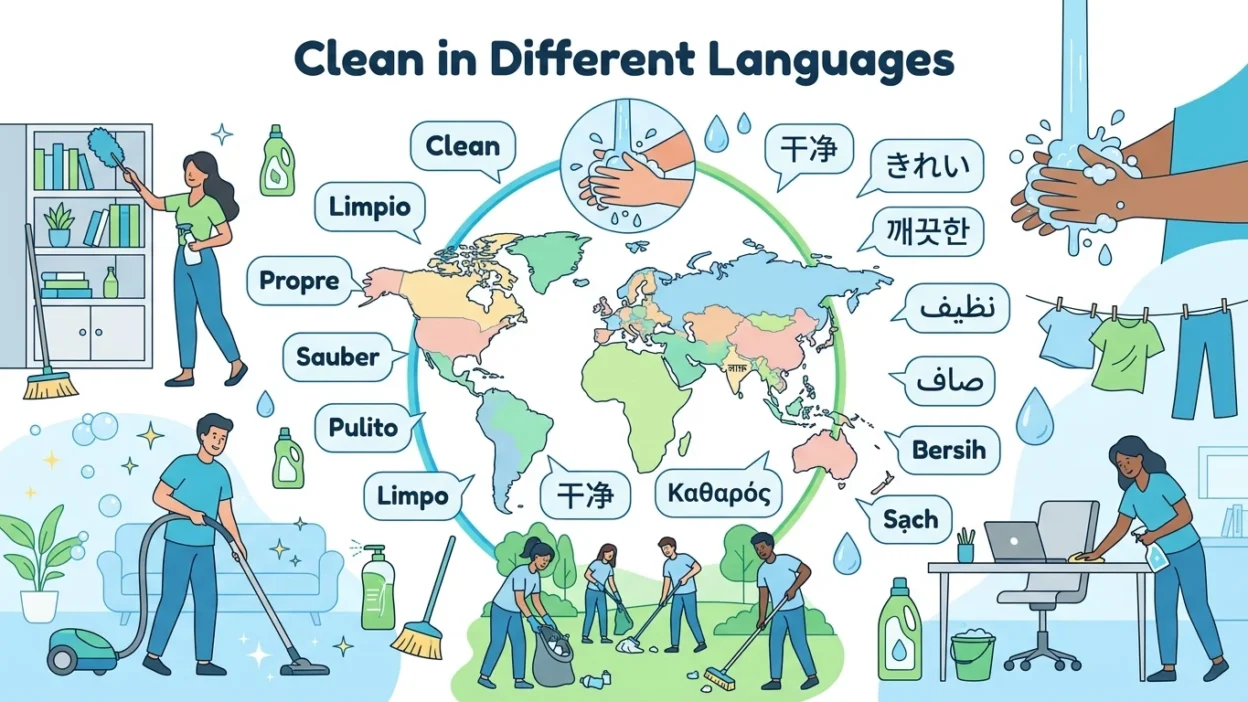
Examples include Limpio (Spanish), Propre (French), Sauber (German), 干净 (Gānjìng) (Chinese), and きれい (Kirei) (Japanese).
2. Is “clean” always an adjective?
No. Clean can be an adjective (“The room is clean”) or a verb (“Please clean the table”), depending on the context.
3. Are these translations commonly used?
Yes. These are the standard everyday words used by native speakers to describe something that is free from dirt or impurities.
4. Why should I learn everyday adjectives?
Everyday adjectives make conversations more natural and help you describe people, places, and objects accurately.
5. What should I learn after “clean”?
You can continue with dirty, wash, soap, water, fresh, and tidy to expand your everyday vocabulary.

Daniel Whitmore is a language writer and editor from the United Kingdom who is passionate about making language learning accessible to everyone. He specializes in English grammar, vocabulary, spelling differences, pronunciation, and multilingual communication. His articles break down complex language concepts into clear, practical lessons that readers can apply in everyday conversations and writing. Daniel enjoys exploring the history, culture, and evolution of languages while creating engaging content for students, educators, travelers, and language enthusiasts. His goal is to provide accurate, reader-friendly resources that help people build confidence in learning English and other world languages through simple explanations and real-life examples.