Chicken is one of the most familiar animals in the world and one of the most popular foods in many countries. Whether you are talking about a farm animal, ordering a meal, or learning a new language, knowing how to say chicken in different languages can be surprisingly useful.
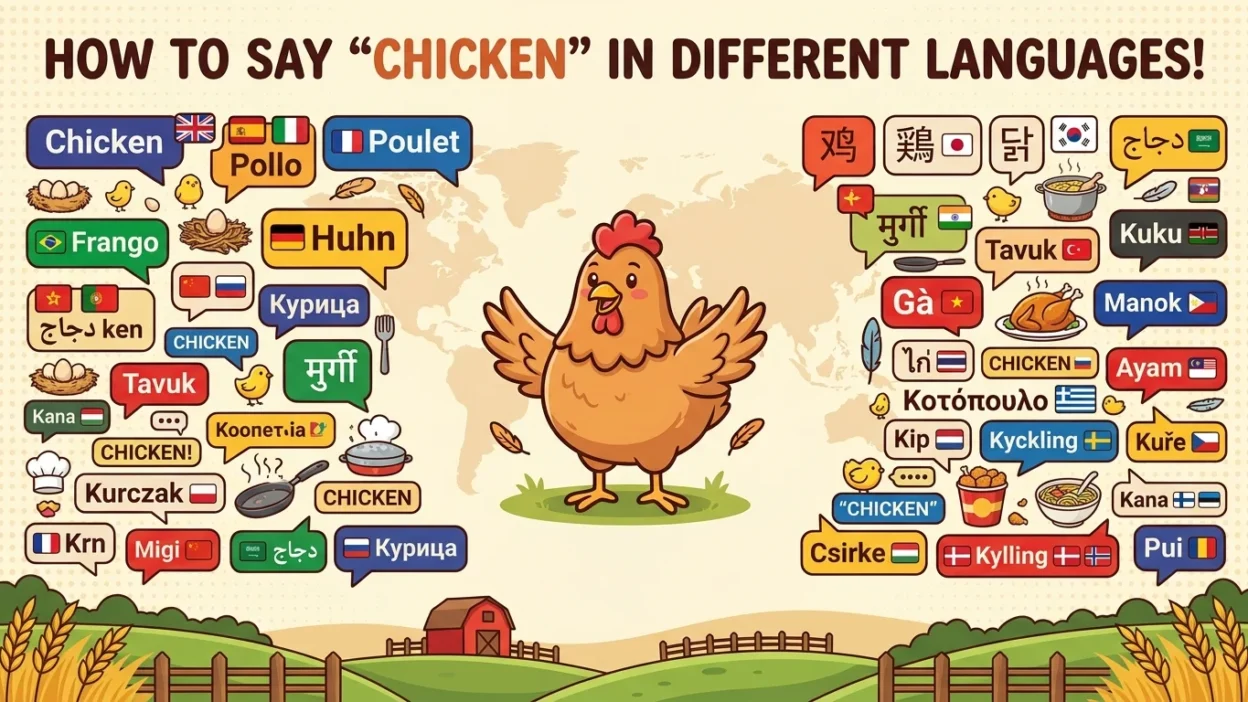
The word for chicken varies from language to language. For example, Spanish uses pollo, French uses poulet, German uses Huhn, and Japanese uses 鶏 (niwatori) when referring to the bird. Some languages also use different words for a live chicken and cooked chicken meat.
In this guide, you will learn how to say chicken in 70 languages, explore native words and easy pronunciations, and discover useful food and animal vocabulary for everyday conversations.
Chicken in 70 Different Languages
The table below provides common translations of chicken in 70 languages. Where a language distinguishes between the live bird and chicken meat, the table gives a widely used general term or the word most useful for everyday conversation.
| Language | Native Word | Easy English Pronunciation |
|---|---|---|
| 1. English | Chicken | CHIK-in |
| 2. Spanish | Pollo | POH-yoh |
| 3. French | Poulet | poo-LAY |
| 4. German | Huhn | HOON |
| 5. Italian | Pollo | POHL-loh |
| 6. Portuguese | Frango | FRAHN-goo |
| 7. Dutch | Kip | KIP |
| 8. Swedish | Kyckling | SHIK-ling |
| 9. Norwegian | Kylling | CHILL-ing |
| 10. Danish | Kylling | KÜL-ling |
| 11. Finnish | Kana | KAH-nah |
| 12. Icelandic | Kjúklingur | KYOO-kling-ur |
| 13. Irish | Sicín | Shi-KEEN |
| 14. Welsh | Cyw iâr | KOO-yar |
| 15. Scottish Gaelic | Cearc | KHYARK |
| 16. Polish | Kurczak | KOOR-chak |
| 17. Czech | Kuře | KOO-zheh |
| 18. Slovak | Kurča | KOOR-cha |
| 19. Slovenian | Piščanec | PISH-cha-nets |
| 20. Croatian | Piletina | Pee-leh-TEE-nah |
| 21. Serbian | Пилетина | Pee-leh-TEE-nah |
| 22. Bosnian | Piletina | Pee-leh-TEE-nah |
| 23. Romanian | Pui | POOY |
| 24. Hungarian | Csirke | CHEER-keh |
| 25. Greek | Κοτόπουλο | Koh-TOH-poo-loh |
| 26. Russian | Курица | KOO-ree-tsah |
| 27. Ukrainian | Курка | KOOR-kah |
| 28. Belarusian | Курыца | KOO-ruh-tsah |
| 29. Bulgarian | Пиле | PEE-leh |
| 30. Macedonian | Пилешко | Pee-LESH-koh |
| 31. Albanian | Pulë | POO-luh |
| 32. Turkish | Tavuk | Tah-VOOK |
| 33. Arabic | دجاج | Di-JAAJ |
| 34. Hebrew | עוף | OHF |
| 35. Persian | مرغ | MORGH |
| 36. Kurdish | Mirîşk | Mee-REESH-k |
| 37. Hindi | मुर्गा | MOOR-gah |
| 38. Urdu | مرغی | MUR-gee |
| 39. Punjabi | ਮੁਰਗੀ | MUR-gee |
| 40. Bengali | মুরগি | MOOR-gee |
| 41. Gujarati | મરઘી | MAR-ghee |
| 42. Marathi | कोंबडी | KOM-buh-dee |
| 43. Nepali | कुखुरा | KOO-khoo-rah |
| 44. Sinhala | කුකුළා | KOO-koo-laa |
| 45. Tamil | கோழி | KOH-zhee |
| 46. Telugu | కోడి | KOH-dee |
| 47. Kannada | ಕೋಳಿ | KOH-lee |
| 48. Malayalam | കോഴി | KOH-zhee |
| 49. Thai | ไก่ | GAI |
| 50. Vietnamese | Gà | GAH |
| 51. Indonesian | Ayam | AH-yam |
| 52. Malay | Ayam | AH-yam |
| 53. Filipino (Tagalog) | Manok | MAH-nok |
| 54. Chinese (Mandarin) | 鸡 | JEE |
| 55. Japanese | 鶏 | Nee-wah-toh-ree |
| 56. Korean | 닭 | DAHK |
| 57. Mongolian | Тахиа | Tah-KHEE-ah |
| 58. Burmese | ကြက် | JET |
| 59. Khmer | មាន់ | MOAN |
| 60. Lao | ໄກ່ | GAI |
| 61. Swahili | Kuku | KOO-koo |
| 62. Zulu | Inkukhu | Een-KOO-khoo |
| 63. Afrikaans | Hoender | HOON-der |
| 64. Amharic | ዶሮ | DOH-roh |
| 65. Yoruba | Adìẹ | Ah-DEE-eh |
| 66. Hausa | Kaza | KAH-zah |
| 67. Māori | Heihei | HAY-hay |
| 68. Hawaiian | Moa | MOH-ah |
| 69. Samoan | Moa | MOH-ah |
| 70. Esperanto | Koko | KOH-koh |
Note: Translations can vary by region and context. Some entries refer primarily to the live bird, while others are commonly used for chicken meat or as a general term for chicken.
What Does Chicken Mean?
The word chicken has two common meanings in English.
- Chicken as an animal: A domesticated bird raised for eggs and meat.
- Chicken as food: Meat prepared from the bird, often roasted, grilled, fried, or cooked in a curry.
For example:
- Animal: “The chicken is walking around the farm.”
- Food: “We are having chicken for dinner.”
This distinction matters when translating the word. Some languages use one word for both meanings, while others have separate terms for the bird, the meat, or a particular dish.
How to Say Chicken in Popular Languages
Here are some common translations of chicken, with example sentences to help you understand how the words are used.
Chicken in Spanish
In Spanish, pollo commonly refers to chicken meat and is also used for a young chicken.
Example: Quiero pollo para cenar.
Meaning: I want chicken for dinner.
Chicken in French
In French, poulet is commonly used for chicken as food. Poule refers to a hen, while coq means a rooster.
Example: Je voudrais du poulet, s’il vous plaît.
Meaning: I would like some chicken, please.
Chicken in German
In German, Huhn refers to a chicken, while Hähnchen is commonly used for chicken meat or a young chicken prepared as food.
Example: Ich esse gern Hähnchen.
Meaning: I like eating chicken.
Chicken in Italian
In Italian, pollo is the common word for chicken, especially when discussing food.
Example: Vorrei del pollo, per favore.
Meaning: I would like some chicken, please.
Chicken in Portuguese
In Portuguese, frango commonly means chicken, especially chicken meat.
Example: Eu gosto de frango grelhado.
Meaning: I like grilled chicken.
Chicken in Arabic
In Arabic, دجاج (dajāj) is a common word for chicken, especially as food. Regional vocabulary may differ.
Example: أريد دجاجًا من فضلك.
Meaning: I would like chicken, please.
Chicken in Hindi
In Hindi, मुर्गा (murga) means rooster or male chicken, while मुर्गी (murgi) means hen. Chicken meat is commonly called चिकन (chicken) in everyday speech.
Example: मुझे चिकन पसंद है।
Meaning: I like chicken.
Chicken in Urdu
In Urdu, مرغی (murghi) commonly means hen or chicken, while مرغ (murgh) can refer to a chicken or rooster. The English-derived word chicken is also widely used for the food.
Example: مجھے چکن پسند ہے۔
Meaning: I like chicken.
Chicken in Chinese
In Mandarin Chinese, 鸡 (jī) means chicken. The word 鸡肉 (jīròu) specifically means chicken meat.
Example: 我喜欢吃鸡肉。
Meaning: I like eating chicken.
Chicken in Japanese
In Japanese, 鶏 (にわとり, niwatori) refers to the chicken bird. 鶏肉 (とりにく, toriniku) means chicken meat.
Example: 鶏肉が好きです。
Meaning: I like chicken meat.
Chicken in Korean
In Korean, 닭 (dak) means chicken, while 닭고기 (dakgogi) means chicken meat.
Example: 저는 닭고기를 좋아해요.
Meaning: I like chicken.
Chicken vs. Hen vs. Rooster
These English words are related, but they do not mean exactly the same thing.
| Word | Meaning | Example |
|---|---|---|
| Chicken | The bird in general or its meat | We cooked chicken for dinner. |
| Hen | An adult female chicken | The hen laid an egg. |
| Rooster | An adult male chicken | The rooster crowed in the morning. |
| Chick | A young chicken | The chicks stayed close to their mother. |
| Poultry | Domestic birds raised for eggs or meat | The farm raises poultry. |
Understanding these differences helps you choose the correct translation when learning a new language.
Popular Chicken Dishes Around the World
Chicken is prepared in many different ways around the world. Learning the names of popular dishes is another useful way to build your food vocabulary.
- Chicken curry: Chicken cooked in a seasoned sauce, popular in South Asia and many other regions.
- Roast chicken: Chicken roasted in an oven, often served with vegetables.
- Fried chicken: Chicken coated and fried until crisp.
- Chicken kebab: Seasoned chicken grilled on skewers or cooked in other kebab styles.
- Chicken soup: A soup made with chicken, broth, and vegetables or other ingredients.
- Chicken teriyaki: A Japanese-style dish featuring chicken prepared with a sweet and savory teriyaki sauce.
- Chicken adobo: A Filipino dish commonly prepared with chicken, vinegar, soy sauce, garlic, and seasonings.
Dish names and recipes vary across regions, even when they use similar ingredients.
Why Learn Chicken in Different Languages?
Learning food vocabulary can make everyday communication easier and help you discover new cultures.
- Travel confidently: Recognize chicken dishes on restaurant menus.
- Order food: Ask for chicken when eating in another country.
- Explore new cuisines: Understand how different cultures prepare chicken.
- Improve vocabulary: Learn related words for meat, animals, cooking, and meals.
- Practice conversations: Use simple phrases when shopping, cooking, or dining with people who speak another language.
Easy Tips to Remember Chicken Translations
1. Connect words with pictures. Use a picture of a chicken to help remember its name in each language.
2. Group similar languages together. Compare words such as pollo in Spanish and Italian, or ayam in Indonesian and Malay.
3. Practice food phrases. Learn sentences such as “I would like chicken” and “Do you have chicken soup?”
4. Listen to native pronunciation. Audio from native speakers can help you learn sounds that are difficult to represent in English.
5. Review a few words daily. Practice five languages at a time, then revisit them the next day.
Frequently Asked Questions
How do you say chicken in different languages?
Chicken has different names around the world. Examples include pollo in Spanish, poulet in French, frango in Portuguese, ayam in Indonesian, and kuku in Swahili.
What is the Spanish word for chicken?
The Spanish word is pollo, commonly used for chicken meat and young chickens.
What is chicken called in French?
The common word for chicken as food is poulet. A hen is called poule, and a rooster is called coq.
How do you say chicken in Hindi and Urdu?
In Hindi, मुर्गा (murga) usually means rooster and मुर्गी (murgi) means hen. In Urdu, مرغی (murghi) commonly means hen or chicken. Both languages also widely use chicken when talking about the food.
What is the Japanese word for chicken?
鶏 (niwatori) means the chicken bird, while 鶏肉 (toriniku) specifically means chicken meat.
What is the difference between chicken and poultry?
Chicken refers to a particular bird or its meat. Poultry is a broader category that includes domestic birds such as chickens, turkeys, ducks, and geese.
Do all languages use different words for chicken and chicken meat?
No. Some languages commonly use the same word for both, while others distinguish between the live bird and its meat.
Why should I learn chicken translations?
These words are useful when traveling, ordering meals, reading menus, learning about other cuisines, and practicing everyday conversations in another language.
Conclusion
Learning how to say chicken in 70 different languages is a fun and practical way to expand your vocabulary. From pollo in Spanish and poulet in French to ayam in Indonesian and 鸡肉 (jīròu) in Chinese, each language offers its own way to talk about this familiar bird and its meat.