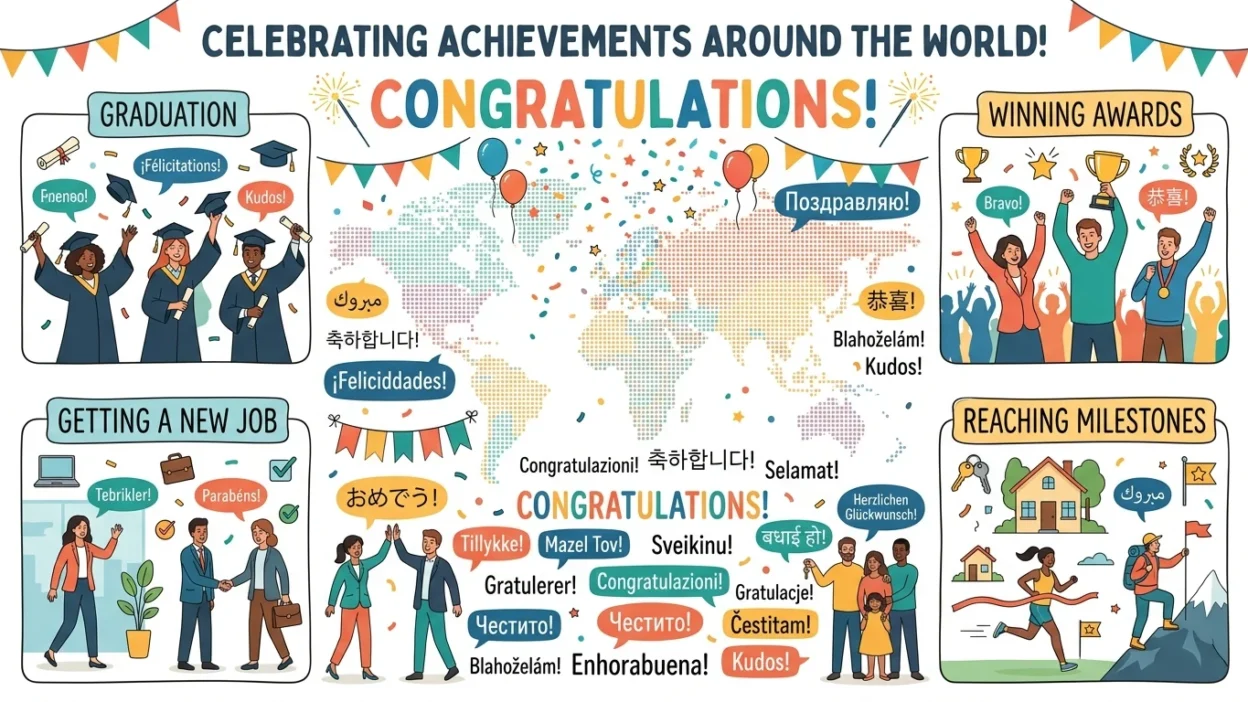
Celebrating someone’s success is a wonderful way to show happiness, encouragement, and appreciation. Whether a friend graduates, a family member gets a new job, or someone achieves an important goal, saying congratulations in different languages makes the moment even more meaningful.
Every language has its own special way of celebrating achievements. In Spanish, people say felicidades; in French, they say félicitations; in German, they say Glückwunsch; and in Japanese, they say おめでとうございます (omedetō gozaimasu).
In this guide, you will learn how to say congratulations in 70 languages, explore native spellings, practice easy pronunciations, and discover useful phrases for celebrating life’s happiest moments.
Congratulations in 70 Different Languages
Here is a list of congratulations translations in 70 languages. Pronunciations are approximate guides for English speakers. Depending on the situation, some languages use different expressions for achievements, celebrations, and good wishes.
| Language | Native Word or Phrase | Easy English Pronunciation |
|---|---|---|
| 1. English | Congratulations | Kuhn-grach-uh-LAY-shunz |
| 2. Spanish | ¡Felicidades! | Feh-lee-see-DAH-des |
| 3. French | Félicitations | Fay-lee-see-tah-SYON |
| 4. German | Herzlichen Glückwunsch | HAIRTS-likh-en GLOOK-vunsh |
| 5. Italian | Congratulazioni | Kon-grah-too-lah-TSYOH-nee |
| 6. Portuguese | Parabéns | Pah-rah-BENS |
| 7. Dutch | Gefeliciteerd | Khuh-fay-lee-see-TEERT |
| 8. Swedish | Grattis | GRAHT-iss |
| 9. Norwegian | Gratulerer | Grah-too-LEH-rer |
| 10. Danish | Tillykke | Tee-LÜ-keh |
| 11. Finnish | Onneksi olkoon | ON-nek-see OL-koon |
| 12. Icelandic | Til hamingju | Til HA-ming-yoo |
| 13. Irish | Comhghairdeas | KOH-ir-jass |
| 14. Welsh | Llongyfarchiadau | Hlon-guh-var-khyah-die |
| 15. Scottish Gaelic | Meal do naidheachd | Myal duh NYE-chk |
| 16. Polish | Gratulacje | Grah-too-LAH-tsyeh |
| 17. Czech | Gratuluji | Grah-too-LOO-yee |
| 18. Slovak | Gratulujem | Grah-TOO-lyoo-yem |
| 19. Slovenian | Čestitke | Ches-TEET-keh |
| 20. Croatian | Čestitam | Ches-TEE-tam |
| 21. Serbian | Честитам | Ches-TEE-tam |
| 22. Bosnian | Čestitam | Ches-TEE-tam |
| 23. Romanian | Felicitări | Feh-lee-chee-TUHR |
| 24. Hungarian | Gratulálok | Grah-too-LAH-lok |
| 25. Greek | Συγχαρητήρια | See-gha-ree-TEE-ree-ah |
| 26. Russian | Поздравляю | Puhz-drahv-LYAH-yoo |
| 27. Ukrainian | Вітаю | Vee-TAH-yoo |
| 28. Belarusian | Віншую | Veen-SHOO-yoo |
| 29. Bulgarian | Поздравления | Pohz-drahv-LEH-nee-yah |
| 30. Macedonian | Честитки | Ches-TEET-kee |
| 31. Albanian | Urime | Oo-REE-meh |
| 32. Turkish | Tebrikler | Teb-REEK-ler |
| 33. Arabic | تهانينا | Tah-HAA-nee-nah |
| 34. Hebrew | מזל טוב | Mah-ZAHL tov |
| 35. Persian | تبریک میگویم | Tab-REEK mee-GOO-yam |
| 36. Kurdish | Pîroz be | PEE-rohz beh |
| 37. Hindi | बधाई हो | Buh-DHAI hoh |
| 38. Urdu | مبارک ہو | Moo-BAH-rak ho |
| 39. Punjabi | ਵਧਾਈਆਂ | Vuh-DHAI-aan |
| 40. Bengali | অভিনন্দন | Oh-bhi-non-don |
| 41. Gujarati | અભિનંદન | Uh-bhi-nun-dun |
| 42. Marathi | अभिनंदन | Uh-bhi-nun-dun |
| 43. Nepali | बधाई छ | Buh-DHAI chha |
| 44. Sinhala | සුබ පැතුම් | Soo-bah PAE-thoom |
| 45. Tamil | வாழ்த்துகள் | VAAZH-thu-gal |
| 46. Telugu | అభినందనలు | Uh-bhi-nun-duh-na-lu |
| 47. Kannada | ಅಭಿನಂದನೆಗಳು | Uh-bhi-nun-duh-neh-ga-lu |
| 48. Malayalam | അഭിനന്ദനങ്ങൾ | Uh-bhi-nun-duh-na-ngal |
| 49. Thai | ยินดีด้วย | Yin-dee duay |
| 50. Vietnamese | Chúc mừng | Chook moong |
| 51. Indonesian | Selamat | Suh-LAH-mat |
| 52. Malay | Tahniah | TAH-nee-ah |
| 53. Filipino (Tagalog) | Binabati kita | Bee-nah-bah-TEE kee-TAH |
| 54. Chinese (Mandarin) | 恭喜 | GONG-shee |
| 55. Japanese | おめでとうございます | Oh-meh-deh-toh goh-zai-mas |
| 56. Korean | 축하합니다 | Choo-kha-ham-nee-da |
| 57. Mongolian | Баяр хүргэе | Bah-yar KHOOR-geh |
| 58. Burmese | ဂုဏ်ယူပါတယ် | Goon-yoo ba-deh |
| 59. Khmer | អបអរសាទរ | Ah-bor-ah-sah-tor |
| 60. Lao | ຊົມເຊີຍ | Som-sern |
| 61. Swahili | Hongera | Hong-GEH-rah |
| 62. Zulu | Halala! | Hah-LAH-lah |
| 63. Afrikaans | Baie geluk | BYE-uh khuh-LÜK |
| 64. Amharic | እንኳን ደስ አለዎት | In-kwan dess ah-leh-WOT |
| 65. Yoruba | Ẹ kú oríire | Eh koo oh-REE-reh |
| 66. Hausa | Barka da taya murna | BAR-kah dah TAH-yah MOOR-nah |
| 67. Māori | Ngā mihi | Ngaa MEE-hee |
| 68. Hawaiian | Hoʻomaikaʻi | Hoh-oh-my-KAI |
| 69. Samoan | Fa’amālō | Fah-ah-MAH-loh |
| 70. Esperanto | Gratulon | Grah-TOO-lon |
Helpful note: Some entries, such as selamat in Indonesian, ngā mihi in Māori, and meal do naidheachd in Scottish Gaelic, can depend on context or be used more broadly for good wishes. For a specific event, a longer phrase may sound more natural.
What Does Congratulations Mean?
Congratulations is an expression used to show happiness for another person’s success, achievement, or special occasion. It communicates appreciation and recognizes that something positive has happened.
People commonly offer congratulations for:
- Graduating from school or university
- Getting a new job or promotion
- Getting married or becoming engaged
- Winning a competition or award
- Having a baby
- Reaching a personal goal
- Completing an important project
For example, if your friend passes an important exam, saying “Congratulations on passing!” shows that you are happy about their achievement.
How to Say Congratulations in Popular Languages
Here are some of the most useful congratulations phrases, with examples you can use in everyday conversations.
Congratulations in Spanish
In Spanish, ¡Felicidades! is a common way to congratulate someone. ¡Enhorabuena! is also widely used, particularly in Spain.
Example: ¡Felicidades por tu nuevo trabajo!
Meaning: Congratulations on your new job!
Congratulations in French
In French, Félicitations ! is the standard expression for congratulating someone.
Example: Félicitations pour ta réussite !
Meaning: Congratulations on your success!
Congratulations in German
In German, Herzlichen Glückwunsch! is a common, warm way to say congratulations.
Example: Herzlichen Glückwunsch zu deinem Abschluss!
Meaning: Congratulations on your graduation!
Congratulations in Italian
In Italian, Congratulazioni! is commonly used to recognize an achievement.
Example: Congratulazioni per il tuo successo!
Meaning: Congratulations on your success!
Congratulations in Portuguese
In Portuguese, Parabéns! is a very common expression for congratulations. It is also used for birthdays.
Example: Parabéns pelo seu novo emprego!
Meaning: Congratulations on your new job!
Congratulations in Arabic
In Arabic, تهانينا (tahānīnā) means congratulations. The expression مبروك (mabrook) is also widely used in everyday celebrations.
Example: مبروك على نجاحك!
Meaning: Congratulations on your success!
Congratulations in Hindi
In Hindi, बधाई हो! (badhāī ho) is a common way to congratulate someone.
Example: नई नौकरी के लिए बधाई हो!
Meaning: Congratulations on your new job!
Congratulations in Urdu
In Urdu, مبارک ہو! (mubarak ho) is a common phrase for congratulations.
Example: آپ کو کامیابی مبارک ہو!
Meaning: Congratulations on your success!
Congratulations in Chinese
In Mandarin Chinese, 恭喜 (gōngxǐ) is a common expression meaning congratulations.
Example: 恭喜你毕业!
Meaning: Congratulations on your graduation!
Congratulations in Japanese
In Japanese, おめでとうございます (omedetō gozaimasu) is a polite and widely used way to congratulate someone.
Example: 卒業おめでとうございます!
Meaning: Congratulations on your graduation!
Congratulations in Korean
In Korean, 축하합니다 (chukahamnida) is a polite way to say congratulations.
Example: 졸업을 축하합니다!
Meaning: Congratulations on your graduation!
Congratulations in Swahili
In Swahili, Hongera! is commonly used to congratulate someone.
Example: Hongera kwa mafanikio yako!
Meaning: Congratulations on your success!
Congratulations for Different Occasions
The best congratulations message often depends on what the person has achieved. Here are some useful English phrases to inspire your own messages.
| Occasion | Congratulations Message |
|---|---|
| Graduation | Congratulations on your graduation! |
| New job | Congratulations on your exciting new job! |
| Promotion | Congratulations on your well-deserved promotion! |
| Wedding | Congratulations to you both on your wedding! |
| New baby | Congratulations on the arrival of your little one! |
| Award | Congratulations on winning this award! |
| Exam success | Congratulations on passing your exam! |
| Business launch | Congratulations on launching your business! |
| Achievement | Congratulations on your amazing achievement! |
| Competition | Congratulations on your fantastic victory! |
You can personalize these phrases by adding the person’s name or mentioning the specific achievement.
Congratulations vs. Best Wishes: What Is the Difference?
Congratulations and best wishes are both positive expressions, but they are not always interchangeable.
- Congratulations recognizes something good that has already happened or an achievement someone has reached.
- Best wishes expresses hope for someone’s happiness or success, often in the future.
Examples:
- Congratulations: “Congratulations on your graduation!”
- Best wishes: “Best wishes for your new career!”
For a wedding, both can be appropriate: you can congratulate the couple on their marriage and offer best wishes for their future together.
Why Learn Congratulations in Different Languages?
Learning congratulations phrases helps you communicate warmly with people from different cultures.
- Celebrate achievements: Recognize the success of friends, family, and colleagues.
- Build relationships: A thoughtful message in someone’s language can make a celebration more personal.
- Improve language skills: Learn useful expressions that go beyond basic greetings.
- Travel confidently: Understand common celebratory expressions when attending events abroad.
- Explore cultural traditions: Discover how different communities express joy and encouragement.
Easy Tips to Remember Congratulations in Other Languages
1. Learn phrases by occasion. Practice one phrase for birthdays, another for graduations, and another for professional achievements.
2. Start with short expressions. Words such as Hongera, Grattis, and 恭喜 are easier to practice than long formal phrases.
3. Listen to native speakers. Pronunciation guides are helpful, but audio can show you the rhythm and sounds of each language.
4. Write personalized messages. Practice using the phrase in a complete sentence, such as “Congratulations on your new job.”
5. Check the level of formality. Languages such as Japanese and Korean have different levels of politeness. Choose a phrase that suits your relationship with the person.
Frequently Asked Questions
How do you say congratulations in different languages?
Examples include ¡Felicidades! in Spanish, Félicitations! in French, Parabéns! in Portuguese, 恭喜 in Mandarin Chinese, and 축하합니다 in Korean.
What is the easiest word for congratulations to remember?
Short expressions such as Grattis in Swedish, Hongera in Swahili, and 恭喜 (gōngxǐ) in Mandarin Chinese are useful starting points.
How do you say congratulations in Spanish?
The common phrase is ¡Felicidades!. In Spain, ¡Enhorabuena! is also widely used for achievements.
How do you say congratulations in French?
The standard phrase is Félicitations !
How do you say congratulations in Japanese?
A polite expression is おめでとうございます (omedetō gozaimasu). The shorter おめでとう (omedetō) is common in casual situations.
How do you say congratulations in Hindi and Urdu?
Hindi commonly uses बधाई हो (badhāī ho), while Urdu commonly uses مبارک ہو (mubarak ho).
Is congratulations the same as best wishes?
Not exactly. Congratulations recognizes a positive event or achievement, while best wishes expresses hope for someone’s future happiness or success.
Can I use congratulations for a birthday?
Yes, but the most natural expression varies by language. For example, Parabéns! is commonly used for birthdays in Portuguese, while Spanish speakers often say ¡Feliz cumpleaños!.
Conclusion
Learning how to say congratulations in 70 different languages is a wonderful way to celebrate achievements and connect with people around the world. From Felicidades in Spanish to Parabéns in Portuguese and おめでとうございます in Japanese, each phrase helps express happiness for someone else’s success.
Start by learning a few expressions, practice their pronunciation, and use them when friends or family reach an important milestone. A simple congratulatory message in another language can make a special moment even more memorable.