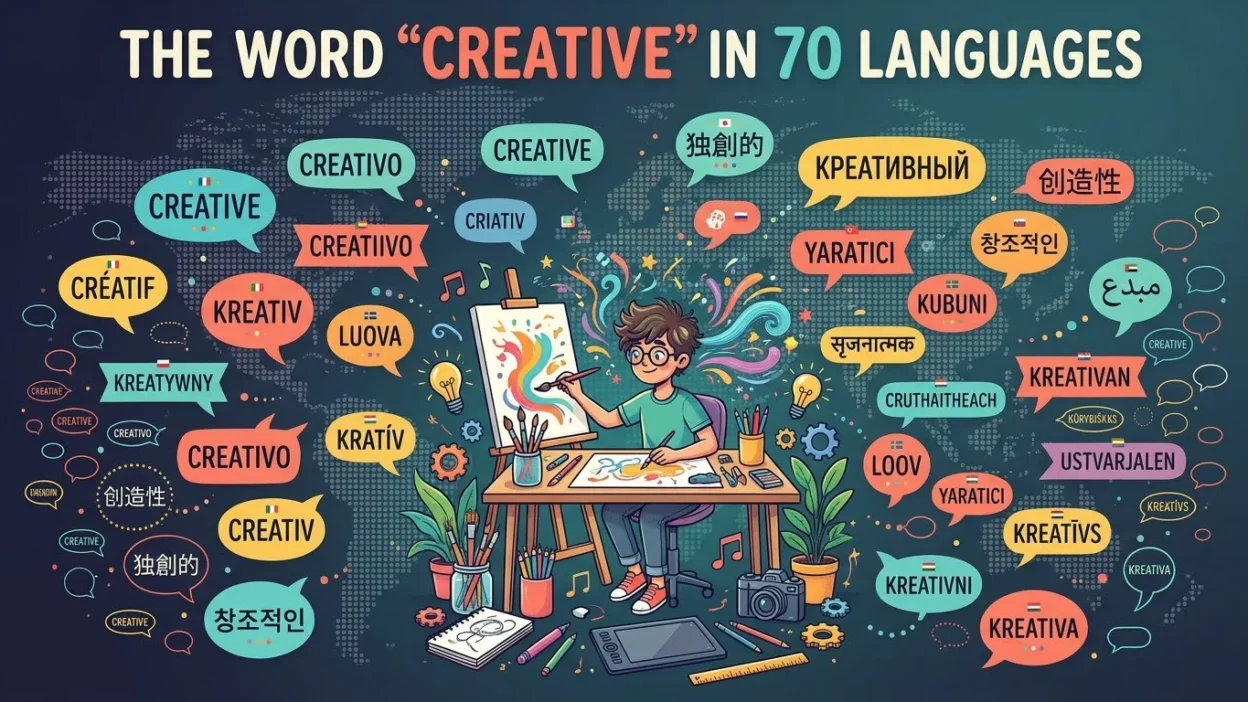
The word “creative” describes someone who can think imaginatively, develop original ideas, and express themselves in unique ways. It is a positive word often used for artists, writers, designers, musicians, inventors, and people who enjoy finding new solutions to everyday challenges.
But how do people say creative in different languages? Every language has its own expression for describing imagination, originality, and artistic ability. Some translations refer to being inventive, while others emphasize imagination or the ability to create something new.
In this guide, you will discover how to say “creative” in 70 languages, along with native translations and easy English pronunciations. Whether you are learning a new language, exploring international vocabulary, or looking for inspiration, this list will help you discover the beauty of the word creative around the world.
How to Say Creative in 70 Languages
Explore the following table to learn how to translate “creative” into 70 different languages.
| Language | Creative in Native Language | Easy Pronunciation |
|---|---|---|
| English | Creative | Kree-AY-tiv |
| Spanish | Creativo / Creativa | Kreh-ah-TEE-voh / Kreh-ah-TEE-vah |
| French | Créatif / Créative | Kreh-ah-TEEF / Kreh-ah-TEEV |
| German | Kreativ | Kreh-ah-TEEF |
| Italian | Creativo / Creativa | Kreh-ah-TEE-voh / Kreh-ah-TEE-vah |
| Portuguese | Criativo / Criativa | Kree-ah-CHEE-voh / Kree-ah-CHEE-vah |
| Dutch | Creatief | Kreh-ah-TEEF |
| Swedish | Kreativ | Kreh-ah-TEEV |
| Norwegian | Kreativ | Kreh-ah-TEEV |
| Danish | Kreativ | Kreh-ah-TEEV |
| Finnish | Luova | LOO-oh-vah |
| Icelandic | Skapandi | SKAH-pan-dee |
| Irish | Cruthaitheach | KROO-hee-ach |
| Welsh | Creadigol | Kreh-ah-DIG-ol |
| Scottish Gaelic | Cruthachail | KROO-ach-al |
| Polish | Kreatywny / Kreatywna | Kreh-ah-TIV-nih / Kreh-ah-TIV-nah |
| Czech | Kreativní | Kreh-ah-TEEV-nee |
| Slovak | Kreatívny / Kreatívna | Kreh-ah-TEEV-nee / Kreh-ah-TEEV-nah |
| Slovenian | Ustvarjalen / Ustvarjalna | OOS-tvar-yah-len / OOS-tvar-yahl-nah |
| Croatian | Kreativan / Kreativna | Kreh-ah-TEE-vahn / Kreh-ah-TEEV-nah |
| Serbian | Креативан / Креативна | Kreh-ah-TEE-vahn / Kreh-ah-TEEV-nah |
| Bosnian | Kreativan / Kreativna | Kreh-ah-TEE-vahn / Kreh-ah-TEEV-nah |
| Romanian | Creativ / Creativă | Kreh-ah-TEEV / Kreh-ah-TEE-vuh |
| Hungarian | Kreatív | Kreh-ah-TEEV |
| Greek | Δημιουργικός / Δημιουργική | Thee-mee-oor-yee-KOS / Thee-mee-oor-yee-KEE |
| Russian | Творческий | TVOR-chehs-kee |
| Ukrainian | Творчий | TVOR-chee |
| Belarusian | Творчы | TVOR-chih |
| Bulgarian | Творчески | TVOR-chehs-kee |
| Macedonian | Креативен / Креативна | Kreh-ah-TEE-ven / Kreh-ah-TEEV-nah |
| Albanian | Krijues / Krijuese | Kree-YOO-es / Kree-YOO-eh-seh |
| Turkish | Yaratıcı | Yah-rah-tuh-juh |
| Arabic | مبدع / مبدعة | Mub-di / Mub-di-ah |
| Hebrew | יצירתי / יצירתית | Yetz-ee-rah-TEE / Yetz-ee-rah-TEET |
| Persian | خلاق | Khallāgh |
| Kurdish | Afirîner | Ah-fee-ree-NER |
| Hindi | रचनात्मक | Rach-naat-MAK |
| Urdu | تخلیقی | Takh-lee-QEE |
| Punjabi | ਰਚਨਾਤਮਕ | Rach-naat-Mak |
| Bengali | সৃজনশীল | Srijon-SHEEL |
| Gujarati | સર્જનાત્મક | Sar-jan-AAT-mak |
| Marathi | सर्जनशील | Sar-jan-SHEEL |
| Nepali | रचनात्मक | Ra-cha-naat-Mak |
| Sinhala | නිර්මාණශීලී | Nir-maa-na-shee-lee |
| Tamil | படைப்பாற்றல் மிக்க | Pa-dai-paat-ral MIK-ka |
| Telugu | సృజనాత్మక | Sru-ja-naat-ma-ka |
| Kannada | ಸೃಜನಶೀಲ | Sru-ja-na-shee-la |
| Malayalam | സർഗാത്മക | Sar-gaat-ma-ka |
| Thai | สร้างสรรค์ | Saang-san |
| Vietnamese | Sáng tạo | Sahng TOW |
| Indonesian | Kreatif | Kreh-ah-TEEF |
| Malay | Kreatif | Kreh-ah-TEEF |
| Filipino (Tagalog) | Malikhain | Mah-lik-HAH-in |
| Chinese (Mandarin) | 有创造力的 | Yǒu chuàngzàolì de |
| Japanese | 創造的 | Sōzōteki |
| Korean | 창의적인 | Chang-ui-jeok-in |
| Mongolian | Бүтээлч | Bü-teelch |
| Burmese | တီထွင်ဖန်တီးနိုင်သော | Tee-htwin-phan-tee-nai-thaw |
| Khmer | ច្នៃប្រឌិត | Chnai-proh-dit |
| Lao | ສ້າງສັນ | Saang-san |
| Swahili | Ubunifu | Oo-boo-NEE-foo |
| Zulu | Nobuciko | Noh-boo-CHEE-koh |
| Afrikaans | Kreatief | Kreh-ah-TEEF |
| Amharic | ፈጠራዊ | Feh-teh-RAH-wee |
| Yoruba | Oníṣẹ̀dá | Oh-nee-SHEH-dah |
| Hausa | Mai kirkira | Mai keer-KEE-rah |
| Māori | Auaha | Ow-AH-hah |
| Hawaiian | Hoʻokumu | Hoh-oh-KOO-moo |
| Samoan | Foafoa | Foh-ah-FOH-ah |
| Esperanto | Kreema | Kreh-EH-ma |
Note: Pronunciations are approximate guides for English speakers. Some languages use gender-specific adjective forms, while others express “creative” through words meaning imaginative, inventive, or capable of creating.
What Does Creative Mean?
The word creative refers to the ability to imagine, design, develop, or produce something original. It describes people who approach situations with fresh ideas and enjoy expressing their thoughts in interesting ways.
A creative person does not necessarily have to be an artist. Someone who finds an unusual solution to a problem, invents a useful product, writes an engaging story, or designs an attractive website can also be creative.
The word creative can describe several qualities:
- Imaginative: Having the ability to develop original ideas.
- Inventive: Finding new ways to create or solve problems.
- Artistic: Showing skill in visual or performing arts.
- Innovative: Introducing fresh methods, products, or concepts.
- Original: Producing something different or unique.
- Expressive: Communicating ideas and emotions in interesting ways.
How to Say Creative in Popular Languages
Let’s explore some popular translations of creative and see how they are used in everyday sentences.
Creative in Spanish
In Spanish, creative is creativo for masculine nouns and creativa for feminine nouns.
Example: Ella es una persona muy creativa.
Meaning: She is a very creative person.
Creative in French
The French translations are créatif and créative. These words describe someone who has imagination and original ideas.
Example: Il est très créatif.
Meaning: He is very creative.
Creative in German
In German, creative is kreativ. It is commonly used to describe imaginative people, artistic projects, and original solutions.
Example: Sie ist sehr kreativ.
Meaning: She is very creative.
Creative in Italian
Italian uses creativo and creativa depending on grammatical gender.
Example: Mia sorella è molto creativa.
Meaning: My sister is very creative.
Creative in Japanese
In Japanese, 創造的 (sōzōteki) means creative or imaginative. Another expression, 独創的 (dokusōteki), emphasizes originality.
Example: 彼は創造的な人です。
Meaning: He is a creative person.
Creative in Korean
The Korean expression 창의적인 (chang-ui-jeok-in) describes someone or something creative.
Example: 그녀는 창의적인 사람입니다.
Meaning: She is a creative person.
Creative in Arabic
Arabic uses مبدع (mubdiʿ) for masculine and مبدعة (mubdiʿa) for feminine. These words can describe someone innovative or creative.
Example: هو شخص مبدع.
Meaning: He is a creative person.
Creative in Hindi and Urdu
In Hindi, रचनात्मक (rachnatmak) is commonly used for creative. In Urdu, تخلیقی (takhleeqi) expresses the same general idea.
Example in Hindi: वह एक रचनात्मक व्यक्ति है।
Meaning: they are creative.
Different Ways to Use the Word Creative
Creative is a versatile adjective that appears in conversations, education, business, and everyday life.
Here are some common expressions:
- Creative ideas: Original thoughts or suggestions.
- Creative writing: Writing that uses imagination and original expression.
- Creative thinking: Finding new ways to approach problems.
- Creative person: Someone who regularly develops original ideas.
- Creative design: A unique and imaginative visual arrangement.
- Creative skills: Abilities used to develop original work.
- Creative solution: A fresh and effective way to solve a problem.
- Creative mind: A person with a strong imagination and original thinking.
- Creative project: Work involving imagination, planning, and originality.
- Creative approach: An unusual or innovative way of doing something.
Synonyms of Creative in English
If you want to describe someone’s imagination without repeating the word creative, you can use several related English words.
| Synonym | Meaning |
|---|---|
| Imaginative | Able to form interesting ideas and images |
| Innovative | Introducing new ideas or methods |
| Inventive | Good at developing original solutions |
| Artistic | Having creative ability in art |
| Original | Different from what already exists |
| Resourceful | Good at finding clever solutions |
| Inspired | Showing imagination or enthusiasm |
| Visionary | Able to imagine exciting future possibilities |
| Expressive | Communicating ideas or emotions effectively |
| Ingenious | Clever and inventive |
Why Is Creativity Important?
Creativity is useful in almost every area of life. It helps people explore possibilities, solve problems, communicate ideas, and discover new opportunities.
Here are some reasons why creativity matters:
- Problem-solving: Creative thinking helps people find solutions when ordinary methods do not work.
- Personal expression: It allows individuals to share their thoughts, feelings, and personalities.
- Learning: Creative activities can make education more engaging and enjoyable.
- Innovation: New inventions and improvements often begin with creative ideas.
- Communication: Creative storytelling, writing, and design help people express messages clearly.
- Confidence: Developing original ideas can encourage people to trust their abilities.
Frequently Asked Questions
How do you say creative in 10 different languages?
Here are 10 popular translations:
- Spanish: Creativo / Creativa
- French: Créatif / Créative
- German: Kreativ
- Italian: Creativo / Creativa
- Portuguese: Criativo / Criativa
- Japanese: Sōzōteki
- Korean: Chang-ui-jeok-in
- Chinese: Yǒu chuàngzàolì de
- Arabic: Mubdi / Mubdi’a
- Hindi: Rachnatmak
What is the Japanese word for creative?
The Japanese word 創造的 (sōzōteki) means creative. It describes something involving imagination, originality, and the ability to create new ideas.
What is the French word for creative?
The French word is créatif for masculine nouns and créative for feminine nouns. Both describe someone imaginative or inventive.
What is the Spanish word for creative?
In Spanish, creative is creativo for masculine nouns and creativa for feminine nouns.
What is another word for creative?
Some common synonyms include imaginative, innovative, inventive, artistic, original, resourceful, and ingenious.
Is creative a noun or an adjective?
Creative is an adjective. It describes a person, idea, activity, or object that shows imagination and originality. The noun form is creativity.
What is the difference between creative and creativity?
Creative describes someone or something that demonstrates imagination or originality. Creativity is the ability or quality of producing original ideas and work.
Conclusion
The word creative represents imagination, originality, and the ability to turn ideas into something meaningful. From kreativ in German to malikhain in Filipino and sáng tạo in Vietnamese, different languages offer interesting ways to express this valuable quality.
Learning how to say creative in 70 languages is a useful way to expand your vocabulary and understand how people around the world describe imagination and innovation.
Keep exploring new expressions, practicing different languages, and finding creative ways to share your ideas. After all, creativity has no language barrier! 🎨

Daniel Whitmore is a language writer and editor from the United Kingdom who is passionate about making language learning accessible to everyone. He specializes in English grammar, vocabulary, spelling differences, pronunciation, and multilingual communication. His articles break down complex language concepts into clear, practical lessons that readers can apply in everyday conversations and writing. Daniel enjoys exploring the history, culture, and evolution of languages while creating engaging content for students, educators, travelers, and language enthusiasts. His goal is to provide accurate, reader-friendly resources that help people build confidence in learning English and other world languages through simple explanations and real-life examples.