
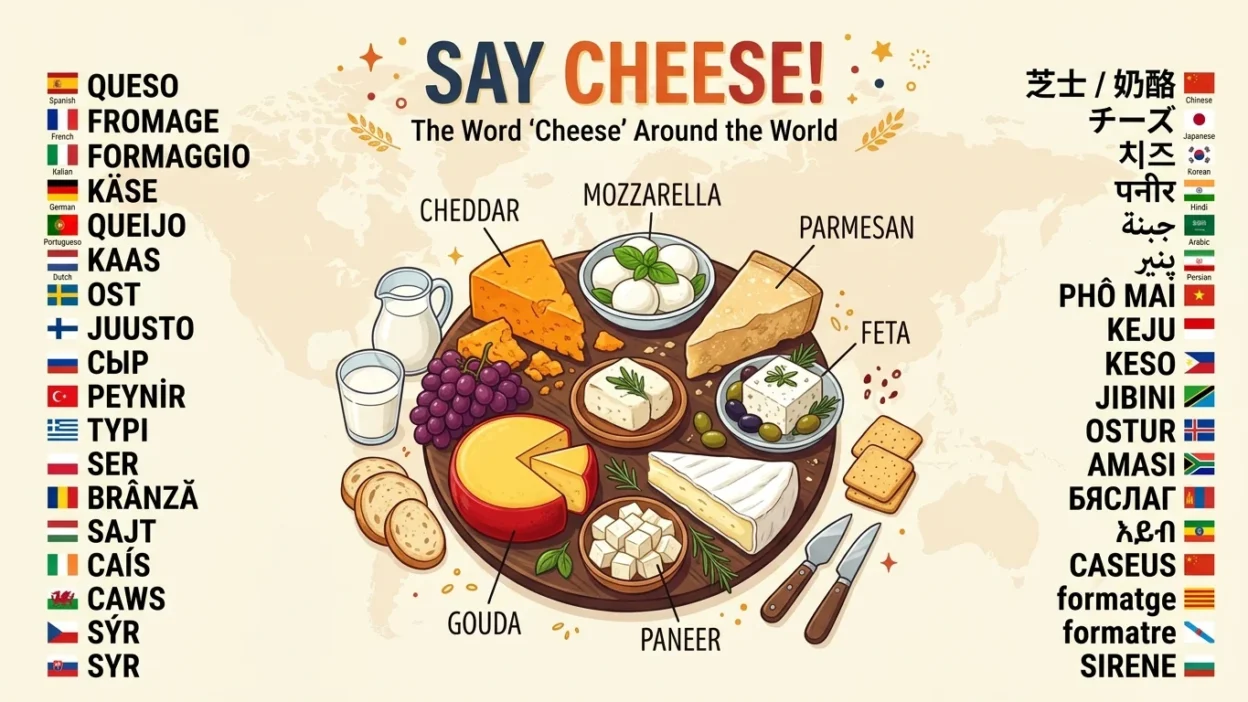
Cheese is a popular food enjoyed around the world. From creamy mozzarella on pizza to cheddar in sandwiches and traditional cheeses served with bread, people use cheese in countless dishes. Learning how to say cheese in different languages is a fun way to expand your vocabulary and explore food cultures.
The word for cheese changes from one language to another. In Spanish, it is queso; in French, fromage; in German, Käse; and in Italian, formaggio. In Hindi and several other South Asian languages, paneer refers to a fresh cheese commonly used in cooking.
In this guide, you will discover how to say cheese in 70 languages, learn native words and easy pronunciations, and explore useful food vocabulary for everyday conversations.
Cheese in 70 Different Languages
The table below includes translations of the word cheese in 70 languages. Pronunciations are approximate guides for English speakers. Some languages use borrowed words, while others have traditional terms or distinguish between different types of cheese.
| Language | Native Word | Easy English Pronunciation |
|---|---|---|
| 1. English | Cheese | CHEEZ |
| 2. Spanish | Queso | KAY-soh |
| 3. French | Fromage | froh-MAHZH |
| 4. German | Käse | KAY-zuh |
| 5. Italian | Formaggio | For-MAHJ-joh |
| 6. Portuguese | Queijo | KAY-zhoo |
| 7. Dutch | Kaas | KAHS |
| 8. Swedish | Ost | OOST |
| 9. Norwegian | Ost | OOST |
| 10. Danish | Ost | OOST |
| 11. Finnish | Juusto | YOO-stoh |
| 12. Icelandic | Ostur | OS-tur |
| 13. Irish | Cáis | KAWSH |
| 14. Welsh | Caws | KOWS |
| 15. Scottish Gaelic | Càise | KAA-shuh |
| 16. Polish | Ser | SEHR |
| 17. Czech | Sýr | SEER |
| 18. Slovak | Syr | SEER |
| 19. Slovenian | Sir | SEER |
| 20. Croatian | Sir | SEER |
| 21. Serbian | Сир | SEER |
| 22. Bosnian | Sir | SEER |
| 23. Romanian | Brânză | BRUHN-zuh |
| 24. Hungarian | Sajt | SHYT |
| 25. Greek | Τυρί | Tee-REE |
| 26. Russian | Сыр | SEER |
| 27. Ukrainian | Сир | SEER |
| 28. Belarusian | Сыр | SEER |
| 29. Bulgarian | Сирене | See-REH-neh |
| 30. Macedonian | Сирење | See-REH-nyeh |
| 31. Albanian | Djathë | JAH-thuh |
| 32. Turkish | Peynir | PAY-neer |
| 33. Arabic | جبن | JUBN |
| 34. Hebrew | גבינה | Gvee-NAH |
| 35. Persian | پنیر | Pah-NEER |
| 36. Kurdish | Penîr | Peh-NEER |
| 37. Hindi | पनीर | Puh-NEER |
| 38. Urdu | پنیر | Puh-NEER |
| 39. Punjabi | ਪਨੀਰ | Puh-NEER |
| 40. Bengali | পনির | Puh-NEER |
| 41. Gujarati | પનીર | Puh-NEER |
| 42. Marathi | चीज़ | CHEEZ |
| 43. Nepali | चीज | CHEEZ |
| 44. Sinhala | චීස් | CHEES |
| 45. Tamil | பாலாடைக்கட்டி | PAA-laa-dai-KUT-tee |
| 46. Telugu | చీజ్ | CHEEZ |
| 47. Kannada | ಚೀಸ್ | CHEEZ |
| 48. Malayalam | ചീസ് | CHEEZ |
| 49. Thai | ชีส | CHEET |
| 50. Vietnamese | Phô mai | FOH-my |
| 51. Indonesian | Keju | KEH-joo |
| 52. Malay | Keju | KEH-joo |
| 53. Filipino (Tagalog) | Keso | KEH-soh |
| 54. Chinese (Mandarin) | 奶酪 | NYE-low |
| 55. Japanese | チーズ | CHEE-zoo |
| 56. Korean | 치즈 | CHEE-jeu |
| 57. Mongolian | Бяслаг | BYAS-lag |
| 58. Burmese | ဒိန်ခဲ | DAIN-kheh |
| 59. Khmer | ឈីស | CHEES |
| 60. Lao | ເນີຍແຂງ | NER-y khaeng |
| 61. Swahili | Jibini | Jee-BEE-nee |
| 62. Zulu | Ushizi | Oo-SHEE-zee |
| 63. Afrikaans | Kaas | KAHS |
| 64. Amharic | አይብ | AYB |
| 65. Yoruba | Warankasi | Wah-rahn-KAH-see |
| 66. Hausa | Cuku | CHOO-koo |
| 67. Māori | Tīhi | TEE-hee |
| 68. Hawaiian | Tīhi | TEE-hee |
| 69. Samoan | Sisi | SEE-see |
| 70. Esperanto | Fromaĝo | Froh-MAH-joh |
Note: In Hindi, Urdu, Punjabi, Bengali, and Gujarati, paneer usually refers to a fresh cheese used in cooking. It is not exactly the same as every kind of cheese, such as cheddar or blue cheese. Regional vocabulary can also vary.
What Does Cheese Mean?
Cheese is a dairy food usually made by coagulating milk and separating the solid curds from the liquid whey. Depending on how it is produced and aged, cheese can be soft, hard, creamy, crumbly, mild, or strong in flavor.
Cheese is enjoyed in many ways, including:
- Melted on pizza and sandwiches
- Served with bread, crackers, and fruit
- Added to pasta, salads, and sauces
- Used in traditional dishes such as paneer curry
- Served on its own as a snack or part of a cheese board
Different regions have developed their own cheese-making traditions, ingredients, and varieties.
How to Say Cheese in Popular Languages
Here are some common cheese translations with example sentences you can use when learning a new language.
Cheese in Spanish
In Spanish, cheese is queso, pronounced approximately KAY-soh.
Example: Me gusta el queso.
Meaning: I like cheese.
Cheese in French
In French, cheese is fromage, pronounced approximately froh-MAHZH.
Example: J’aime le fromage.
Meaning: I like cheese.
Cheese in German
In German, cheese is Käse, pronounced approximately KAY-zuh.
Example: Ich esse gern Käse.
Meaning: I like eating cheese.
Cheese in Italian
In Italian, cheese is formaggio, pronounced approximately for-MAHJ-joh.
Example: Mi piace il formaggio.
Meaning: I like cheese.
Cheese in Portuguese
In Portuguese, cheese is queijo, pronounced approximately KAY-zhoo.
Example: Eu gosto de queijo.
Meaning: I like cheese.
Cheese in Arabic
In Arabic, cheese is جبن (jubn).
Example: أحب الجبن.
Meaning: I like cheese.
Cheese in Hindi
In Hindi, पनीर (paneer) is a fresh cheese widely used in Indian cooking. For cheese in the broader international sense, speakers may also use चीज़ (cheez).
Example: मुझे पनीर पसंद है।
Meaning: I like paneer.
Cheese in Urdu
In Urdu, پنیر (paneer) commonly refers to fresh cheese used in South Asian dishes. The word چیز is also used for cheese in the broader international sense.
Example: مجھے پنیر پسند ہے۔
Meaning: I like paneer.
Cheese in Chinese
In Mandarin Chinese, a common word for cheese is 奶酪 (nǎilào). In Taiwan, 起司 (qǐsī) is also widely used.
Example: 我喜欢奶酪。
Meaning: I like cheese.
Cheese in Japanese
In Japanese, cheese is チーズ (chīzu).
Example: チーズが好きです。
Meaning: I like cheese.
Cheese in Korean
In Korean, cheese is 치즈 (chijeu).
Example: 저는 치즈를 좋아해요.
Meaning: I like cheese.
Cheese in Indonesian
In Indonesian, cheese is keju, pronounced approximately KEH-joo.
Example: Saya suka keju.
Meaning: I like cheese.
Popular Types of Cheese Around the World
Learning the word for cheese is a good starting point. Knowing the names of popular varieties can also help when reading menus, shopping, or traveling.
| Cheese Type | Common Description |
|---|---|
| Cheddar | A firm cheese with a flavor that can range from mild to sharp |
| Mozzarella | A soft, stretchy cheese often used on pizza |
| Parmesan | A hard, savory cheese commonly grated over pasta |
| Gouda | A Dutch cheese that can be mild or aged |
| Feta | A crumbly cheese traditionally associated with Greece |
| Brie | A soft cheese with a pale, edible rind |
| Blue cheese | A cheese made with characteristic blue or green veins |
| Paneer | A fresh cheese commonly used in South Asian cooking |
| Cream cheese | A soft, spreadable cheese |
| Swiss cheese | A name often used for cheeses such as Emmental, known for their holes |
Cheese varieties differ in ingredients, texture, aging methods, and flavor. Some names refer to a particular traditional product, while others cover a broader family of cheeses.
Cheese vs. Paneer: What Is the Difference?
Although paneer is a type of cheese, it differs from many popular Western cheeses.
- Cheese: A broad category that includes fresh, soft, hard, aged, and blue-veined varieties.
- Paneer: A fresh, usually unaged cheese commonly made by curdling milk with an acid such as lemon juice.
- Texture: Paneer is generally firm enough to cut into cubes and often holds its shape when cooked.
- Flavor: Paneer usually has a mild flavor and absorbs the seasonings in a dish.
Paneer is commonly used in dishes such as palak paneer and paneer tikka. Cheddar, mozzarella, and Parmesan are other types of cheese used in different cuisines.
Why Learn Cheese in Different Languages?
Learning food words is a practical way to improve your language skills and understand other cultures.
- Travel more confidently: Recognize cheese on restaurant menus and in grocery stores.
- Order food: Ask for cheese or identify a particular variety.
- Explore world cuisines: Learn how cheese is used in dishes from different countries.
- Build vocabulary: Practice food names, ingredients, and everyday expressions.
- Understand cultural differences: Discover the distinction between traditional fresh cheeses and aged varieties.
Easy Tips to Remember Cheese Translations
1. Connect each word with a food. Remember queso with a Spanish dish or formaggio with Italian food.
2. Group similar words together. Dutch kaas and Afrikaans kaas are identical, while Italian formaggio and Esperanto fromaĝo look and sound related.
3. Practice with simple sentences. Try saying “I like cheese” or “I would like cheese, please” in the language you are learning.
4. Use labels and flashcards. Write the native word on one side and the English meaning on the other.
5. Learn food words together. Study cheese alongside bread, milk, butter, and other ingredients to remember vocabulary more easily.
Frequently Asked Questions
How do you say cheese in different languages?
The word varies by language. Examples include queso in Spanish, fromage in French, Käse in German, formaggio in Italian, and keju in Indonesian.
What is the Spanish word for cheese?
The Spanish word is queso, pronounced approximately KAY-soh.
What is cheese called in French?
Cheese is called fromage in French.
How do you say cheese in Hindi and Urdu?
पनीर in Hindi and پنیر in Urdu usually refer to fresh cheese commonly used in South Asian cooking. The word cheez is also used for cheese in the broader international sense.
How do you say cheese in Japanese?
The Japanese word is チーズ (chīzu).
How do you say cheese in Chinese?
In Mandarin Chinese, a common word is 奶酪 (nǎilào). In Taiwan, 起司 (qǐsī) is also widely used.
Are cheese and paneer the same?
Paneer is a type of fresh cheese, but not all cheese is paneer. Cheddar, mozzarella, Parmesan, and paneer have different textures, production methods, and culinary uses.
Why are cheese words different across languages?
Each language has its own history and vocabulary. Some words developed locally, while others were borrowed or adapted from other languages.
Conclusion
Learning how to say cheese in 70 different languages is a delicious way to expand your vocabulary and explore food traditions around the world. From queso in Spanish and fromage in French to 奶酪 (nǎilào) in Mandarin Chinese, each translation offers a new way to talk about a familiar food.
Start with a few words, practice them in everyday sentences, and explore how cheese is used in different cuisines. Whether you are traveling, cooking, or learning a new language, these translations can make your next food conversation a little easier.