
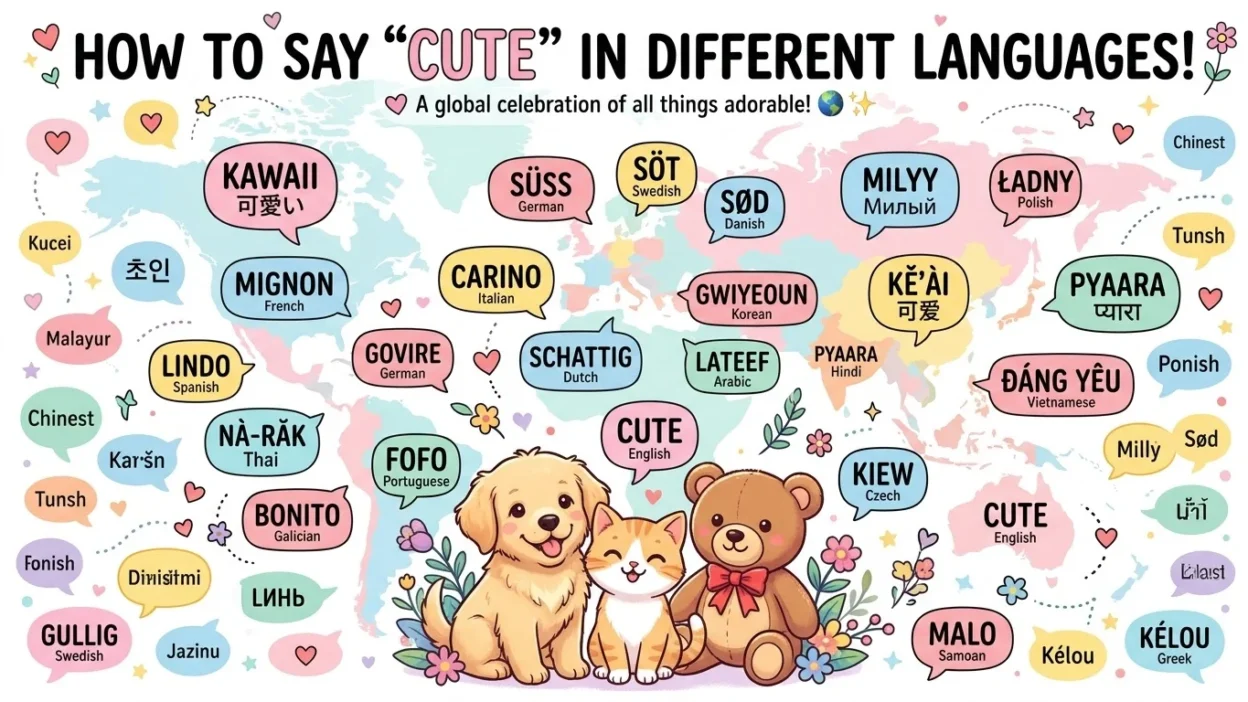
The word “cute” is a sweet and charming way to describe someone or something adorable, attractive, lovely, or delightful. We use it for babies, pets, romantic partners, beautiful objects, and even small everyday things that make us smile.
But how do people say cute in different languages? Every language has its own expression for describing something adorable. Some translations refer to beauty, while others emphasize sweetness, charm, or loveliness.
In this guide, you will discover how to say “cute” in 70 languages, including native translations and easy English pronunciations. Whether you are learning a new language, traveling, or simply exploring beautiful words from around the world, this list will help you expand your vocabulary.
How to Say Cute in 70 Languages
Here is a helpful table featuring the word “cute” translated into 70 different languages. Some languages use different forms depending on gender or context, so alternative forms are included where useful.
| Language | Cute in Native Language | Easy Pronunciation |
|---|---|---|
| English | Cute | Kyoot |
| Spanish | Lindo / Linda | LEEN-doh / LEEN-dah |
| French | Mignon / Mignonne | Mee-NYON / Mee-NYON |
| German | Süß | ZOOS |
| Italian | Carino / Carina | Kah-REE-noh / Kah-REE-nah |
| Portuguese | Fofo / Fofa | FOH-foo / FOH-fah |
| Dutch | Schattig | SHAH-tikh |
| Swedish | Söt | Suht |
| Norwegian | Søt | Suht |
| Danish | Sød | Suhth |
| Finnish | Söpö | SUH-puh |
| Icelandic | Sætur / Sæt | SAI-tur / SAI-t |
| Irish | Gleoite | GLYOH-chuh |
| Welsh | Ciwt | Kyoot |
| Scottish Gaelic | Bòidheach | BOY-ach |
| Polish | Uroczy / Urocza | Oo-ROH-chih / Oo-ROH-chah |
| Czech | Roztomilý / Roztomilá | Roz-toh-MEE-lee / Roz-toh-MEE-lah |
| Slovak | Roztomilý / Roztomilá | Roz-toh-MEE-lee / Roz-toh-MEE-lah |
| Slovenian | Ljubek / Ljubka | LYOO-bek / LYOO-bkah |
| Croatian | Sladak / Slatka | SLAH-dahk / SLAHT-kah |
| Serbian | Сладак / Слатка | SLAH-dahk / SLAHT-kah |
| Bosnian | Sladak / Slatka | SLAH-dahk / SLAHT-kah |
| Romanian | Drăguț / Drăguță | Druh-GOOTS / Druh-GOOTS-uh |
| Hungarian | Aranyos | AH-rah-nyosh |
| Greek | Χαριτωμένος / Χαριτωμένη | Kha-ree-toh-MEH-nos / Kha-ree-toh-MEH-nee |
| Russian | Милый / Милая | MEE-leey / MEE-lah-yah |
| Ukrainian | Милий / Мила | MEE-leey / MEE-lah |
| Belarusian | Мілы / Мілая | MEE-lih / MEE-lah-yah |
| Bulgarian | Сладък / Сладка | SLAH-duhk / SLAH-dkah |
| Macedonian | Сладок / Слатка | SLAH-dok / SLAHT-kah |
| Albanian | I lezetshëm / E lezetshme | Ee leh-ZET-shuhm / Eh leh-ZET-shmeh |
| Turkish | Sevimli | Seh-VEEM-lee |
| Arabic | لطيف / لطيفة | La-TEEF / La-TEE-fah |
| Hebrew | חמוד / חמודה | Kha-MOOD / Kha-moo-DAH |
| Persian | بامزه | Baa-MAZ-zeh |
| Kurdish | Xweşik | Khweh-SHEEK |
| Hindi | प्यारा / प्यारी | PYAAR-aa / PYAAR-ee |
| Urdu | پیارا / پیاری | PYAAR-aa / PYAAR-ee |
| Punjabi | ਪਿਆਰਾ / ਪਿਆਰੀ | PYAAR-aa / PYAAR-ee |
| Bengali | মিষ্টি | MISH-tee |
| Gujarati | ક્યૂટ / સુંદર | Kyoot / SOON-dar |
| Marathi | गोड / सुंदर | GOD / SOON-dar |
| Nepali | प्यारो / प्यारी | PYAA-roh / PYAA-ree |
| Sinhala | හුරුබුහුටි | HOO-roo-boo-HOO-tee |
| Tamil | அழகான | A-za-GAA-na |
| Telugu | ముద్దుగా | MUD-doo-gaa |
| Kannada | ಮುದ್ದಾದ | MUD-daa-da |
| Malayalam | സുന്ദരമായ | SOON-da-raa-ma-ya |
| Thai | น่ารัก | NAA-rak |
| Vietnamese | Dễ thương | ZEH THUONG |
| Indonesian | Lucu | LOO-choo |
| Malay | Comel | CHOH-mel |
| Filipino (Tagalog) | Cute / Kyut | Kyoot |
| Chinese (Mandarin) | 可爱 | Kě ài (kuh-eye) |
| Japanese | かわいい | Kawaii (kah-wah-ee) |
| Korean | 귀여운 | Gwi-yeo-un (gwee-yuh-oon) |
| Mongolian | Хөөрхөн | KHUUR-khun |
| Burmese | ချစ်စရာကောင်းသော | Chit-sa-ya-kaung-thaw |
| Khmer | គួរឱ្យស្រឡាញ់ | Koo-oy hai sra-lanh |
| Lao | ໜ້າຮັກ | Naa-hak |
| Swahili | Mzuri / Mrembo | Mzoo-ree / MREM-boh |
| Zulu | Muhle | MOO-hleh |
| Afrikaans | Oulik | OH-lik |
| Amharic | ቆንጆ | KON-jo |
| Yoruba | Ẹlẹ́wà | Eh-leh-WAH |
| Hausa | Kyakkyawa | Chyah-KYAH-wah |
| Māori | Ātaahua | Aa-taa-HOO-ah |
| Hawaiian | Nani | NAH-nee |
| Samoan | Aulelei | Ow-leh-LAY |
| Esperanto | Ĉarma | CHAR-ma |
Note: Pronunciations are approximate guides for English speakers. The most natural translation can change depending on whether you are describing a person, animal, object, or situation.
What Does Cute Mean?
The word cute describes something that creates feelings of affection, admiration, or happiness. It is commonly used for people, animals, objects, and behaviors that seem sweet, charming, or attractive.
For example, a little puppy playing with a ball might be called cute. A baby smiling at someone can also be described as cute. Even a tiny decorated notebook or a lovely outfit may receive the same compliment.
Cute can have several meanings depending on the situation:
- Adorable: Something that makes people feel affection.
- Sweet: Something pleasant, gentle, or lovable.
- Charming: Something that attracts attention in a delightful way.
- Pretty: Something attractive or visually appealing.
- Lovely: Something that creates a positive impression.
How to Say Cute in Popular Languages
Here are some popular translations with simple examples to help you understand how the word is used in everyday conversations.
Cute in Spanish
In Spanish, cute can be translated as lindo for masculine nouns and linda for feminine nouns. Another common word is bonito or bonita.
Example: ¡Qué lindo perro!
Meaning: What a cute dog!
Cute in French
The French word for cute is mignon or mignonne, depending on grammatical gender.
Example: Ce chat est mignon.
Meaning: This cat is cute.
Cute in German
In German, süß is a common word for cute or sweet. It can describe babies, animals, and adorable things.
Example: Das Baby ist süß.
Meaning: The baby is cute.
Cute in Italian
Italian speakers commonly use carino and carina to describe something cute or charming.
Example: Che gattino carino!
Meaning: What a cute kitten!
Cute in Japanese
The Japanese word かわいい (kawaii) is widely recognized around the world. It describes something cute, adorable, or charming.
Example: この犬はかわいいです。
Meaning: This dog is cute.
Cute in Korean
In Korean, 귀여운 (gwiyeoun) is used to describe someone or something adorable.
Example: 강아지가 귀여워요.
Meaning: The puppy is cute.
Cute in Arabic
The Arabic word لطيف (lateef) can mean cute, kind, pleasant, or gentle. The feminine form is لطيفة (lateefa).
Example: هذا القط لطيف.
Meaning: This cat is cute.
Cute in Hindi and Urdu
In Hindi, प्यारा (pyara) and in Urdu, پیارا (pyara) can describe someone or something lovely or adorable. Feminine forms include प्यारी and پیاری.
Example: यह बच्चा प्यारा है।
Meaning: This child is cute.
Different Ways to Use the Word Cute
The word cute is flexible and can be used in many everyday situations. Here are some common expressions:
- So cute: Used to express strong affection or admiration.
- Super cute: A casual way to emphasize how adorable something is.
- Cute little thing: A sweet description of a small or adorable object.
- Cute smile: A compliment about someone’s smile.
- Cute outfit: A positive comment about someone’s clothing.
- Cute puppy: A common expression for an adorable young dog.
- Cute couple: A phrase used to describe two people who seem affectionate together.
Cute Synonyms in English
If you want to expand your vocabulary, several English words have meanings similar to cute. However, each synonym has a slightly different feeling.
| Synonym | Meaning |
|---|---|
| Adorable | Extremely lovable or charming |
| Lovely | Pleasant, attractive, or delightful |
| Sweet | Gentle, kind, or endearing |
| Charming | Attractive in a pleasing way |
| Precious | Very special or lovable |
| Darling | Dear, sweet, or beloved |
| Pretty | Attractive or beautiful |
| Delightful | Very pleasing or enjoyable |
| Endearing | Making someone feel affection |
| Charming | Pleasant and attractive |
Why Learn the Word Cute in Different Languages?
Learning how to say cute in different languages is a fun way to discover how cultures express affection and appreciation.
Here are a few reasons to learn these translations:
- Improve your vocabulary: Learn useful descriptive words in different languages.
- Communicate naturally: Use familiar compliments when speaking with people from other countries.
- Understand cultures: Discover how different languages express sweetness and affection.
- Enjoy entertainment: Understand common words in international movies, songs, and social media.
- Make connections: A thoughtful compliment can make everyday conversations warmer.
Frequently Asked Questions
How do you say cute in 10 different languages?
Here are 10 popular translations:
- Spanish: Lindo / Linda
- French: Mignon / Mignonne
- German: Süß
- Italian: Carino / Carina
- Portuguese: Fofo / Fofa
- Japanese: Kawaii
- Korean: Gwiyeoun
- Chinese: Kě ài
- Arabic: Lateef / Lateefa
- Hindi: Pyara / Pyari
What is the Japanese word for cute?
The Japanese word for cute is かわいい (kawaii). It is commonly used for adorable animals, people, clothing, characters, and objects.
What is the Korean word for cute?
The Korean adjective is 귀여운 (gwiyeoun). In everyday conversation, people also say 귀여워요 (gwiyeowoyo) to mean “It’s cute” or “You are cute,” depending on context.
What is the French word for cute?
The French word is mignon for masculine nouns and mignonne for feminine nouns. It is commonly used to describe adorable people, pets, and objects.
What is another word for cute?
Some common English alternatives are adorable, lovely, sweet, charming, precious, pretty, and delightful.
Can cute describe a person?
Yes! Cute can describe a person’s appearance, smile, personality, behavior, or style. It is generally a friendly compliment.
Is cute the same as beautiful?
Not exactly. Cute usually suggests sweetness, charm, or adorableness, while beautiful often emphasizes attractiveness or beauty. Both are positive compliments, but they express different feelings.
Conclusion
The word cute is a simple but meaningful expression that brings warmth and affection to everyday conversations. From kawaii in Japanese to mignon in French and lindo in Spanish, every language has its own charming way to describe something adorable.
Learning these 70 translations can help you discover new vocabulary, understand different cultures, and communicate more naturally with people around the world. Whether you are describing a cute puppy, a lovely smile, or an adorable little gift, you now have plenty of ways to express it in different languages.
Keep exploring new words, practicing their pronunciation, and sharing a little cuteness wherever you go! 🥰